Alaska Boating Adventure
©Bert Gildart: The February issue of Boating (claiming to be the “World’s Largest Powerboat Magazine”), featured a story about one of the many river trips Janie and I have made in Alaska in our Johnboat.
The title for its story was “Great Adventures, Why are you still tied to the dock,” and described three other outings under separate titles in addition to ours.
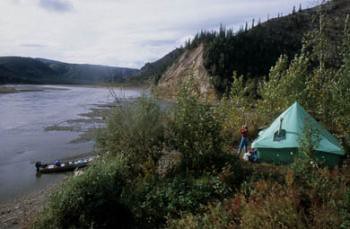
Looking for Caribou
Our adventure was entitled “North to the Yukon,” and the story resulted from telephone interviews editors in New York conducted with us in our home in Montana.
Answers were easy to provide as we had written stories about these lengthy boat trips for several different publications, including the environmental section of the Christian Science Monitor.
Our Alaska boat trip was certainly an adventure, but if you’re willing to invest the time required for organization you can also make the trip, and do so in a manner that will not make it a misadventure.
Obviously, there are some things you must have and one of those is flat-bottomed boat, for despite the fact that the Yukon is a huge brawling river, in places it is also a very shallow river, and it is difficult to predict just where those places might be.
So you need a Johnboat, and one of substantial size. Ours is 20 feet long, and it is considered small.
We power it with a 50 hp four stroke Yamaha, and because you must often travel hundreds of miles without access to fuel, you’ll need to carry about 50 gallons of gas.
In other words, you need space.
The other thing you need is a good tent, and we carried a wall tent constructed from a burn-proof fabric.
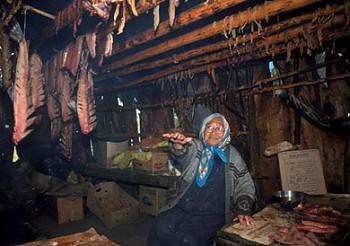
Fishing Camp in Yukon Territory
Because weather is at times harsh, you need a place to hole up for several days that is comfortable, and without the
capability of a tent that can handle a small wood stove (“called a sheep-herder stove”) you’ll be uncomfortable.
We also carried collapsible cots, a Coleman lantern, winter cloths and lots of dried food.
Why embark on such an adventure? In part to experience the raw country, for there were nights when caribou surged in mass across the Porcupine River, one of the tributaries of the Yukon up which we traveled.
And then there were simply nights we spent in the tent listening to the wind blow—realizing that no other human beings were anywhere within a hundred miles or more.
Just the wolves, which often howled, and the curious bears that sometimes left tracks within feet of our tent.
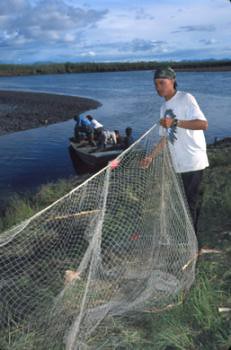
Fishing upstream from Fort Yukon
And then there were days with the few inhabitants who do live along the Yukon and Porcupine located in their small villages. Essentially, all were Native Americans belonging to a tribe known as the Gwich’in.
Once we worked as summer school teachers in a number of these Gwich’in villages, responding to a call from a friend (then the assistant superintendent) for people willing to explain their profession, which in my case was journalism and photojournalism.
We continued for three more summers as teachers and some of these villagers we now consider friends whom we will always want to know about.
In fact, several have visited us here in Montana, and one of our web pages is devoted to this group.Trips along the Yukon and Porcupine later compelled us to take other trips, and one of them took us up the ALCAN to the Dempster Highway.
The Dempster is a 500-mile long road that leads from the ALCAN to the McKenzie River and to more Gwich’in Indian Villages, but located in Canada.
Here, we traveled with a friend down much of this historic river to the Peel Channel of the McKenzie, and then to the Arctic Ocean, all in our Johnboat.
Along the route, we stayed at fish camps, and met remarkable people such Caroline Kay, a woman who had lived a life in the bush.
And so our lives go on, and we are particularly enjoying the recounting of these adventures the day before our anniversary, happy we’ve been blessed to lead such a life and anxious for the time to come when we can embark on yet other excursions, some of which will certainly be made by boat or travel trailer.
4th ed. Autographed by the Authors
Hiking Shenandoah National Park
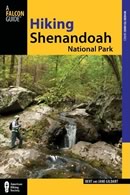 Hiking Shenandoah National Park is the 4th edition of a favorite guide book, created by Bert & Janie, a professional husband-wife journalism team. Lots of updates including more waterfall trails, updated descriptions of confusing trail junctions, and new color photographs. New text describes more of the park’s compelling natural history. Often the descriptions are personal as the Gildarts have hiked virtually every single park trail, sometimes repeatedly.
Big Sky Country is beautiful
Montana Icons: 50 Classic Symbols of the Treasure State
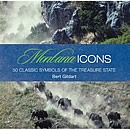 Montana Icons is a book for lovers of the western vista. Features photographs of fifty famous landmarks from what many call the “Last Best Place.” The book will make you feel homesick for Montana even if you already live here. Bert Gildart’s varied careers in Montana (Bus driver on an Indian reservation, a teacher, backcountry ranger, as well as a newspaper reporter, and photographer) have given him a special view of Montana, which he shares in this book. Share the view; click here.
$16.95 + Autographed Copy
What makes Glacier, Glacier?
Glacier Icons: 50 Classic Views of the Crown of the Continent
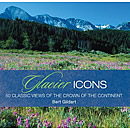 Glacier Icons: What makes Glacier Park so special? In this book you can discover the story behind fifty of this park’s most amazing features. With this entertaining collection of photos, anecdotes and little known facts, Bert Gildart will be your backcountry guide. A former Glacier backcountry ranger turned writer/photographer, his hundreds of stories and images have appeared in literally dozens of periodicals including Time/Life, Smithsonian, and Field & Stream. Take a look at Glacier Icons
$16.95 + Autographed Copy

June 6th, 2007 at 12:41 am
Great pictures – so exciting to see the glory of Alaska!
October 21st, 2008 at 3:45 pm
Bert and Janie,we too have a jon boat (16′ all welded Alumicraft) powered by a 40 hp Susuki Jet Drive. I’m wondering if you are Jet driven too? We use ours on the upper Mississippi River above Monticello, MN. It’s a wonderful way to enjoy a rock strewn river and the small mouth bass and musky fishery.
I’ve often thought it would be the way to go for an all-upstream camping adventure, But, not at 70+, I’ll leave that to the grand kids.
Thanks for the great adventure stories.
Tom & Sandi Palesch
October 21st, 2008 at 7:03 pm
Tom, greatly appreciate the comments–and still keep hoping our paths will cross.
Regarding prop vs. jet, all folks along the Yukon seem to use prop-driven boats, even though the water is often shallow. Still, they know where to go and how to avoid hitting the bottom, something I spend the summer trying to learn,but never quite accomplishing. It’s called “Reading the River,” and I must admit, I have a long way to go.
But the reason for using a prop is part economics, part weight. Hundreds of miles separate these villages and jets seem to get only about half of what a prop-driven boat will get. What that means is that in a small jon boat, we’d have to pack twice as much gas as we did, and then, weight and space become real concerns.
We took four props along with us, and I often found myself banging out the dents over a fire at night.
July 10th, 2015 at 12:32 pm
[...] 1991 I married Janie and that inaugurated a genuinely adventurous period of time. Together, we’ve shared 25 more birthdays — highlighted by months on the Yukon, [...]