Learning about The Antiquities of Anza-Borrego with a Park Archaeologist
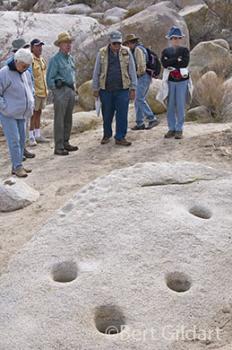
Boulder with Morteros
©Bert Gildart: We were a small group of about nine and had joined Sam Webb, a volunteer archaeologist in Anza Borrego, on a hike described as the Morteros Hike. Less than a hundred yards into the walk Webb stopped and asked our group what we saw.
Webb was looking at a small pile of rocks that didn’t appear particularly unusual, and when none responded he picked up one of the rocks and asked us if we could see the darkness in the rock. “Burn marks,” he added, helping us out.
We moved on a few steps further and then he turned and asked us about a huge boulder which glistened with smoothness. “It’s a milling slick,” said Webb. “It’s where the Kumeyaay Indians worked so hard preparing flower the granite became smooth.”
The amount of Indian ruins in Anza Borrego is immense, but as we had been discovering the past few days, all is not apparent. To improve our chances of learning more about the way in which the various tribes once lived, we concluded that we’d be much further ahead joining a naturalist-led walk. Yesterday, that’s what we did, driving from our campground over Yaqui Pass to Blair Valley just off Highway S-2.
PARK ANTIQUITIES
In this way we learned over a relatively short period of time about some of the problems now confronting park archaeologists as they attempt to catalogue the richness of a past culture. On this short walk of about one-mile, Webb led us to morteros, pictographs, and one rock grinding that was a thousand-year-old predecessors to pornography pictured in Playboy. There’s just no other way to describe it.
“It’s probably about fertility.” said Webb. “Maybe there was sickness and many in their tribe died; maybe warfare. Who knows? It does seem to be an obvious attempt to foster procreation, but perhaps,” he added with a chuckle, “it’s just the interpretation of a deranged archaeologist…” Then growing more serious, he added, “Native American informants don’t say much; in fact they’re non committal about such subjects.”
Artifacts that required but little explanation were some of the morteros, and one huge boulder included four. Here, the Kumeyaay placed the agave into holes–the morteros–where they ground it into flour. As well, they pulverized seeds from the mesquite. They flocked to such areas on a seasonal basis–but mostly when the agave bloomed. They stayed for several months.
Because the boulder with morteros also contained a number of smaller holes, Sam thought the rock might have possessed a spiritual component. “The smaller holes,” theorized Webb, “the cupoles, may have been created to release the spirits.”
UNIQUE MORTEROS
Another large boulder contained a mortero in which the bottom had been drilled through, a condition Webb revealed by inserting his hand from the bottom of the hole. “Maybe the Kumeyaay were trying to simplify their techniques for recovering the flour.”
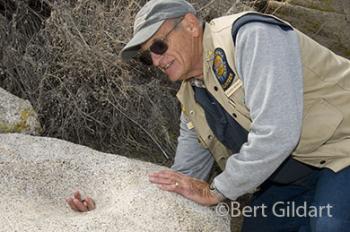
Sam Webb asks about unusual morteros?
Interlaced throughout this vast boulder field were a number of pictographs. Most were deteriorating with time, and were difficult to interpret (not like the ones in Zion we photographed several weeks ago), but not all. One huge boulder contained a pictograph, one that appeared as though it had been made yesterday–but that wasn’t the case. Several decades ago an archaeologist had enhanced the badly deteriorated image created hundreds of years ago from pigments. “Our policy has changed since that time,” said Webb. “Now we simply let time take its toll. That seems to be what Native American advisors want us to do.”
STRUGGLING TO RETAIN THEIR PLACE IN THE SUN
Throughout the walk Webb also shared some of his concerns for the future of Anza-Borrego State Park. He said there was a certain element that had little regard for the park’s antiquities. “Someone came out here and dug around this rock,” said Webb, pointing at what appeared to be a small pounding rock. “They thought the rock was a mortar, and were trying to abscond until they discovered the exposed portion was part of a huge boulder the rest of which was covered by dirt.”
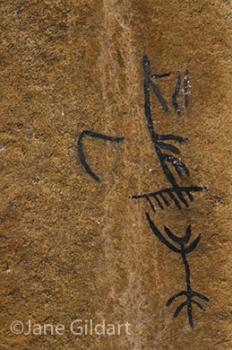
Enhanced pictograph
Other activities also worry park officials, one that might seem innocuous, but which is not. Geo-caching (where participants leave an object and then challenge others to find it with the pro-offered clues) in fragile areas can be detrimental to the resource. Several years ago someone directed geo cachers to the area protecting the Kumeyaay morteros-and other antiquities. In the course of looking for the geo-cached item they destroyed Native American works that had been created hundreds of years ago.
“The superintendent was furious,” said Webb. “For one thing, park policy specifically states that you take nothing-and leave nothing. Here’s an example of what can happen when those rules aren’t followed.”
The day’s explorations lasted several hours, and though we didn’t cover many miles, we learned a great deal. As well we were delighted to realize the degree to which the park’s volunteers are attempting to preserve resources that are struggling in this premier desert park for their very existence.
———————
4th ed. Autographed by the Authors
Hiking Shenandoah National Park
 Hiking Shenandoah National Park is the 4th edition of a favorite guide book, created by Bert & Janie, a professional husband-wife journalism team. Lots of updates including more waterfall trails, updated descriptions of confusing trail junctions, and new color photographs. New text describes more of the park’s compelling natural history. Often the descriptions are personal as the Gildarts have hiked virtually every single park trail, sometimes repeatedly.
Big Sky Country is beautiful
Montana Icons: 50 Classic Symbols of the Treasure State
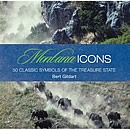 Montana Icons is a book for lovers of the western vista. Features photographs of fifty famous landmarks from what many call the “Last Best Place.” The book will make you feel homesick for Montana even if you already live here. Bert Gildart’s varied careers in Montana (Bus driver on an Indian reservation, a teacher, backcountry ranger, as well as a newspaper reporter, and photographer) have given him a special view of Montana, which he shares in this book. Share the view; click here.
$16.95 + Autographed Copy
What makes Glacier, Glacier?
Glacier Icons: 50 Classic Views of the Crown of the Continent
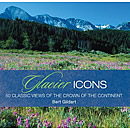 Glacier Icons: What makes Glacier Park so special? In this book you can discover the story behind fifty of this park’s most amazing features. With this entertaining collection of photos, anecdotes and little known facts, Bert Gildart will be your backcountry guide. A former Glacier backcountry ranger turned writer/photographer, his hundreds of stories and images have appeared in literally dozens of periodicals including Time/Life, Smithsonian, and Field & Stream. Take a look at Glacier Icons
$16.95 + Autographed Copy

January 28th, 2008 at 5:16 pm
Hi guys,
We hope to spend several weeks in Palm Canyon starting next week. Now in snowy Oregon! Did I hear that you got a little rain there in Palm Canyon? I sure hope so for the sake of wildflowers in Mar-April.’
Have fun.
January 29th, 2008 at 4:49 pm
It’s so sad when people destroy things that should be left alone. I’m a firm believer in ‘take only pictures, leave only footprints’.
Love the history you’ve uncovered here.