Favorite Travel Quotes

"Travel is fatal to prejudice, bigotry, and narrow-mindedness, and many of our people need it sorely on these accounts."
-- Mark Twain
Innocents Abroad

"Stop worrying about the potholes in the road and celebrate the journey." -- Fitzhugh Mullan

"A good traveler has no fixed plans and is not intent on arriving." -- Lao Tzu

Archive for the 'RV Travel' Category

Fishing, Camera Gear–and Border Crossings

posted: October 10th, 2008 | by:Bert

Departing Kootenai NP

Departing Kootenai National Park

©Bert Gildart: It’s rough having to travel through some of the beautiful segments of North America and then return to the tedium of everyday life in Montana. So unsettling was the transition that I took the day and joined one of my good fishing friends, Bill Schneider, described previously as a *Fishing Fool.

That, however, didn’t help much as he caught all the fish, so now I’m left reviewing the highlights of the trip as a form of solace. Believing some of my readers might be interested in traveling to southern Alberta, I’ve provided a quick highlight of what we consider must-see areas.

This past month, our travels took us from Glacier National Park and then north into Canada. Major stops in Alberta included Waterton National Park, the Kananaskis Recreation Area, Banff, and finally Jasper. Departing Jasper, we passed through Kootenai National Park in British Columbia where we spent the night before crossing the border and returning to Montana through Eureka.

PAST BORDER CROSSING HAVE RAISED EYEBROWS

In years past, we have had some difficulty making border crossing. Once in 1991, Canadian customs apparently didn’t like my longish hair and beard. Our old van probably didn’t help either.

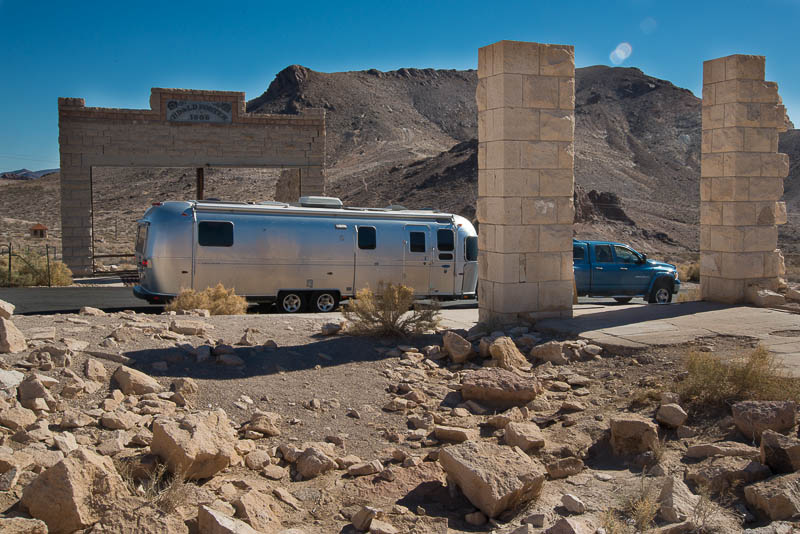
This time, however, we were towing an Airstream Travel Trailer pulling it with a Dodge ¾ ton truck.

We also are older now, have Passports and must therefore create a better international profile. Customs officials, however, asked one question I did not understand. Departing the U.S. at the Chief Mountain Customs the officer asked about firearms. We said we didn’t have any.

“No pistols,” he asked.

“No Sir,” realizing, of course, that those who are caught in Canada with pistols face jail time.

Swan Lake pike

Swan Lake pike

He then asked (and this is what I thought strange) whether we normally carried firearms in the United States. I told him “No,” but a more honest answer would have been: “When in the United States we abide by the laws of our country and do likewise when in yours.”

PHOTO GEAR

The purpose of virtually all of our trips is to gather photographs and story information, and because we’re often asked about our photography equipment I provide the following breakdown. I carry one D-200 and one D-300. I carry four Nikon lenses and include the 12-24, the 35 to 70, the 90 to 400 with image. As well, I carry two SB-800 strobes which are part of Nikon’s Wireless Lighting System.

In addition I carry a 600mm Nikon ED lens in a large Lowepro pack. When I carry this pack, much from the other pack is loaded into this one. Essentially, pack number is essentially my travel and nature photography pack, while pack number two is the one I use for wildlife and nature photography in general.

In addition, Janie carried a Nikon D-90 and, generally, I stow a film camera in the large Lowepro pack in which I carry my 600mm lens.

So now we’re back and as I say there’s always a period of readjustment, as a result, my day off yesterday for fishing. My companions were Bill Schneider and his wife Marne, and interestingly, Bill and I fished these same waters last year–but I didn’t do much better (as posted), though photographic opportunities were exceptional.

Normally Janie would have joined, but the Airstream had to be unloaded, and someone, of course, has to work. Wish I’d had caught a fish to show for my day’s efforts.
TWO YEARS AGO WE WERE DEPARTING NOVA SCOTIA:

*Princess of Acadia


ADS FROM AMAZON & GOOGLE AUGMENT OUR TRAVELS:


Read Comments | Post a Comment »

Beware! Tis the Season of the Elk

posted: September 25th, 2008 | by:Bert

"Keep out!" says this bull

"Keep out!" says this bull

© Bert Gildart: Here in Jasper National Park, Alberta, it is the season of the elk, and if you are interested in the story of enraged bulls, yesterday, there was no better place in the world to be than in this park’s Whistler Campground. So much activity was occurring that we decided to simply remain in the campground throughout the day.

Climax of the activities was toward the end of the day when dozens of people in cars and motorhomes gathered along a meadow, hoping to capture the drama on film. Most had no idea how to go about doing that, and one poor woman walked into the midst of the elk herd and was immediately charged by a huge and completely enraged bull. Just barely the lady made it back toward the tiny road and to our parked vehicle, which we had been using as a barrier. Unbelievably, she jumped into the back seat-but then she was terrified almost beyond belief. These are huge animals and some bulls can weigh more than 800 pounds and average eight feet in length.

The bull was enraged, and when the driver in a pickup camper inched closer for better photos, the bull turned his wrath on it, clubbing the sides several times with the tines of his dagger sharp antlers. The driver had made the mistake of moving, and by this motion, the bull sensed intrusion.

“ELK CAN BE DANGEROUS”

Signs, of course, are posted all over the campground, and the first bit of cautionary advice attendants provide campers is to beware of the rutting elk. “Don’t get too close,” they say. “At this time of year, elk can be dangerous. Very dangerous!”

Challenging call

Challenging call

Cause of all this aggression is basic and easy to understand. The amount of light per day is changing and it is growing cooler. These seasonal events stimulate the pituitary which in turn stimulates the release of testosterone into the circulatory system. In bulls it causes their necks to swell and generally creates much unrest. They are in a mating mode and are now looking for their source of affection.

The object of their affection is, of course, the cows, and bulls are looking not for just one cow but for lots of them-and yesterday, all these factors were present. Here were bulls with their harems, and the bulls were determined to maintain supremacy.

Mr. 8X7

Wandering throughout the campground were about 40 cow elk and several bulls. One bull was an 8×7, meaning that it had eight tines on one side and seven on the other. The bull was a monster and it was the one that had gathered in this harem of 11 cows; it was the one that was trying to prevent the intrusion of the other two males-and anything else it perceived as a threat.

Bulls prevent intrusion in several ways, and it was these techniques we saw yesterday. When Mr. 8×7 sensed the presence of another bull, he went crazy. First he reared back his head and voiced his anger using a threatening call known as “the bugle.”

In elk country the sound is unmistakable and it begins on a low note and then concludes with a high sibilant cry, finally punctuated with an “Uhhh; uhhh!” There’s absolutely no mistaking it!

Mr. 8×7 was particularly enraged and it began pawing at the earth; then it bashed a tree with its antlers and tried to murder it.

Murdering log

Murdering log

Then he began looking around for an antagonist. It saw me, and it raised its head in anger, but I was at a safe distance with a long telephoto lens, unlike the lady using the small camera who had been attempting to capture all this excitement from a distance of about five feet.

STILL ENRAGED

That brings us to late in the afternoon, and Mr. 8×7 is still angry. His challenge has been met several times but he had successfully used his antlers to chase other bulls away from his ladies.

Venting anger

Venting anger

If he had been unsuccessful, the bulls might have fought, but by this date in late September, dominance had apparently been determined, probably by fights that occurred before we arrived.

But Mr. 8×7 remained enraged, and was using his antlers to gouge several more pickup campers and more than once he charged other spectators (not me!) whom he felt were threats to his supremacy. As well, he charged a moving school bus that had apparently brought children out from one of the local schools. Everyone wants to be part of the excitement.

Warden hazes elk

Warden hazes elk

Finally, realizing a real danger, a park warden (term Canadians use for our park rangers) moved in and spent the better part of an hour hazing elk from the meadow. Mostly he was intent on moving the cows, knowing that where ever they go, the bulls won’t be far behind.

It is, after all, the season of the elk, something that must be viewed with some circumspect and a little prudence.

THIS TIME LAST YEAR:

*Airstream camping in Yellowstone

ADS FROM AMAZON & GOOGLE AUGMENT OUR TRAVELS:


Read Comments | Post a Comment »

Maintaining Your Internal Balance–When the World Goes Beserk

posted: September 15th, 2008 | by:Bert

In shadow of Mount Indefatigable

In shadow of Mount Indefatigable

©Bert Gildart: On this day when it appears as though two of the world’s greatest banking institutions are about to fail (one of which holds some of our stock portfolio), since there is not a darn thing we can do about it, I guess we’ll simply continue to enjoy this magnificent part of the world–precisely as we’ve been doing.

One of those ways is by sea kayak and for the past few days it has been in a vast area known as Kananaskis Country. The region is sandwiched between the Waterton/Glacier International Peace Park and Banff.

PRIOR PREPARATION

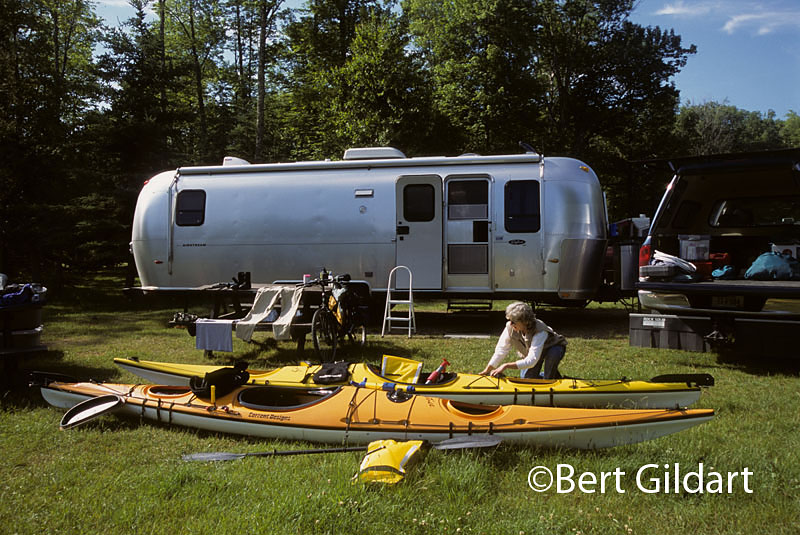
To enjoy the magnificent lakes found in the Rockies (and most other places to which we travel), we carry a bin loaded with all sorts of equipment to outfit us as we paddle our two Current Design sea kayaks. We have wet suits to protect us from the frigid waters should we flip. We have floats to assist with self rescues–and I’ve taken classes on rolling.

My camera equipment is packed into a dry bag, and is secure except of course when I remove it for photography. Should disaster befall, it’s insured, and I have a back-up camera.

And so, yesterday, we launched our kayaks on the lower of a series of lakes called Kananaskis Lakes, though ours has the further designation of being known as the Lower Kananaskis Lake. As we pushed off a mist was rising over Mount Indefatigable, and the setting was one found no where else in the world but in the Canadian Rockies.

WHAT’S IN A NAME?

The area we were in is located just south of Banff and exists because of the forethought of a number of Canadian outdoor planners. Because of their work, Premier Peter Lougheed dedicated the area on September 22nd, 1978. Today, this 4,200 square kilometre recreation area quickly has became a cherished location for Canadians and tourists (such as ourselves, though we prefer the notion that we’re “searchers”) to connect with the environment-and with the rich history it recalls.

According to displays at the Visitor Center Captain John Palliser on his expedition through the area 150 years ago provided the region with the Kananaskis name. The word is derived from the Cree ‘Kin-e-a-kis’ and is said to be the name of a warrior who survived an axe blow to the head.

Lower Kananaskis Lake

For several hours we kayaked this remarkable recreation area, exploring small coves and marveling at the extraordinary folding and faulting so unique to the region’s mountains. We were delighted that when so much of our world is in a state of chaos we still have pristine areas to help us forget world problems and maintain some sense of internal balance.

TWO YEARS AGO WE WERE ALSO KAYAKING

*Kayaking the Bay of Fundy (Which has world’s highest tides)

Ads from Google and Amazon help support our travels:


Read Comments | Post a Comment »

From Waterton to Kananaskis Country

posted: September 14th, 2008 | by:Bert

View from Bear's Hump

View from Bear’s Hump

©Bert Gildart: The trail from the visitor center in Waterton Lakes National Park was one of the steepest trails Janie and I have hiked in a long time. It was, however, short, and about an hour later the one-mile-long almost vertical-seeming trail reached its end at a rounded edifice known as the “Bear’s Hump.”

Other than just a great leg stretcher, we hiked the trail as we knew it would provide magnificent views, and we weren’t disappointed. From “the hump,” we could peer down the entire length of the Waterton Lake clear to Goat Haunt, which is in Glacier National Park. Together the two parks form a grand idea.

GRAND IDEA

The idea was conceived by the Rotary Clubs who believed the good will expressed by our two nations should be celebrated, and in 1932, the international acknowledgement of good will was made official when Canada and the United States created the Waterton/Glacier International Peace Park.

From the management point of view, the unification makes sense, as wildlife certainly doesn’t understand boundaries. For instance, biologists from the two countries can mange bears as part of an ecosystem, rather than saying: “Well, these are U.S. bears,” or “These are Canadian bears.”

HIGHEST MOUNTAIN

From Bear’s Hump, you are also reminded just how lofty the Canadian Rockies can be. As you look down this grand sweep the relief is great and from here Glacier’s highest mountain, Mount Cleveland juts up from the lake to reach the height of 10,466 feet.

Kananaskis Country

Kananaskis Country

My one disappointment is that I never climbed the mountain during my 13 years of employment in Glacier and that I haven’t done it since. It’s not a difficult mountain to climb, essentially just a walk-up. And I still plan to climb it. As always, time is the problem-as Janie and I have been doing so many other exciting things.

CAMERAS SETTING OUR PACE

So far, if anything summarizes this trip it’s our slow progress, based on curiosity and on the pace set by our cameras. After leaving Waterton, we proceeded north toward Banff, but re-discovered along the way a beautiful segment of land known as the Kananaskis.

Greeting us...

Greeting us…

I first drove the Kananaskis back in the 60s, when I first moved to the Northwest shortly after graduating from high school. At the time the road was all gravel and the country was extraordinarily wild. Now the road is paved and the provincial government has created from this 100-mile-long stretch of wilderness a number of provincial parks.

KANANASKIS COUNTRY

The parks help manage wildlife and shortly after we departed the little prairie town of Pincher Creek in Alberta, we encountered a band of sheep in the Don Getty Provincial Parks. At that point we had entered Kananaskis Country.

What an incredible time to drive this two-lane winding road. In fact, the country was so spectacular that when we were mid way along the drive, we began looking for campgrounds and discovered one of the most beautiful in yet another provincial park known as the Peter Lougheed.

This park contains mountains typified by some of the most profound folding and faulting I’ve ever seen. They’re all snowcapped now from storm of just the previous night. And now we’re learning that some of this park contains some of Alberta’s best mountain biking and that the lakes offer spectacular kayaking.

If the weather were to hold-and if we didn’t have assignments in Banff and Jasper, we could spend a month. Now, we’ll just have to see how much time we can squeeze out from the Lower Lake campground in the Peter Lougheed Provincial Park. Last night it again snowed, but now the clouds are rising and the mist on the lakes is framing some of the grand peaks on Mount Indefatigable that rise above Kananaskis Lake.

“Wouldn’t it be wonderful,” Janie keeps saying, “to stay here for a day or so, build a fire and watch the weather patterns sweep through this country that remains ever so wild?”

Well, we’ll see; we’ll see.

Read Comments | Post a Comment »

Into The Wild–and the Fashion Magazine “Io Donna”

posted: September 10th, 2008 | by:Bert

Into the Wild, take one

Into the Wild, take one

©Bert Gildart: Translated, the expression “IO Donna” means “I Woman,” and it is the name of a high-end fashion magazine directed mostly to a female audience who can read the Italian language. American magazines that are similar might include Cosmopolitan or Vogue.

As well, its readers include those who might travel widely, and when they do, they might flirt with adventures that take them to the fringe–but probably not quite into–hard-core wilderness areas. What they’d be looking for then is a high-end RV, one that has class and can slice through the winds they’d encounter in a region that would range from the west side of Glacier National Park to the Blackfeet Indian Reservation on the park’s east side.

INTO THE WILD

Appropriately, they might say they’re going “Into the Wild,” and with the above-mentioned caveats, the most appropriate way to get into the type of wild that they might have in mind would be with an Airstream Travel Trailer. But not everyone in this region has one, and so when the art director began looking around, she asked several photographers if they knew who might have this most classic of all RVs-and that’s how IO Donna got our name. We have an Airstream, and it is often a base for those times that we do in fact go “into the wild.” Yesterday, however, it served for IO Donna still-model photographs, and we were delighted we could help.

Janie and I rendezvoused with the film group in a vast, isolated swath of prairie land on the Blackfeet Indian Reservation. The crew consisted of eight men and one woman and further broke down to included three male models, a make up artist, an assistant makeup artist, a photographer, a photographer assistant, a location director, and a support RV with a most talented driver who alternates as a tailor for many famous actors, such as Robert Redford.

Cultural affairs officer Jim Rivera

Cultural affairs officer Jim Rivera

The group also included the presence of Jim Rivera, a representative of the Blackfeet Indian Nation present to insure that the group did not impinge on items of cultural value-such as the many teepee rings in the area. He was also there to make sure we were accepted by other tribal members who might be passing by.

SOPHISTICATED MODELS

Most interesting to Janie and me were the male models. All were 22 years of age. They were tall and thin, and very athletic in appearance. One wore an ear ring, but nothing unusual for this day and age. All had girl friends but did seem to live “on the edge,” waiting for the next assignment to crop up. In the past few years they have worked all over the world.

Rory, an international model

Rory, an international model

Andrea Gandini was the photographer and all you need to do is look at his online portfolio and you’ll recognize that his work tops the genre. Though his images are decidedly different from the outdoor work that I’ve created these past few decades, I felt fortunate fate had given me the day to follow him around.

A GIFTED PHOTOGRAPHER

Several of the photographs I’ve posted here were based on setups he’d created, but, later, when we looked at his images on the computer, I could tell that there were subtle variations in his prints and that they were all important. His had that Je ne sais quoi, that mysterious nothingness that tends to mesmerize you.

Andrea, fashion photographer

Andrea, fashion photographer

Andrea was creating a 19-page spread for the magazine that would eventually include about 40 images from the hundreds he was taking. Our Airstream would be a part, but the ultimate spread would include much more. In an artful manner–a high-fashion manner–he’d photograph the young men in an assortment of garb. For one shoot, they wore high-derby black hats offset with purple boots. Several wore wrap-around scarves.

The three models were all practiced and could assume a variety of posses on demand. Sometimes that would include a shift of the body to the left–to the right; the tilt of the head, the cocking of a boot.

At times, most photographers try and capture such nuances but I must say that Andrea seemed to draw from the models the precise body language needed for the moment.

"Into the Wild," take two

"Into the Wild," take two

And now, I am looking forward to seeing the issue that will carry “Into the Wild.” Certainly I’ll look forward to seeing our Airstream, but I’ll also look forward to seeing the art of photography taken to an exceeding high form of expression.

Read Comments | 2 Comments »

Italian Film Crew Picks Airstream

posted: September 8th, 2008 | by:Bert

Headin' out

Headin’ out

©Bert Gildart: Kayaks, bikes, and camping gear are all loaded and we’re off for a two-week trip that will include some very interesting stops.

High on that list is a rendezvous with an eight-member Italian film crew from the magazine Io Donna. The magazine is devoted to high fashion and they concluded before arriving that they needed to photograph an Airstream.

“They’re kind of iconic,” said Rob Story, the film crew’s location scout and the man who contacted me.

Because the magazine seems to be so glamorous and upscale, I thought the models accompanying the crew would be women patterned after Sophia Loren, and so I was particularly enthusiastic. Yesterday, however, Rob told me the models were male, so now Janie’s enthusiastic.

HEARTFELT THANKS

Though we’re not entirely sure how Io Donna got our name, Rob did say they checked out our website and that they had contacted some Montana photographers, who in turn had told them about us. Quite likely the photographers in question are from the Montana Department of Tourism as we work often with them. If that’s the case, we owe them a very, very big “Thank you!”

At any rate, if the wind doesn’t blow too hard, we’ll rendezvous tomorrow in Browning, Montana, with the

Week's best photo

Week’s best photo

crew for a day-long photo session. Because the theme of their story is “Into the Wild,” they wanted a vast and wide open setting, and the Heart Butte section of the Blackfeet Indian Reservation surrounding Browning certainly fills the bill. Depending on what else they might want we’ll either stick around–or we’ll head out for our own destination–to complete magazine assignments of our own. Those destinations include Banff and Jasper, Alberta.

ELK ARE BUGLING

We’re particularly looking forward to this segment of the trip as fall is a wonderful time to visit the Canadian Rockies. Elk are bugling and there should be many other signs, too, of fall.

As we head out, we’re going to be very aware of the brand new state-of-the-art Hensley Hitch I added this past weekend. The manufacture guarantees that because it can so effectively equalize trailer and truck loads that it will provide for a much smoother ride. More significantly, however, they guarantee that it will completely eliminate trailer sway.

REDUCING SWAY

In the past, sway has been a problem in prairie states particularly when semi trucks pass and there’s a significant cross wind. The sudden cessation of wind created by the trucks insertion–followed seconds later by an enhanced blast after the truck has passed–has created great instability that has been alarming. Hensley says that won’t happen any more. Because we will be driving through country with a reputation for wind, I should be able to form my own opinion as we travel along.

And now after one more check (and the posting of my best photo from last week of daughter Angie with friend Libby) to make sure we’ve got our Bruce Springteen and Ray Charles CDs, we’re off…

LAST YEAR AT THIS TIME:

*Fall Along the Natchez Trace

Read Comments | 1 Comment »

Pakboats Serve the “Minimalist” Approach of this Airstream Couple

posted: August 1st, 2008 | by:Bert

Assemblage is easy

Assemblage is easy

©Bert Gildart: Don and Nancy Dennis are self-described minimalists, part of the reason they drive a Toyota and use it to tow a 20-foot Airstream Safari Travel Trailer. Into this setup they have everything for extended trips, such as one they’re now on.

But the gear they have in this minimalist setup is astounding. Inside their Toyota are two compact bags containing sea-worthy kayaks, meaning that what they can do with those bags is impressive.

We met Don and Nancy last week in Glacier National Park’s Apgar campground (See: Hiking the Highline ), a waypoint for them on their way to Alaska. In turn, the trip is part of a year-long adventure, which will include stops along the West Coast, and eventually, an excursion into Mexico’s Baja Peninsula. Both are recently retired, Don as a research forester and Nancy from a career in outdoor sales and marketing.

COMPACT BOATS

But as I write, they’re on the ALCAN , and they plan to visit a whole host of places in Alaska to include Denali National Park . They love kayaking, and when they originally sat down to line out their year, they were determined to include all the gear that so helps to make an adventure.

Because Nancy had worked in the outdoor industry, she was familiar with collapsible kayaks, but which brand to select was the dilemma. Many days of research later and they settled on PAKBOATS , a company that makes collapsible kayaks and canoes.

They selected kayaks, and the wonder of all their vessels is that they can be dismantled and then be folded into a size that can be loaded on a plane as a piece of baggage–or, loaded into the back of a small Toyota pickup. Disassembled, the “pack kayak” stores in a 35″x17″x13″ bag.

And the beauty is that once you assembled and disassembled them a time or two, they go together very quickly.

ASSEMBLY TIME CAN BE QUICK

As I watched the couple assemble the kayaks Nancy and Don explained that the reason for their lightness is that they are make of a heavy-duty synthetic canvas coated with high-abrasion-resistance PVC. Skins for PAKBOATS have reinforcement strips welded on under all longitudinal rods for even better abrasion resistance.

Sea worthy PAKBOATS on Glacier's Lake McDonald

Sea worthy PAKBOATS on Glacier’s Lake McDonald

The rods create the frame and they assemble much like you would a multi-roomed tent. Poles are numbed, but you still must assemble them a time or two before you can do so with any speed. Nancy and Don said the first time they assembled their kayaks, it took them about 45 minutes. Now, they’ve got it down to about 20.

But if space is a problem, the time required to learn assembly techniques is more than worth the effort. PAKBOATS have been used in virtually all parts of the world and on virtually all types of waters. Because they have thwarts around the upper edges, they are extraordinarily stable, meaning they’ll work for fishing, and for some fairly wild river floating.

Ready again to stow

Ready again to stow

Looking them up on the web, I learn that adventurers have used PAKBOATS all over the world to include such places as Maine’s Penobscot Bay, Belize, and oceans off the coast of Oregon.

ONLY SLIGHTLY SLOWER

Because Don and Nancy’s PAKBOATs have a higher profile than our kayaks, I thought forward progress might be retarded, and though they are not quite as fast as our low-profile kayaks, still, they responded quickly on Glacier’s Lake McDonald.

Bottom line, if you’ve got a space problem, PAKBOATS might provide the solution for you. Certainly, they have for this recently retired couple-and they just might work next year for us. If all works out, Janie and I will be duplicating Don and Nancy’s trip and will be stopping at many of the beautiful lakes along the ALCAN as well as along some of the great rivers and lakes in Alaska.

PREVIOUS POST ON KAYAKING: Wreck of the Francisco Morazan

Read Comments | 2 Comments »

Why the Instant Kinship Among Airstreamers?

posted: July 6th, 2008 | by:Bert

Ricky and Tami Kesel

Ricky and Tami Kesel

©Bert Gildart: Janie and I missed the International Airstream Rally, held late June of this year in Bozeman, Montana. It’s our home state, but I had obligated myself long ago to attend the OWAA Convention , which I have been covering in my blog postings these past few weeks.

But we didn’t miss the Airstream Rally entirely, or, that is to say, we certainly didn’t miss the dispersal. As we drove the 150-mile span of highway today from Billings to Bozeman, Airstreams coming toward us probably numbered close to 60. And what was so amazing is that every single one of them (without exception!) flashed their lights or flung their arms out of the window to greet us, clear from the other side of Interstate 90, a four-lane highway. Apparently these folks had had a darn good time.

I submit that there is no other road organization that feels such a personal kinship. What’s more that kinship seems to be instant–and you have to wonder why? The attraction transcends socio-economic lines and well as political philosophies. Again, you have to wonder why.

That’s how we meet Ricky and Tami Kesel (and their valued pets in window behind them) of New York, an attractive couple that launched a maiden voyage last month with a 1988 34-foot Airstream motorhome. We saw them going our direction in a Rest Area and were instantly drawn to them.

“Hey, looks like we’re the only Airstreamers going toward Bozeman.”

Continuing, they disclosed that they are now full-timers, having recently retired as a husband-wife cross-country truck driving team. Periodically they hope to participate in the work/campers program-and see America!

But what then would the Gildarts and Kesels have in common with all the others who use Airstreams?

A UNIVERSAL CACHET?

Though that is hard to pinpoint, I’m guessing it is the spirit of adventure that the name Airstream seems to invoke. Historically, individuals and groups of Airstream caravaners have traveled to all parts of the world, so the brand has a certain universal cachet. Without any conscious effort owners then live up to the image because adventure is in their blood–and possession is simply an extension of their psyche.

There’s something more, too. Because Airstreams are not cheap, it means people who now own them have thoroughly investigated their wants and needs and then planned and implemented well. In other words, there is great pride in ownership resulting from an attractive brand that is well assembled. Their Airstream is more than utilitarian, it makes a statement that says: “We enjoy traveling; it’s where we are at this stage of our lives–and we want to do it well. ”

Please understand that I’m not saying that those who own other brands of RVs don’t share all the above-mentioned qualities. And I’m certainly not an elitist! All I’m doing is trying to offer suggestions that might explain why those driving other excellent brands such as Tiogas, Winnebagos, and Jaycos, what ever have you… don’t share this instant recognition that produces hand waves and flashing lights. Airstreamers do; and that’s a fact! And it’s not just around rally time.

At any rate, you put all this Airstream stuff together: You combine, a spirit of adventure, pride in ownership, and certainly the desire to see new places and meet new people, and maybe that’s a start at unraveling this puzzle of instantaneous kinship.

On a more personal note, Janie and I tow our 28-foot Airstream Safari with slide out because it tows so darn easy. Maybe that’s all there is to it. Certainly one of the 70 or 80 Airstreamers we saw today who have just departed the rally can do a better job of answering the question than can I.

Care to try?

*PREVIOUS AIRSTREAM POST (Picked up last year by the Airstream Forum): Airstream Camper Tips

Read Comments | 1 Comment »

Reflections On the Badlands–As We’re Heading Home

posted: July 5th, 2008 | by:Bert

"Lonely" Bull Bison

"Lonely" Bull Bison

©Bert Gildart: From across the campground the man with Minnesota tags who had just pulled into his site called out with a statement, then a question.

“Hey,” he said, apparently referring to the pink liquid in our glasses. “They don’t allow this is Minnesota. Watch it now!”

Flabbergasted, we simply remained silent, which apparently didn’t satisfy the white-haired man. Reaching into his cooler, he brought over several pops, apparently to replace what he thought was wine in our glasses with something more in keeping with his own religious dictates.

“Wouldn’t you prefer this instead?”

“No thanks,” we said. “But would you care for some of what we’re drinking?”

In the past couple of years of travel, Janie and I have learned that you meet all types of people on the road, and that in many cases, they have no compunctions about imposing their beliefs. Yesterday, it may have been the heat, for out here on the Great Plains the temperatures have been hovering close to 100.

Or maybe it’s something else. Perhaps it’s because he was lonely and knew of no other way to interact. The RV life is great, but it sure makes it better when you have someone to share both the highs and the lows.

PHOTO TECHNIQUES

For the past couple of days, Janie and I have been working hard trying to capture both the spectacle of the Badlands and the beauty of the wildlife that occupies these incredible formations. Certainly one of the most impressive species in the Badlands is the bison, but photographing them against the light-colored Badlands would have been a challenge with film. But the digital age has changed that-but only if you understand PhotoShop, and know what you can do with the different digital formats.

Certainly you can shoot high-res jpgs, for with this format you can bring the highlights and the dark areas together providing they are separated by no more than a stop or two.

But in this exceedingly contrast-y scene there was more than a one-stop separation, so I shot Raw. Then, loading the image with Adobe Browser in Photoshop CS3, I easily added detail to both the dark areas and to the very light-colored Badlands. Film would have washed out one or the other, depending on which you area you exposed for. So, too, would an image shot as a jpg.

I wanted a good photo of a bison in the Badlands to help illustrate some thoughts I’ve been having recently about one of the worst chapters in American history: the forced eviction of the Lakota Sioux from land granted to them by treaty. Part of this eviction was accomplished by the slaughter of the bison in this very area. The government wanted the Sioux to cease their nomadic ways, and thought to bring about that transformation by converting these people into farmers. In that way the nearby Blackhills would be available to white settlers who wanted to mine for gold.

Today, bison once again roam the Badlands, but they are closely managed to prevent them from proliferating and soon overgrazing their allotted land. Here in the Badlands, it’s mating season for these lords of the plains, and this huge and lonely bull was looking for a mate.

FOURTH OF JULY

Last night we watched a Fourth of July Fireworks display out the back window of our Airstream. The good folks in Hardin, Montana, put on quite a show and how lucky are those of us who have someone with whom to share such spectacles. Alone, there might have been the tendency to elevate a person from the sin of drinking wine, which I must admit we were doing when the man attempted to replace our drink of the moment with cans of pop.

Read Comments | 1 Comment »

Huge Hail, Snake in the Grass & Other Travel Trivia

posted: June 19th, 2008 | by:Bert

Snake In-the-Grass

Snake In-the-Grass

©Bert Gildart: Erick Hanson is generally a reticent man, but yesterday at Montana’s Little Bighorn Battlefield, he hollered out loudly. “Watch it;” he hollered. “Snake!”

Erick was yelling at Dave Vedder and there was a real reason. We were hiking along a trail to the Reno-Benteen hold out, when Erick heard a rattlesnake. Dave was no more than four feet from it, and the snake so blended with the grass that neither David nor I saw it nor did we hear the rattle of the rattles. But Erick sure did! And fortunately, he let us know.

HUGE HAIL

That was not our group’s first lucky break in the past 24 hours. The night before while camped in a KOA located about 15 miles from the battlefield, the wind had swelled and it blew with a fury, battering the three RVs our group was now driving on the way to Bismarck for the annual Outdoor Writer’s convention. Thick rain and silver-dollar-size hail had accompanied the wind, and the next morning I rose at the crack of dawn, fearful the pounding had mangled the aluminum on our Airstream. Because of our concerns, neither Janie nor I had slept that night.

The cracking noise of the hail inside the trailer had been deafening, but as I looked around, I could find no denting, which simply amazed me. Likewise I examined another nearby Airstream, but it, too, appeared OK. However, I then walked over to a utility trailer also made of aluminum, and the entire shell of the man’s cargo trailer was pitted in a way that was sickening.

OTHERS NOT SO LUCKY

Apparently (as one would hope) the Airstream’s aluminum is of a very high quality, but I knew that if the hail had been a bit larger we might not have been so lucky. The year before I’d seen an Airstream Bambi pitted from what the owner said had been huge, almost apple-sized hail. That’s somewhat freakish, but still, it can happen.

Peace & Unity

Peace & Unity

And so after thanking the Great Spirit that morning for sparing us, we carpooled from the KOA to the Battlefield, encountered the rattlesnake and then made our way to the new Indian Memorial.

NAME CHANGE

As a writer and photographer, the battlefield has been good to me, and I’ve worked with the park historian on various stories for a number of magazines. Recently, two of the battlefield’s superintendents have been Native American, and one of them, Gerard Baker, has become a good friend. He’s a man I first met at Theodore Roosevelt National Park where he’d been serving as a ranger, and we immediately hit it off because of our love for Ray Charles and for blues music in general.

Not all work for Sue

Not all work for Sue

Several years later the park transferred Baker to Little Bighorn where he was instrumental in securing a name change. It has not been easy, and he had even weathered several death threats.

Previously, the battlefield had been called Custer Battlefield, but, now, rather than celebrating the person who lost and was responsible for the death of over 220 men in his command, the park with its new name celebrates those who won a battle. Now the park celebrates the victory of Crazy Horse, Sitting Bull and other Lakota Sioux and Northern Cheyenne in a way intended to set aside the animosity that has cropped up during the year, for the theme of the Indian Memorial is “Peace and Unity.”

That message is symbolized through an open slot in the memorial that leads the eye to the obelisk on Last Stand Hill listing the names of all those fallen 7th Calvary soldiers.

CELEBRATING THE SETTING SUN

Our time at the battlefield was limited and so we scurried back to the KOA, loaded up our respective campers and then proceeded on, driving four hours to Makoshika State Park, still in Montana. Pam Vedder and Sue Hanson mixed up a batch of Gimlets using their battery powered blenders, Dave fired up a portable barbeque to cook salmon he’d caught only the week before in the Queen Charlotte Islands, and in that way we recounted all of our good fortune. The snake had not bitten either Dave or me, and none of us had sustained any damage to our RVs.

Celebrating the Setting Sun

Celebrating the Setting Sun

And so we celebrated the beauty of the setting sun and the fun all six of us were now having as a group.

Read Comments | Post a Comment »

Springtime in Glacier National Park

posted: May 19th, 2008 | by:Bert

Airstream backdropped by Divide Peak

Airstream backdropped by Divide Peak

©Bert Gildart: For the past three days Janie and I have been exploring spring in Glacier National Park. It hasn’t been particularly easy as campgrounds on the east side of the park are all closed, though expected to be open in about a week on a very primitive basis.

However, the KOA Campground at St. Mary is open, but then it is much lower in elevation and, therefore, is now snow clear. Not so, however, the park, where some of the more exciting and more lofty campgrounds are still filled with snow.

So, too, are some of the roads. Nevertheless, for the person with some spirit of adventure, there’s much to do.

BICYCLING IS GREAT

We found we could drive the road from near East Glacier toward Two Medicine and then park (Airstream and all) at the Running Eagle parking lot. Past this point, the road is snow free, but the road remains closed. Flooding is anticipated and some portions of the road could be difficult drive.

But you can bicycle the road, and that’s what I did, pedaling about two miles uphill to the Two Medicine Lodge, still closed and completely engulfed with snow.

LAKE PARTIALLY FROZEN

Interesting, I also found Two Medicine Lake to be partially frozen, but what a photo opportunity the lake provided all backdropped by Sinopah Mountain. Though the campground here will be open in about a week, at the moment, most campsites are banked with old spring snow.

Road to Two Medicine Chalet

Road to Two Medicine Chalet

From Two Medicine, we pulled the Airstream over Looking Glass Hill, descending to Kiowa Junction, then about 10 miles further, past the turn off to my old ranger station located along Cut Bank Creek. Later, we returned and did visit the ranger station, and this time both Janie and I bicycled the mile long section of this dirt road that wasn’t yet open either to vehicular traffic. Later this week, we’ll be providing some reflections on my days at Cut Bank.

TRAGIC FIRE

From Cut Bank, it is about another 15 miles to St. Mary, passing first over Divide Peak and then descending the northern flank that passes by one of the park’s most tragic burns. Just two years ago, the St. Mary Fire almost devoured the small settlement, and I’ll be posting here in yet a few more days photos of the devastation, and what might now be expected. As well, Janie and I also hiked the area, and we’ll be posting photos of our four mile hike that passed through some of the most incredible flower displays the park provides.

Sinopah Mountain

Sinopah Mountain

Our three days in the park in early spring was a trip we’ve been wanting to make for some time, and we are delighted we could squeeze out the time. Drop back throughout the week and we’ll be posting more Glacier photographs and providing a few reflections of the 13 years I spent in this incredible park.

Read Comments | Post a Comment »

Soiled Doves, Lingering Winter and the Charm of The Nugget Campground

posted: May 2nd, 2008 | by:Bert

Airstream and Snow-packed Lookout Pass

Airstream and Snow-packed Lookout Pass

©Bert Gildart: Yesterday, as Janie and I crossed Lookout Pass (separating Montana from Idaho), we discovered a new substance.

Natives call it snow (rhymes with glow) and in places it was so deep that it towered over our Airstream. We quickly discovered the substance is wet, very cold–and that at this time of year the banks are dark with thousands of pine needles and certainly don’t glow. Then, last night, we actually discovered how this stuff is made, for tiny hard flakes starting falling from the sky. To compound matters, this morning we awoke in a campground in St. Regis (just over the border and in Montana) to discover our water hose was stiff as a rod, which means it F-R-O-Z-E.

After four months in the desert, these phenomena are foreign to us, but it appears as though winter has not released her fierce grip yet on Montana and that we’ll learn more about these features before the month of May is over. That, at any rate, is what our neighbors from Bigfork told us–who joined us for the last leg home. They’re new to RV camping and wanted to rendezvous with us somewhere along the way. Originally, we’d mentioned Oregon, but Oregon was so rainy we all agreed that Montana (cold as it can be in late April/early May) might be better. So here we are now in St. Regis, all bundled up, rain free, but surrounded by banks of lingering snow. Apparently so much of the stuff remains that the words “June flooding” are now on the lips of weathermen.

SOILED DOVES

Most campgrounds are still closed but not “The Nugget,” one of the nicest campgrounds we’ve discovered in a long time. First, it’s ideally located, offering biking, fishing and hiking–all in a short radius. Equally as important, Jim and Shirley Shotwell, the relatively new owners, have created a personality for their grounds, imparting an old mining atmosphere.

Brothel & Soiled Doves

Brothel & Soiled Doves

Near the entrance they’ve brought in old mining structures, and then added ambiance. “Soiled doves” were always a part of the mining atmosphere and the nearby town of Wallace, Idaho, is famous as a town that has preserved all aspects of its mining history. The town’s “Bordello Tour” and its summer playhouse performance (”There Ain’t No Sin In Wallace”) is well known in the Northwest.

Above is our contribution to that theme, obviously posted in a joking way. However, to the lonely men who lived here during those times women were scarce and bordellos probably did much to reduce violence, always on the cusp. Elsewhere throughout “The Nugget,” Jim and Shirley have artfully placed old farm implements and mining paraphernalia. The campground has the Good Sam stamp of approval and, as one would expect, is immaculate. We’re talking about a multi-family get together and agree the Nugget would be ideal.

Later today, Janie and I will return to Bigfork. We’ll de-winterize the house, WINTERIZE the Airstream and begin preparations for other upcoming travels. Despite rising gas prices, they will be many.

Read Comments | Post a Comment »

Airstream Updates Simplify Work

posted: April 26th, 2008 | by:Bert

Janie at Airstream Work Station

Janie at Airstream Work Station

©Bert Gildart: We’re in Salem, Oregon, attending the Northwest Outdoor Writer’s Association. The convention includes lots of seminars, and perhaps most importantly, enables us to make new contacts and renew acquaintances with old friends. The convention also provides supporting members with the opportunity to acquaint us with new products.

Two days ago I met, Mike, the PR man for Toyoto, and had the chance to learn more about their line of pickups (such as the Tundra) and their SUVs.

But more interesting, Mike and I shared a mutual interest in the Gwich’in, and he has traveled through some of the same Arctic lands that Janie and I have traveled. Go to our Home Page and you’ll see the Gwich’in have figured so significantly in our lives that one of my pages is devoted to the Arctic Refuge and the dependency of the Gwich’in on the refuge.

Like us, Mike has thrilled to the passage of throngs of caribou through this sensitive land. As well, we’ve both spent time in the Canadian Arctic, but he has been to Hershel Island, located near the mouth of the McKenzie. The fabled river flanks Gwich’in Indian land, and one day, I’d like to visit this old whaling stopover.

AIRSTREAM UPDATES

But other meetings are just getting started and so this seems a good time to share some updates we’ve made to our Airstream. Several weeks ago, while in Tucson, I visited with the Airstream dealer about installing an inverter I’ve carried loose for the past few years. I wanted to have it installed to an area of the trailer that would enable me to use it without wires running all over the floor–because 12V outlets are remote.

Airstream suggested they link it to the wires from the stereo located immediately above the Airstream’s work station. They created a permanent installation and now, when we have no 120 electrical hookups, we have easy access to a 12V energy source.

ELIMINATING HOOKUPS

As well I purchased a much smaller inverter which now provides power for our TV, meaning that we can remain pretty much independent of commercial campgrounds. Of course we need a source of power to keep our batteries charged, which we had in the desert. Sun and our solar panels kept the batteries fully charged.

Permanently installed inverter

Permanently installed inverter

That will also work in the Northwest when the sun shines, but when it doesn’t, we’ll have to rely on our generator, a Honda generator in our case, which operates at less than 50 decibels, and so is fairly unobtrusive.

All totaled, our expenses for these new modification was about $80. That, however, does not include the pure sin wave (required for a computer) 300 watt inverter we purchased about five years ago when we bought our first Airstream. These additions (cost about $300) mean we can work anywhere, watch TV (or movies) without the necessity of commercial hookups.

Our meetings conclude tomorrow, but tonight is the big night for Janie and me, for this is banquet night and the night Janie and I get a chance to see how our small part goes over. As mentioned in previous posts, we have about 24 “mystery” items we display. They’re all related to the outdoors and are intended to test the knowledge of all these outdoor writers, but in a way that provides a few chuckles.

Read Comments | Post a Comment »

World’s Eighth Wonder?

posted: April 23rd, 2008 | by:Bert

World's Eighth Wonder?

World’s Eighth Wonder?

©Bert Gildart: Though most of us have probably never heard of Burney Falls, Theodore Roosevelt, probably our most noted conservation president, pronounced the hundred-yard long lip with its thousands of plunging rivulets “One of the wonders of the world.”

Our acquaintance with this northern California park, known officially as McArthur-Burney Falls Memorial State Park, was purely accidentally. Tired from so much driving we pulled off the Volcanic Legacy National Byway and into the park.

The park is located on the Modoc plateau halfway between Mount Shasta and Lassen Peak, and we should have suspected that any area located between two such spectacular areas would itself be spectacular.

WORLD’S EIGHTH WONDER?

Still, it was the camping that initially lured us there, for with the exception of but two other campers, we had the park all to ourselves. Maintenance people said that’s the way it is before Memorial Day and then again after Labor Day.

After setting up our Airstream, we walked to the overlook and began taking in the scenery. The park offered a 1.25 mile long nature trail, well laid out with interpretive signs posted along the way. Geological conditions, we quickly learned, converted the 50- to 60-foot wide stream into wide basaltic plateau over which millions of gallons of water dropped each day.

Hundreds of mini falls cascade over 130 feet

Hundreds of mini falls cascade over 130 feet

Though water from this falls was primarily confined to two major drops, still there were hundreds of other mini cascades. Together they created a resounding roar and then, as they splashed almost 130 feet into the pools below, a mist swept up and then drifted over the trail below.

TALUS SLOPE

From the pool, the trail paralleled the creek and passed a number of yet other features the park celebrated with interpretive panels. One area that stopped us short was a talus slope created from black basaltic chunks of rock. The sign said that the slope was the result of erosion of the softer strata and that eventually that erosion caused the lava layer to collapse, leaving behind the near-vertical talus slope that descends into Burney Creek. The slope provides mute testimony that once-in the geologic past-the falls existed here.

Talus Slope plunges into Burney Creek

Talus Slope plunges into Burney Creek

Because it was spring in this part of the country, the trail was also lined with various species of vegetation now in bloom, most notably the greenleaf Manzanita, which in Spanish interprets as “little apple.” The species is fire resistant, and grows back quickly after a fire. However, it burns hot when ignited.

Several other species also flank the trail to include Mountain Misery (other names are bear mat and bear clover), and this is the northern extension of this species. Other species include Ponderosa, and there is a wonderful display of growth rings near the end of the loop trail. The tree was cross-sectioned and then historic dates included. Dates ranged from about 1500 and ended with the inauguration of President Reagan.

Manzanita or "Little Apple" flank trail

Manzanita or "Little Apple" flank trail

Unfortunately, travel obligations restricted us from staying more than a day, but if we could make it through the snow, sleet and rain we’d heard awaited us on several Oregon Passes, we’d be with good friends Sue and Eric Hansen , who live in Corvallis, Oregon. They’re the couple we rendezvoused with in Death Valley.

WHAT THE HECK IS IT?

Obviously, we made it, then parked in their drive. Sue had a wonderful dinner prepared and then, today, we drove the final 40 miles to Salem, Oregon, site this year of the Northwest Outdoor Writer’s Conference. I’ll be working hard the next day or so preparing for a “What the Heck is it Contest” Janie and I provide for the several hundred participants.

The contest is for the enjoyment of all NOWA members and is intended to test their knowledge about outdoor items-and sometimes our ability to pull the wool over their eyes. Some of the more challenging (but fun) items from the past have included the bacculum (sorry, but you’ll have to look this one up) from a walrus, wolf scat; and ticks preserved in a bottle of formaldehyde. As well, the contest includes the usual assortment, such as fishing lures, and cartridges of various calibers.

This year we believe we also have a good assortment (in part because of much help from Eric) and will share with you our presentation–but not until after it’s over. Sorry, but if you check back in I’ll share with you items which are now classified as Top Secret. In fact, I’ll even have photographs of a few of our more interesting selections.

Read Comments | Post a Comment »

Unknown Marta Becket Created Audience, and a Work of Art

posted: April 20th, 2008 | by:Bert

©Bert Gildart: When Janie and I departed the Amargosa Opera House in late February I was happy with the photographic opportunities that had presented themselves. I’d met a group of Vietnam Veterans who had come to know Marta Becket well. One of the men introduced me to Ms. Becket, and she allowed me to photograph her. (Click to see that posting, and also close-ups of her work.)

INITIALLY MARTA GENERATED AUDIENCE THROUGH ART

When we left, my only disappointment was that I had not been able to take a picture of the immense art work Marta created in the early 1960s when she began her one-woman performance. Because she was unknown at the time, she wanted to pretend the auditorium was full, and so she began painting in an audience on the surrounding walls and on the ceiling. To create the work on the walls required four years; the work on the ceiling, two.

Unknown Becket Painted Her Audience

Unknown Becket Painted Her Audience

To dramatize the setting, I thought that if I could only get into the auditorium when it was empty (See, the auditorium often fills to capacity now!) I might duplicate the times, which was, of course, an auditorium filled primarily with the art work she had created.

Yesterday, luck was with me, for our route to Oregon passed adjacent to the Opera House, and so I called ahead; said I had an assignment (which I do), and asked if I might have a few moments in the auditorium. Permission was granted, and because it required some special techniques, I provide the following:

I took many photographs, all from a tripod and all were long time exposure, ranging from 3 to 12 seconds. I used a super-wide angle 12mm lens–and I bracketed my exposures.

PHOTO TECHNIQUES

Because digital images exposed for several seconds sometimes produces “noise,” or unwanted light points, I went to the camera’s shooting menu and choose “On” to eliminate such possibilities. (Caution if you use this technique, you must have fully charged batteries.)

Over the years, Marta’s work as an artist has been recognized internationally. Currently she spends winters giving her live stage performances and summers creating works of art. Recent clients include the movie actor Martin Sheen. Certainly, Ms. Becket is a talented woman, and I hope my images in this visually reduced format do justice to her immense talent.

Read Comments | 1 Comment »

Things Have Changed

posted: April 14th, 2008 | by:Bert

Tuzigoot Ruins

Tuzigoot Ruins

©Bert Gildart: Two days ago we checked into Dead Horse State Park in Cottonwood (about 20 miles from Sedona) and have been catching up a little on all the work involved with writing stories while on the go. That includes filing digital photographs and then captioning them. Though it may seem as though we do little more than drift from one place to the other, such is not the case.

However, that is not to say that it’s all work either, and the past two days have also included short trips to some of the endless attractions this area offers that can be enjoyed as mini excursions. First on our list was the Indian ruins known as Tuzigoot.

ANCIENT INDIAN RUINS

Tuzigoot is one of the smaller National Monuments, but it preserves an important component of the Sinagua Indian culture. Once the pueblo consisted of 110 rooms, and in an eroded form the park preserves many of them. The rooms comprising the pueblo are perched high on a hill and gaze over the agricultural land the group once farmed. The group occupied the area from around A.D. 1000 to around 1400. Currently the site preserves 42 acres.

Our explorations of Tuzigoot were made two days ago, shortly after we arrived. Yesterday, Rich and Sadira took sympathy on our need to learn much quickly and rendezvoused with us at our campground then gave us another quick tour of the area they call home. If you know the route, the drive from Prescott to Sedona requires little more than an hour.

Striking on a red rock hike

Striking on a red rock hike

One of the activities the four of us share in common is the desire to explore local trails, and we drove first to Bell Rock located just on the outskirts of this very tourist-y town. Art galleries were everywhere and so were adventure exploring stores. One of the jeep touring stores actually had a Native American dressed in very traditional garb trying to lure folks in. He was the only Indian we saw.

We visited several of the stores to include the “Life is Good Store,” and “Rollies Camera” and a health food store.

THINGS HAVE CHANGED

I’ve been here before, but that was 20 years ago, and as we walked around I could not suppress my absolute horror at the way in which Sedona has grown. Gated communities and major housing developments are now creeping on the sides of the beautiful red rock canyons that initially lured these folks here. On the plus side is that most of the homes blend in with their surroundings, for they are all constructed of rock and that rock, of course, is from local sources. Though I’m not sure, I believe Sedona strictly governs the way in which people can build, and that, I think, is good. Sedona, for example, is the only place in the world where you’ll find a McDonald’s Hamburger demarcated by a small purple “M”. No golden arches here.

Oh, that were the way of things back in Montana’s Flathead Valley.

Bell Rock

Bell Rock

Fortunately, some of the land surrounding Sedona remains in public ownership, and that included Bell Rock and the trails that surround it. We hiked one 2-mile long trail that wound through the rocks. Many other people were also hiking (or biking) the trail, but the majority of folks were several miles away in Sedona, shopping. Though I’ll never understand the way in which some people place priorities, I’m glad that’s the way it apparently is.

Our companions were of a similar mind and we hope to see them again soon. As Rich has noted in one of his blogs, that could happen this summer in Bozeman, Montana, for that’s where the International Airstream Rally will be held.

Today, we’re off for a tour of Montezuma’s Castle.

Read Comments | Post a Comment »

So How Do You Like It? Or, Cycling Prescott’s Peavine Trail

posted: April 12th, 2008 | by:Bert

Peavine Trail & columnar rocks

Peavine Trail & columnar rocks

©Bert Gildart: In this day of high gas prices, it is prudent to find a campground that provides various non-motorized forms of recreation. In part that is probably why our good friend Rich Charpentier decided to base himself at Point of Rocks Campground (a superb RV park that provides long-term camping).

About a year ago, Rich pulled his Airstream into this campground and has been here ever since. Yesterday, I found out yet another reason why he’s been so happy with his selection. For one thing, it is close to work for him, but perhaps as important, it provides ready access to some of Arizona’s best cycling.

Apparently he never gets tired of exploring one area in particular–by bike–and neither have I, for yesterday was the fourth time I’ve ridden the area in a week. I’ve discovered you can cycle the 12-mile-long Peavine Trail in about an hour if you push, but not so if photography is your objective. Yesterday, we explored for well over three hours, departing early for the best light. Obviously, photography was our objective.

“SO HOW DO YOU LIKE IT?

Departing Point of Rocks on bikes, within a quarter of a mile (less than five minutes) of extremely wide-shoulder riding, we were cruising into Watson Lake State Park and the trailhead for the Peavine.

The trail passes around an arc of Watson Lake, crosses a bridge near the animal shelter, and then joins Peavine Trail proper. And here is where the geology and history get so fascinating. And here’s where Rich, who remains enamored with his huge backyard begins asking, “So how do you like it, Bert? How do you like it?”

Within a few more minutes the granite mountains–with its hills and spire-like formations that appear so impenetrable–begin to open up. Then, they gobble you up. They do so because stresses within the earth occurred here well over a billion years and eventually created conditions that would form the many jumbles of rocks now littering the landscape.

Rich Charpentier: "So how do you like it?"

Rich Charpentier: "So how do you like it?"

These jumbles are what the trail now passes through–and again, Rich couldn’t help himself:

“So how do you like it?”

As I looked around at the cluster of spires and the fields of boulders that seemed to fold one into another I could do little more than nod my approval.

GEOLOGICAL WONDERS

Geologists use the term to describe the deeply buried molten rock that eventually became today’s landscape as a “batholith.” They explain that the batholith eventually solidified, then cracked–creating all the “joints” that weathering rendered as spires. That, of course, required millions of years.

Today, the effect on those who pass them by is at times profound, as expressed by an unknown author:

“Mighty nature’s whims sometimes produce such grotesque and ponderous jumbles of rock material
that in a place like this man stands in fascinated awe and respectful admiration.”

HIDDEN PASSAGES

We continue our ride, and, Rich, whose enthusiasm continued unabated, explained that the Yavapai Indians once used the area, but that it was later used by miners who brought railroads into the area, and that most of the Peavine was once part of one of the old railroad beds. Adjacent to us as we rode was Watson Lake, and Rich pointed to the dam in the distance. Today, the “lake” provides habitat for a variety of waterfowl as well as a wonderful area on which kayakers can practice and explore hidden passages

Granite Mountain backdrops Watson Lake & kayaker

Granite Mountain backdrops Watson Lake & kayaker

.

But the Peavine opened passages for us, and Rich and I continue to explore the land-based ones with our cameras. Eventually we came to one set of spires and we stopped. Light was streaming in from the side and seemed to be illuminating each of the tall finger-like projections with light that almost appeared celestial. We looked at one another and then almost laughed–for simultaneously the question popped out.

“How do you like it; how do you like it.”

There then followed moments of silence in which we both gazed in admiration.

Note: Janie and I leave Prescott today with much regret, thankful for the time both Rich and Sadira have provided in acquainting us with this wonderful part of Arizona.

Read Comments | Post a Comment »

The Palace: “Arizona’s Oldest Frontier Bar”

posted: April 10th, 2008 | by:Bert

Brunswick Bar, saved from fire

Brunswick Bar, saved from fire

©Bert Gildart: The ambiance is clear the moment you walk into the Palace Bar in Prescott, Arizona. Along the walls, hang images of Tom Seleck, Willie Nelson, John Wayne and others. Along yet another wall hang images of Wyatt Earp, Virgil Earp, Doc Holiday and Big Nose Kate.

This is a western bar–as yet other features attest.

The images and other features are not false advertising; the Palace makes the claim that it is “Arizona’s oldest frontier bar,” and that claim is apparently true, though there was an interruption to its tenure. In 1900 the Palace went up in flames in what is infamously known as the “Whiskey Row Fire.”

BRUNSWICK BAR SAVED

Though the bar burned to the ground, the massive and ornately carved Brunswick Bar shown here was carried across the street to the plaza by patrons. One year later, the Palace was back in business, the Brunswick Bar restored to its original position.

Because of its history, the Palace is certainly a place to reminisce about the Wild West. The Earps all frequented the bar and so did Doc Holiday, often accompanied by his lady friend, Big Nose Kate.

Historically busy--and still busy

Historically busy–and still busy

Holiday died in a sanitarium for tuberculous in Tombstone, but Kate died in Pioneer Home here in Prescott; and before departing this mile-high city, I hope to visit her site, for she was such a western character, as the picture on the bar wall seems to suggest.

Though the photographic angle down plays her famous nose, she certainly appears to be a woman who could take care of herself, something the movie “Tombstone” so graphically revealed.

GOOD DINING

Today, the Palace Bar has added dining to its stable of drinks, and after taking “intrusive” photographs in the bar (with the manager’s permission) we enjoyed a delightful meal. Janie ordered a bison burger while I opted for fish and chips. Granted, not a very “western” choice, but next time I’ll try and do better.

And now a note on the photography, which was more than simply grabbing snap shots. Because the premises were so huge, I selected a 12- to 24-mm lens and then used the widest focal length the lens offered.

Prescott Courthouse lawn, where "ambiance" begins.

Prescott Courthouse lawn, where "ambiance" begins.

Then, beca