Favorite Travel Quotes

"Stop worrying about the potholes in the road and celebrate the journey." -- Fitzhugh Mullan

"A good traveler has no fixed plans and is not intent on arriving." -- Lao Tzu

Archive for the 'Photography' Category

Photo Blinds

posted: April 30th, 2008 | by:Bert

Cinnamon Teal pair

Cinnamon Teal pair

©Bert Gildart: Question: What does creating good photographic opportunities share in common with finding an outstanding fishing hole?

Answer: Generally, you don’t share the opportunities with the rest of the world, particularly when a friend has created the opportunities.

In this case an Oregon photographer agreed to share a photo blind with me, one that he built in cooperation with a wildlife agency. Though I wasn’t asked to swear to secrecy, I’m certainly not going to draw a map to the area. I will, however, share some of the photos and then explain a bit about the advantages of creating a blind. If you are interested in improving your wildlife images, particularly waterfowl, you should know about photo blinds.

ADVANTAGES OF A BLIND

Let’s call my friend Eric, and then let me share with you that fact that Eric has been photographing waterfowl for a number of years. Early on he realized that if he could conceal himself that waterfowl would ignore his presence, often to within feet of his camera. Contacting a local wildlife agency, he proposed the idea of erecting a semi-permanent wooden blind. Because he knew he might be spending entire days in the blind, he wanted some comfort, so he covered the floor with a rug. Lens holes were created and then his real work began: waiting for the birds to move into position.

Eric was particularly excited the other day because he knew wood ducks and cinnamon teal were courting and nesting, and so we settled inside the blind for a long afternoon wait. From inside we could see birds on the other side of the blind, but it wasn’t quite as easy as I’d hoped, and we waited for several hours before there was any action.

WOOD DUCK LIFE HISTORY

In the interim, Eric told me about some of the bird life he’d seen from the confines of the blind. Wood ducks, he said, nest inside the cavities of trees, much like a woodpecker and once, he said, he watched as ten wood duck chicks leaped from the cavity into the pond below. The mother coaxed them out with a clucking sound.

Wood duck

Wood duck

We continued to share stories, but then suddenly Eric placed his index finger to his lips, pointed and told me to move into position. Position was on the floor just a foot or so above water level and the birds were just feet away, at times not more than 6- to 10-feet away. Ideally, you hope the birds will engage in some type of action, but the several male wood ducks simply sat there, but they looked gorgeous.

Preening Cinnamon Teal

Preening Cinnamon Teal

The Cinnamon Teal, however, climbed onto a small log, and then started preening, creating just the type of images I had hoped for. All together, we spent about five hours in the blind, and we were both pleased with our results. Unfortunately, Janie and I had to leave next day; but Eric opened my eyes to techniques we might use near our home in Montana, where we’re now heading.

Read Comments | Post a Comment »

Unknown Marta Becket Created Audience, and a Work of Art

posted: April 20th, 2008 | by:Bert

©Bert Gildart: When Janie and I departed the Amargosa Opera House in late February I was happy with the photographic opportunities that had presented themselves. I’d met a group of Vietnam Veterans who had come to know Marta Becket well. One of the men introduced me to Ms. Becket, and she allowed me to photograph her. (Click to see that posting, and also close-ups of her work.)

INITIALLY MARTA GENERATED AUDIENCE THROUGH ART

When we left, my only disappointment was that I had not been able to take a picture of the immense art work Marta created in the early 1960s when she began her one-woman performance. Because she was unknown at the time, she wanted to pretend the auditorium was full, and so she began painting in an audience on the surrounding walls and on the ceiling. To create the work on the walls required four years; the work on the ceiling, two.

Unknown Becket Painted Her Audience

Unknown Becket Painted Her Audience

To dramatize the setting, I thought that if I could only get into the auditorium when it was empty (See, the auditorium often fills to capacity now!) I might duplicate the times, which was, of course, an auditorium filled primarily with the art work she had created.

Yesterday, luck was with me, for our route to Oregon passed adjacent to the Opera House, and so I called ahead; said I had an assignment (which I do), and asked if I might have a few moments in the auditorium. Permission was granted, and because it required some special techniques, I provide the following:

I took many photographs, all from a tripod and all were long time exposure, ranging from 3 to 12 seconds. I used a super-wide angle 12mm lens–and I bracketed my exposures.

PHOTO TECHNIQUES

Because digital images exposed for several seconds sometimes produces “noise,” or unwanted light points, I went to the camera’s shooting menu and choose “On” to eliminate such possibilities. (Caution if you use this technique, you must have fully charged batteries.)

Over the years, Marta’s work as an artist has been recognized internationally. Currently she spends winters giving her live stage performances and summers creating works of art. Recent clients include the movie actor Martin Sheen. Certainly, Ms. Becket is a talented woman, and I hope my images in this visually reduced format do justice to her immense talent.

Read Comments | 1 Comment »

The V-Bar-V Heritage Site

posted: April 16th, 2008 | by:Bert

A Panel full of stories--and cranes

A Panel full of stories–and cranes

©Bert Gildart: Certainly one of the most remarkable petroglyph sites we’ve seen in years was the one we saw yesterday at the V-Bar-V Heritage Site.

Once a former ranch the site is located just south of Sedona and is managed (and protected) by the U.S. Forest Service. Adjacent to the site is a lovely campground located along Beaver Creek, and most assuredly the small river was used by the Sinagua, the same group who constructed Tuzigoot.

The site is unique not only because of the huge number of glyphs all contained in one area (a total of 1032 petroglyphs have been identified), but because of some of the figures. Heron-like figures adorn the main panel, but why they dominate is a mystery.

Yet another aspect we appreciated at the V-Bar-V is that there has been little vandalism, and perhaps that is because the ranch was privately owned and not accessible by the general public, a small segment of which has destroyed our antiquities so the majority can no longer enjoy them. As Janie and I have traveled the country we find that is more often the case than not. It’s part of the reason that the Antiquities Act of the early 1900s was necessary. The other reason was to stop the massive pot collecting, rampant at the time. But regardless of how this site came to retain its integrity, it is here now and its features can be studied.

PAIRED FIGUERS

Though many other unique features characterize these panels, one of the most interesting is the paired figures. Look at the

Unique paired figures, probably turtles

Unique paired figures, probably turtles

first image carefully, and you’ll see two humans and two large female figures. The panel also contains paired turtles, and I’ve included an example here.

Though all these features are interesting in themselves perhaps the most significant feature of the panel is the presence of symbols that appear to be the sun. Linked to those is a long line and some archaeologist believe the line represents a solar calendar. An entire interpretive booklet discusses the possibility and because light touches the line on the day of the summer solstice, the conclusion is accepted by most.

TIME TO PLANT CORN

Fortifying the hypothesis is the further evidence that the Sinagua were an agricultural based society. It’s an easy step then to say that when the sun strikes the line on the third week it June, it was time to plant corn.

Both Janie and I thoroughly enjoy exploring ancient cultures, and as we’ve discovered, the Sedona area with all of its red rocks was apparently a haven for these land based cultures. Why they departed is the never ending question, but apparently by 1500 or so, they were all gone, absorbed perhaps by other tribes.

V-Bar-V is well preserved site

V-Bar-V is well preserved site

Though the V-Bar-V Heritage Site may contain the greatest concentration of petroglyphs in the Verde Valley, there’s yet another site called Palatki that also has interesting examples of Indian rock art, and that is our destination for today.

Read Comments | Post a Comment »

Things Have Changed

posted: April 14th, 2008 | by:Bert

Tuzigoot Ruins

Tuzigoot Ruins

©Bert Gildart: Two days ago we checked into Dead Horse State Park in Cottonwood (about 20 miles from Sedona) and have been catching up a little on all the work involved with writing stories while on the go. That includes filing digital photographs and then captioning them. Though it may seem as though we do little more than drift from one place to the other, such is not the case.

However, that is not to say that it’s all work either, and the past two days have also included short trips to some of the endless attractions this area offers that can be enjoyed as mini excursions. First on our list was the Indian ruins known as Tuzigoot.

ANCIENT INDIAN RUINS

Tuzigoot is one of the smaller National Monuments, but it preserves an important component of the Sinagua Indian culture. Once the pueblo consisted of 110 rooms, and in an eroded form the park preserves many of them. The rooms comprising the pueblo are perched high on a hill and gaze over the agricultural land the group once farmed. The group occupied the area from around A.D. 1000 to around 1400. Currently the site preserves 42 acres.

Our explorations of Tuzigoot were made two days ago, shortly after we arrived. Yesterday, Rich and Sadira took sympathy on our need to learn much quickly and rendezvoused with us at our campground then gave us another quick tour of the area they call home. If you know the route, the drive from Prescott to Sedona requires little more than an hour.

Striking on a red rock hike

Striking on a red rock hike

One of the activities the four of us share in common is the desire to explore local trails, and we drove first to Bell Rock located just on the outskirts of this very tourist-y town. Art galleries were everywhere and so were adventure exploring stores. One of the jeep touring stores actually had a Native American dressed in very traditional garb trying to lure folks in. He was the only Indian we saw.

We visited several of the stores to include the “Life is Good Store,” and “Rollies Camera” and a health food store.

THINGS HAVE CHANGED

I’ve been here before, but that was 20 years ago, and as we walked around I could not suppress my absolute horror at the way in which Sedona has grown. Gated communities and major housing developments are now creeping on the sides of the beautiful red rock canyons that initially lured these folks here. On the plus side is that most of the homes blend in with their surroundings, for they are all constructed of rock and that rock, of course, is from local sources. Though I’m not sure, I believe Sedona strictly governs the way in which people can build, and that, I think, is good. Sedona, for example, is the only place in the world where you’ll find a McDonald’s Hamburger demarcated by a small purple “M”. No golden arches here.

Oh, that were the way of things back in Montana’s Flathead Valley.

Bell Rock

Bell Rock

Fortunately, some of the land surrounding Sedona remains in public ownership, and that included Bell Rock and the trails that surround it. We hiked one 2-mile long trail that wound through the rocks. Many other people were also hiking (or biking) the trail, but the majority of folks were several miles away in Sedona, shopping. Though I’ll never understand the way in which some people place priorities, I’m glad that’s the way it apparently is.

Our companions were of a similar mind and we hope to see them again soon. As Rich has noted in one of his blogs, that could happen this summer in Bozeman, Montana, for that’s where the International Airstream Rally will be held.

Today, we’re off for a tour of Montezuma’s Castle.

Read Comments | Post a Comment »

Focus Photography

posted: April 13th, 2008 | by:Bert

Mourning Dove

Mourning Dove

©Bert Gildart: Let’s call this posting “Focus Photography,” as that was the intention Rich and I had the other night when I joined him for one last climb to all those spectacular boulders located no more than ten minutes from Point of Rocks Campground. It’s the place where Rich Charpentier now hangs his hat.

It was irresistible: the evening was warm and the skies perfectly clear. Now all we had to do was find appropriate subjects. That was our focus.

I think we found them just as the sun was beginning to set. First we found a dove, and when Janie looked at the image she wondered if it had been banded around the neck, but that, in fact, was not the case. That’s the way the species comes.

I photographed the bird with a 400mm lens, hand holding it, relying on image stabilization to help prevent blur from camera shake. It’s a method I’ve been using for years, and it generally seems to work.

Because the lens was not quite long enough to fill the frame with the dove, I included a little of its habitat, which actually seemed to add to the image.

FINAL IMAGE

Finally, as we wandered around, we found rocks, and of course, more rocks, not surprising I suppose just above this particular campground. I made this image just a few minutes before the sun dipped below the horizon.

The lens was opened as wide as I could, but the light was so diminished that the shutter speed dropped to about 1/20 of a second. Because I didn’t have a tripod with me, I found a rock that served as support.

For me, the evening’s outing with photography as our focus was a delightful way to end a week in Prescott–and once again, I have to say that leaving when you still want to explore may, in fact, be a good time to leave. It means you have not worn out your welcome, and that you want to return, for you realize there is still so much more to see.

Endless Rocks

Endless Rocks

.

That’s the way it always seems to be–and we’ll certainly return to Prescott to enjoy the area and see Rich and Sadira.

NEXT DAY

This morning as I conclude this post, I’m doing so from Dead Horse State Park, located a few miles from Sedona. It’s also in the shadow of Jerome , and last night as we stepped out from our trailer we could see the night lights iminating from the old mining settlement.

The lights set a nice stage for more explorations of this beautiful section of Arizona, which will include the exploration of ancient Indian ruins, and the beautiful red rocks for which Sedona and the area in general is so well known. We’ll be here for about a week.

(Note: Last year about this time I was reliving one of the many trips we have made to Alaska. Read post .)

Read Comments | Post a Comment »

So How Do You Like It? Or, Cycling Prescott’s Peavine Trail

posted: April 12th, 2008 | by:Bert

Peavine Trail & columnar rocks

Peavine Trail & columnar rocks

©Bert Gildart: In this day of high gas prices, it is prudent to find a campground that provides various non-motorized forms of recreation. In part that is probably why our good friend Rich Charpentier decided to base himself at Point of Rocks Campground (a superb RV park that provides long-term camping).

About a year ago, Rich pulled his Airstream into this campground and has been here ever since. Yesterday, I found out yet another reason why he’s been so happy with his selection. For one thing, it is close to work for him, but perhaps as important, it provides ready access to some of Arizona’s best cycling.

Apparently he never gets tired of exploring one area in particular–by bike–and neither have I, for yesterday was the fourth time I’ve ridden the area in a week. I’ve discovered you can cycle the 12-mile-long Peavine Trail in about an hour if you push, but not so if photography is your objective. Yesterday, we explored for well over three hours, departing early for the best light. Obviously, photography was our objective.

“SO HOW DO YOU LIKE IT?

Departing Point of Rocks on bikes, within a quarter of a mile (less than five minutes) of extremely wide-shoulder riding, we were cruising into Watson Lake State Park and the trailhead for the Peavine.

The trail passes around an arc of Watson Lake, crosses a bridge near the animal shelter, and then joins Peavine Trail proper. And here is where the geology and history get so fascinating. And here’s where Rich, who remains enamored with his huge backyard begins asking, “So how do you like it, Bert? How do you like it?”

Within a few more minutes the granite mountains–with its hills and spire-like formations that appear so impenetrable–begin to open up. Then, they gobble you up. They do so because stresses within the earth occurred here well over a billion years and eventually created conditions that would form the many jumbles of rocks now littering the landscape.

Rich Charpentier: "So how do you like it?"

Rich Charpentier: "So how do you like it?"

These jumbles are what the trail now passes through–and again, Rich couldn’t help himself:

“So how do you like it?”

As I looked around at the cluster of spires and the fields of boulders that seemed to fold one into another I could do little more than nod my approval.

GEOLOGICAL WONDERS

Geologists use the term to describe the deeply buried molten rock that eventually became today’s landscape as a “batholith.” They explain that the batholith eventually solidified, then cracked–creating all the “joints” that weathering rendered as spires. That, of course, required millions of years.

Today, the effect on those who pass them by is at times profound, as expressed by an unknown author:

“Mighty nature’s whims sometimes produce such grotesque and ponderous jumbles of rock material
that in a place like this man stands in fascinated awe and respectful admiration.”

HIDDEN PASSAGES

We continue our ride, and, Rich, whose enthusiasm continued unabated, explained that the Yavapai Indians once used the area, but that it was later used by miners who brought railroads into the area, and that most of the Peavine was once part of one of the old railroad beds. Adjacent to us as we rode was Watson Lake, and Rich pointed to the dam in the distance. Today, the “lake” provides habitat for a variety of waterfowl as well as a wonderful area on which kayakers can practice and explore hidden passages

Granite Mountain backdrops Watson Lake & kayaker

Granite Mountain backdrops Watson Lake & kayaker

.

But the Peavine opened passages for us, and Rich and I continue to explore the land-based ones with our cameras. Eventually we came to one set of spires and we stopped. Light was streaming in from the side and seemed to be illuminating each of the tall finger-like projections with light that almost appeared celestial. We looked at one another and then almost laughed–for simultaneously the question popped out.

“How do you like it; how do you like it.”

There then followed moments of silence in which we both gazed in admiration.

Note: Janie and I leave Prescott today with much regret, thankful for the time both Rich and Sadira have provided in acquainting us with this wonderful part of Arizona.

Read Comments | Post a Comment »

The Palace: “Arizona’s Oldest Frontier Bar”

posted: April 10th, 2008 | by:Bert

Brunswick Bar, saved from fire

Brunswick Bar, saved from fire

©Bert Gildart: The ambiance is clear the moment you walk into the Palace Bar in Prescott, Arizona. Along the walls, hang images of Tom Seleck, Willie Nelson, John Wayne and others. Along yet another wall hang images of Wyatt Earp, Virgil Earp, Doc Holiday and Big Nose Kate.

This is a western bar–as yet other features attest.

The images and other features are not false advertising; the Palace makes the claim that it is “Arizona’s oldest frontier bar,” and that claim is apparently true, though there was an interruption to its tenure. In 1900 the Palace went up in flames in what is infamously known as the “Whiskey Row Fire.”

BRUNSWICK BAR SAVED

Though the bar burned to the ground, the massive and ornately carved Brunswick Bar shown here was carried across the street to the plaza by patrons. One year later, the Palace was back in business, the Brunswick Bar restored to its original position.

Because of its history, the Palace is certainly a place to reminisce about the Wild West. The Earps all frequented the bar and so did Doc Holiday, often accompanied by his lady friend, Big Nose Kate.

Historically busy--and still busy

Historically busy–and still busy

Holiday died in a sanitarium for tuberculous in Tombstone, but Kate died in Pioneer Home here in Prescott; and before departing this mile-high city, I hope to visit her site, for she was such a western character, as the picture on the bar wall seems to suggest.

Though the photographic angle down plays her famous nose, she certainly appears to be a woman who could take care of herself, something the movie “Tombstone” so graphically revealed.

GOOD DINING

Today, the Palace Bar has added dining to its stable of drinks, and after taking “intrusive” photographs in the bar (with the manager’s permission) we enjoyed a delightful meal. Janie ordered a bison burger while I opted for fish and chips. Granted, not a very “western” choice, but next time I’ll try and do better.

And now a note on the photography, which was more than simply grabbing snap shots. Because the premises were so huge, I selected a 12- to 24-mm lens and then used the widest focal length the lens offered.

Prescott Courthouse lawn, where "ambiance" begins.

Prescott Courthouse lawn, where "ambiance" begins.

Then, because the light was so dim, I mounted the camera on a tripod and took most all of the images for about ½ second. And, then, because movement could have detracted from the final image, I took about a dozen, selecting for my blog and for my “Prescott Folder” one in which motion contributed to the picture.

Generally, our time in the Palace was in a rather subdued environment, but Janie and I both wagered that on any given Saturday night, the Palace might well live up to the Wild West experienced by the Earps, Doc Holiday, and Big Nose Kate. That thought was reinforced by the Borglum (famous for the presidents at Mount Rushmore) bronze of the bronc rider found right outside in the court yard square–directly across the street from the Palace Bar.

Might the rider have been thinking about trying to ride his hoss’ into the Palace?

Read Comments | 1 Comment »

Jerome Preserves Arizona’s Wild, Wild West

posted: April 7th, 2008 | by:Bert

Jerome, "ghost town" on National Historic Register

Jerome, "ghost town" on National Historic Register

©Bert Gildart: Once again, we’ve been fortunate to have Prescott “Insiders ” taking a little time from their schedules to show us more of this part of Arizona.

Two days ago, Rich Charpentier and his friend Sadira, took us to Jerome, one of the oldest mining towns in North America. Located about 25 miles from Prescott, once, according to Rich, Jerome was considered to be the “wickedest town in the West.”

The town was built on Cleopatra Hill above a vast deposit of copper and today is part of a vast National Historic District. Because of this distinction, plaques everywhere help acquaint you with its past. Once, Americans, Mexicans, Croatians, Irish, Spaniards, Italians and Chinese made the mining camp a cosmopolitan mix that added to its rich life and filled its streets with excitement.

Today, the area is a photographer’s paradise. Gravity has performed its work on some of the buildings, but that adds to their charm for photographs.

SETTING THE STAGE

Rich and I started out with a quick walk around the settlement of about 500 while our two ladies heading toward the pottery shop. The day was warm, somewhere in the mid ‘70s, and Rich and I both gravitated toward all the old signs and bits of nostalgia for which the town has become famous.

We found an old Ford, perfectly restored and images of that seemed to set the stage for further exploration.

Old Ford sets stage

Old Ford sets stage

The “Cribs District” also caught our attention as town’s folks capitalized on the period and used suggestive names for some of their business. For instance, the pizza parlor sports images of fancy ladies in various states of attire and then associated it with a banner reading, “The Best Piece in Town.” Rich liked the images and posted one on his blog .

Unfortunately Rich and Sadira had to leave early, so Janie and I found a series of terraced rock steps and engaged in a bit of people watching. A group of motorcyclists rode into town, and they generated interest. Then we watched two attractive young ladies hail down several nice looking young men. The young woman had cameras dangling around their necks, and they asked the fellows if they’d photograph them. Wow, now that’s quite a handkerchief to drop, but if I were single and lots younger that seems like a technique that might be worth exploring.

BLUES MUSICIAN

The girls left, and our attention was soon diverted, however, to the Hotel Connor just below us from which jazz music filtered out and up. The musicians, we soon learned, were part of an on-going jazz series entitled “Jazz Without Borders,” and their blues sounds lured us into the bar.

Expressive musician

Expressive musician

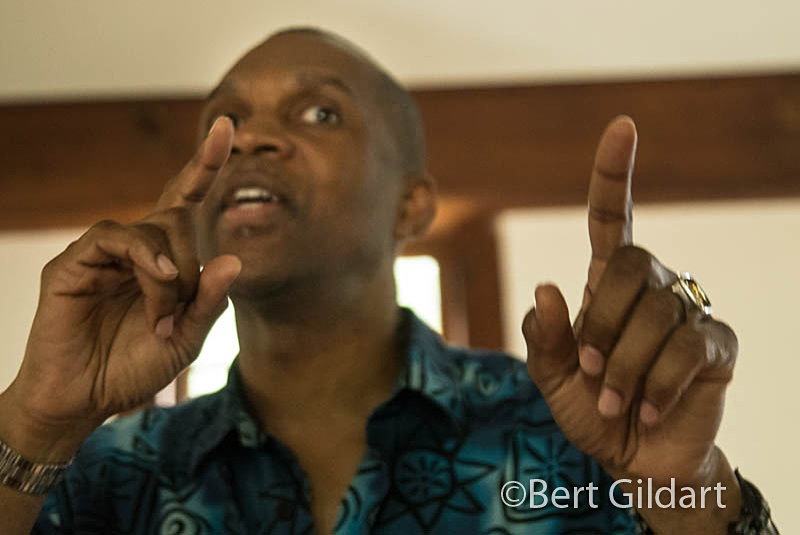
One man, who appeared to be a Native American, was particularly expressive as he played a huge bass fiddle. As he played I photographed him, and he didn’t seem to mind t all.

Jazz Without Borders

Jazz Without Borders

The town seems devoted to nostalgia and Janie and I walked to the theater shop. Much of the store was devoted to the recollection of old movies, and they’ve constructed an old time theater for projecting old films, one of which interpreted Jerome.

MARILYN MONROE–TRIUMPH & TRAGEDY

But scattered throughout were many wax images, one of Elvis, which attracted Janie.

Elvis and Janie

Elvis and Janie

But there were also images of Humphrey Bogart–and that classic image of Marilyn Monroe with her dress blowing up. The film, “The Seven Year Itch,” was released in 1955 and includes the scene in which Monroe stands over a grate, and the warm air from the grate whips up her dress. For movie aficionados the image has become a famous one, and helped further immortalize Monroe, who has also become symbolic of great beauty, but also, great tragedy, for she cut short her life in 1962 when she was only 36.

Marilyn Monroe, triumph and tragedy

Marilyn Monroe, triumph and tragedy

As we wandered the town, it seemed a number of men had long flowing beards, suggestive, perhaps, of a desire to revert to the past. They may also be attracted here because Jerome seems to be such a throw back in time.  One store owner with whom Janie struck up a conversation said that the town was laid back but wasn’t without a problem that seems insidious to small towns. “Everyone knows your business,” said Janie, recalling her conversation with one of the resident store owners. “And if that business raises eyebrows, you become the subject of much barroom talk.”

Well, we’re not looking for a place to relocate, just for places with much fascination. Jerome sure fits that bill and we left at the ideal time, which is that time when you still feel you want to know more–and stay longer.

Note: Here a posting from last year at this time: National Bison Range .

Read Comments | Post a Comment »

Organ Pipe Photo Restospective

posted: March 29th, 2008 | by:Bert

Departing Organ Pipe

Departing Organ Pipe

©Bert Gildart: Though we are returning to Organ Pipe on Monday to accompany a Park Service led drive to Quitobaquito, currently we’re at Rich Luhr’s in Tucson, Arizona. Rich produces Airstream Life Magazine and in the course of writing stories for him, we’ve become good friends. Over the years now, we’ve rendezvoused about a dozen times. Another Airstream couple, Adam and Sue Maffei, are also “courtesy parking” at Rich and Elenaor’s, and in the last few years we’ve also rendezvoused with them. They’re a delightful couple and once worked for Public Radio.

MEXICO OR ORGAN PIPE?

In a day or so the Luhr’s and Maffei will be departing Tucson for a week long trip to Mexico. We were, of course, invited to join, but I have other priorities at the moment, and one of them is to learn more about Organ Pipe and some of the immigration problems. In other words, though the park is now out of sight, it is not out of mind. As a result, we offer here a few photographs from time spent this past week in that park, and hope they suggests the beauty spring in this desert has to offer.

Matilda Saraficio, a memember of the Tohono O’odam tribe, still harvests saguaro cactus. She also makes baskets from beargrass and other native vegetation. In the past Janie has purchased her baskets, and we carry a small one with us in our Airstream to hold coins and other loose items. They are exquisitely made. Photographically, the light streaming over her shoulder presented a problem, so I used a strobe. The light from the strobe complements the sunlight meaning that I was actually using two light sources. Nikon makes it easy to balance the two sources with their TTL lighting, an inherent part of their SB-800 strobe.

Matilda Saraficio creates baskets

Matilda Saraficio creates baskets

ORGAN PIPE: It is always a challenge to dramatize the organ pipe species, and so I photographed a large clump with backlighting, allowing the sun to register in the lower right hand corner. I thought the silhouette might dramatize the pipe appearance of the desert plant, which only grows in North America in Organ Pipe National Monument.

Organ Pipe

Organ Pipe

Brittle Brush now covers many hillsides, though it appears as though it is starting to fade. It has been blooming, however, for over a month and has been with us not only in Organ Pipe but in several other desert parks as well.

Brittle Brush

Brittle Brush

Cholla: I used two strobes to photograph what I believe is Teddy Bear Cholla. I held my two SB-800 strobes off to either side. By setting the strobes at f32 and the shutter on the camera at 250, the strobes so overwhelmed the existing daylight that the background went dark, helping to isolate the color of the flowers and dramatize further the spiny nature of this species of cacti.
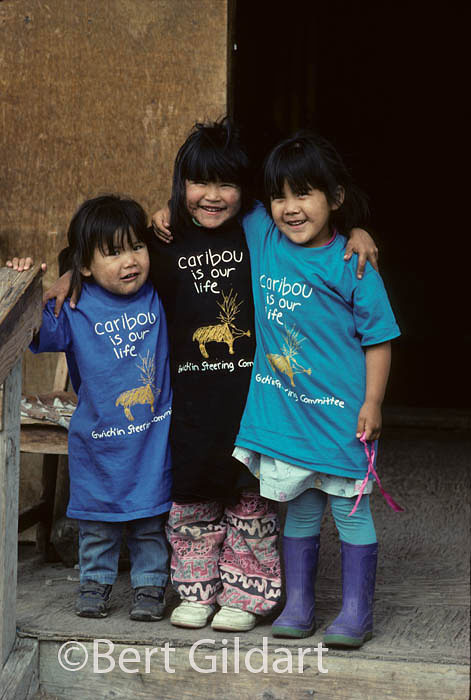
Cholla

Cholla

As mentioned, Janie and I will be returning to Organ Pipe and be joining a group to Quitobaquito springs, a particularly beautiful spot in the monument. Getting there is symbolic of the problems the park now suffers, specifically, the illegal border crossing. To see these beautiful springs, the park must send out an advanced patrol to make sure no illegal immigrants are in the area, particularly ones smuggling drugs and that could be potentially dangerous. After the park has been assured the area is safe, we then board a van that is further protected by rangers and then make the drive.

To prepare myself for the return to Organ Pipe I’ve been reading articles about the immense problems created by illegal immigrants. By joining this group I’m hoping to learn more about what the future bodes for this spectacular desert park.

(Where were we about a year ago ? Not far from Organ Pipe–and Tucson.)

Read Comments | Post a Comment »

Photographing Mitchell Caverns

posted: March 17th, 2008 | by:Bert

Mitchell Caverns

Mitchell Caverns

©Bert Gildart: Photographing caverns can present an immense lighting challenge, and Mitchell Cavern, a California state park literally engulfed on all sides by the Mojave National Preserve, is no exception.

The problem is even more acute if you are trying to include people in your scene, and the only way I’ve found that works somewhat successfully is to place your camera on a tripod, attach a cable release and then set your camera to “Slow Sync,” available on my Nikon D-300 and on most advanced digital cameras. Light from the flash will be adequate to illuminate visitors, but not the huge cavern. You’ll then need a long exposure to properly record all those stalagmites and stalactites illuminated only by the low lighting provided by the caverns.

PHOTOGRAPIC SPECIFICS

Here, then, is the way the camera functioned in response to those settings. In my case, proper exposure for the cavern illuminated with fixed cavern lights was F-5.6 at about five seconds. First, then, the camera used F-5.6 and the quick high-speed blink of the strobe as the proper exposure for people–and then left the aperture open. Then, because of the slow sync setting the camera remained open for five more seconds and used the cavern lights for the rest of the exposure. The result is the image shown here.

Tour guide for today’s outing was a delightful speaker named Myke Ray. Because weather was not ideal, he prefaced his talk from a sheltered area explaining the importance of tiny calcium-producing micro-organisms that provided the foundations for the cave millions of years ago. Tectonic plate activity subsequently took the layers upon layers of calcium and thrust it into the right position for subsequent cave formation. Ground water did much of the rest.

The result today is a series of spectacular caverns with individual formations that Myke helped embed into our memories with names familiar to us all. “See South America?” he said. Or, “see the giant rooster?”

He was referring, of course, to the orientation of the various stalagmites and stalactites and what, with imagination, you might easily envision–and then easily recall in the future.

SNOWY DESERT DAY

The tour took about 1-1/2 hours. Temperature inside the cavern registered 65 degrees and it was a measurement on everyone’s mind. Outside, the Mojave Desert which typically averages about 70 at this time of year, was asserting her temperamental side and had taken a drastic turn downward.

Snow engulfs Hole in the Wall VC

Snow engulfs Hole in the Wall VC

Today, Palm Sunday, outdoor temperatures in and around the preserve registered about 32. Snow was falling and the wind of several days ago had not yet abated, so it was a good day for spelunking.

However, these outrageous weather conditions must come to a halt, and after complaining to the weatherman, have learned he will accommodate us visiting Montanans and that by mid-week temperatures will be back in the low 80s.

That, Sir, will be more like it–and we thank you for your cooperation.

(Alert: Here’s a posting from ABOUT one year ago.)

Read Comments | Post a Comment »

MANY STORIED SANDS

posted: March 11th, 2008 | by:Bert

Kangaroo rat tracks

Kangaroo rat tracks

©Jane Gildart: Camping at Kelso Dunes in Mojave National Preserve is a delight. Three miles off the beaten road, there are no amenities, not even water. Just sand–an endless expanse of it. In other words, those who intend to stay need to plan!

But, the rewards are silence; desert flowers popping up everywhere; stars creating a heavenly smorgasbord of patterns; and the ever-changing light playing on the dunes. And, of course, there are the stories created by all the creatures that live in these 45-square miles of sand.

THE MORNING HERALD

Yesterday and last night a strong wind blew constantly. I woke early this morning, knowing that the lower sand dunes would be fresh, obliterating all old tracks of humans and mammals. It is kind of like looking at fresh snow before anyone else gets to see what’s there.

I knew that kangaroo rats (they hop) live here, as do coyotes and kit fox (the tiny fox with the large ears). Before long I spotted the trails of two kit foxes (maybe this is their idea of a date), going after a kangaroo rat. At one point I could see where the fox might have come to an abrupt stop, maybe playing with the rat.

The rat’s tail left a foot-long line in the sand near its hole, but it was hard to determine if the rat had escaped or had been grabbed by the pursuing kit fox.

Whatever, the fox had trotted off into the cactus area. Because kangaroo rats are so interesting, I wasn’t rooting for either. Simply said, it is all part of nature.

FLOWERS NOW EMERGING

If coyotes had been there in the night, we’d have heard their “singing dog” sounds, and maybe seen their tracks too. Kit fox tracks are smaller than those made by coyotes and all was silent in the desert except for the songs created by the wind.

Wild rhubarb

Wild rhubarb

It was fun to see what each mound of sand had to offer not only in the way of new tracks, but also in the way of all the now-emerging spring flowers.

But for awhile, it was all the tales the mammals had left during the night that so thoroughly held my attention-in these many-storied sands.

Read Comments | Post a Comment »

Belly Plants

posted: March 6th, 2008 | by:Bert

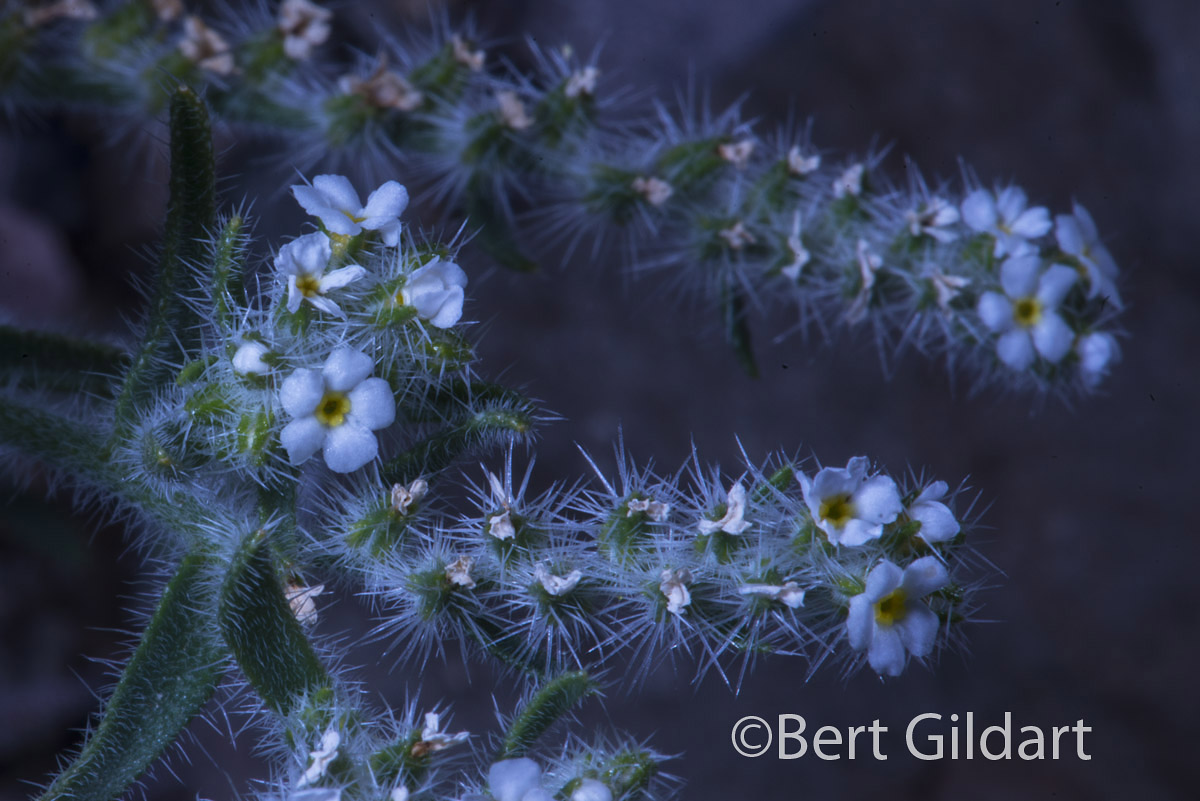
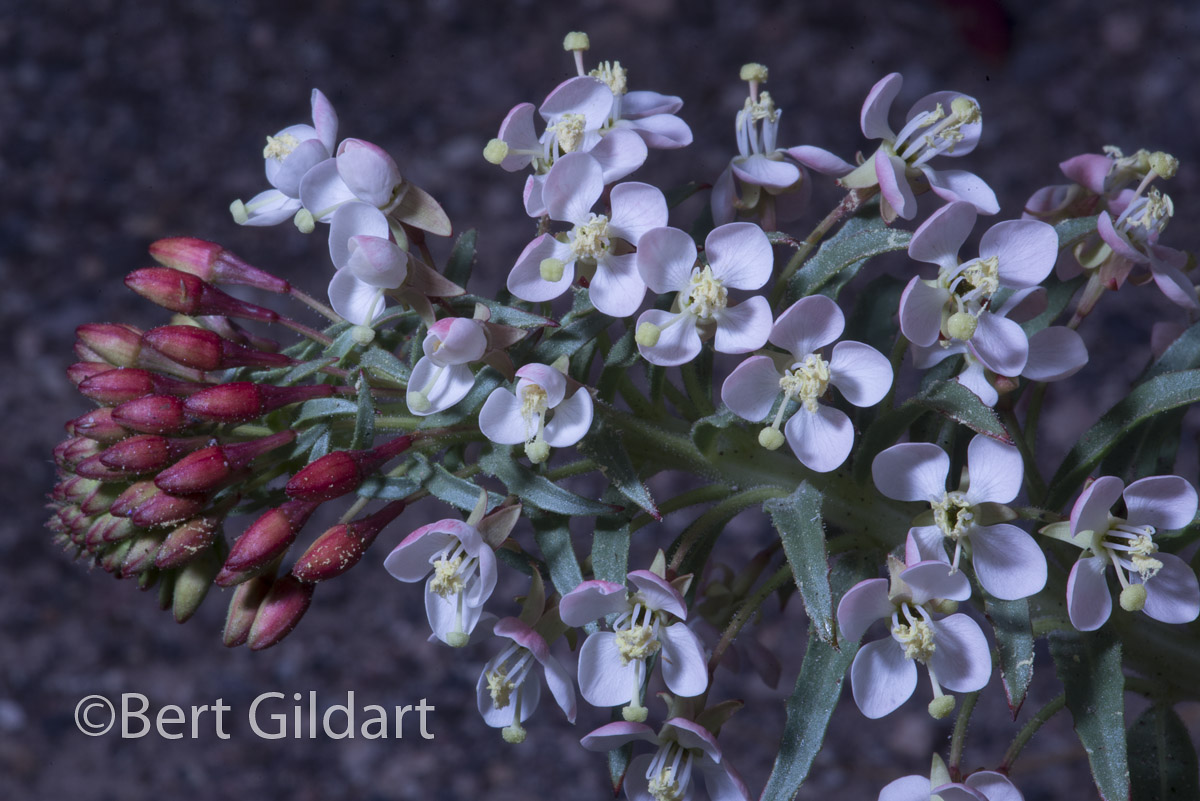
©Bert Gildart: “Belly plants” are defined as: “plants that must be observed while lying on your belly to enjoy.” Because we are now camped in the Mojave National Preserve, plants that grow in this dry and sometimes blustery environment tend to be “belly plants.” They’ve acquired that low-hugging feature to help prevent desiccation.

Other survival features of such species include waxy stems and the production of tiny hairs that fringe a plant’s stem.

Though not all the species posted here are “belly plants” several are. Regardless, all are now blooming in this glorious spring of 2008, essentially because, according to a park biologists, of the abundant rain. “Best season we experienced since 2005,” said the researcher we meet at the Kelso Dunes, where we are now camped. The lady was researching bees unique to the dunes area, but stopped for a moment to visit.

Here are a few of the “belly plants” now flowering in the Mojave Desert.

Dune Evening Primrose

Dune Evening Primrose

The DUNE EVENING PRIMROSE is a month early, according to the friendly biologist. It produces a beautiful white flower and those flowers are now dotting the base of the Kelso Dunes, which is, incidentally, the third largest in the nation. The flowers are quite fragrant. “As the plant dries out,” notes our reference book, Mojave Desert Wildflowers, “the stems curl toward the center and produce a characteristic ‘bird cage.’”

Verbena

Verbena

One of the most beautiful plants is VERBENA, (and I hope I’ve I.D this plant correctly). From a photographer’s point of view the tiny repetitious flowers combine to create a nice pattern as does the slight curve formed by the individual flowers. We found the plant on a desert wash, which seems to characterize the habitat in which the species grow.

Desert Star

Desert Star

Finally, here’s an image of what truly is a “belly plant,” the DESERT STAR. The plant grows in clumps, which is yet another survival technique. Plants in clusters can more easily retain moisture.

All photographs of these plants were taken from a tripod, but because this particular plant grows so low, I had to dig several holes in the ground to adequately lower my camera. All these photographs, incidentally, were taken with natural light. However, because I think most close up photographs look better in subdued light, I inserted myself between sun and plant, so creating a shadow. As well, all photographs were taken at very slow shutter speeds (about 1/15 of a second) so that I could use tiny apertures (f-32) to enhance depth of field.

Read Comments | Post a Comment »

Marta Becket’s Amargosa Opera House–And the Power of One

posted: March 3rd, 2008 | by:Bert

©Bert Gildart: Every now and then a spur of the moment decision opens a window that reveals the amazing impact one person’s life can have on many others. Such was the case for me this past Saturday night.

After making the 40-minute drive from Pahrump, Nevada, to the Amargosa Opera House located at Death Valley Junction, I encountered a group of veterans, all former army paratroopers, who said they’d had difficulty re-entering society upon completion of active duty in Vietnam. Contemporaries, they said, turned to alcohol, others to drugs.

For this group, however, salvation had been Death Valley, Marta Becket and her Amargosa Opera House–and the fun atmosphere this Grand Dame of the art world created. Trained in ballet, titles such as: “The Goodtime Cabaret,” “The Second Mortgage,” and “On With the Show,” suggest themes–and appeal. The appeal eventually become worldwide but more locally, it found its way into the hearts of a group of army veterans.

Amargosa Opera House

Amargosa Opera House

The group met Marta about 20 years ago, and has returned every year, basing themselves at the motel associated with the Opera House. During the day, these aging men jog through the park, but come performance time (now confined to Saturday nights), all attend Marta’s iconic performance.

Vietnam Vetran Hank Humphreys

Vietnam Vetran Hank Humphreys

Hank Humphreys, one of the Vets, explained the circumstances in personal terms. “It took me a long time to grow up,” he said, “and because of Vietnam I guess you could say I didn’t mature until my late forties. But then we came to Death Valley, and after a failed marriage, when I needed inspiration most, there was Marta Becket.”

Hank continued his story, and the gist is that he felt a kinship with all that Marta had accomplished.

AN EPHIPHANY

“Marta came here in 1967 when she was in her early 40s,” said Hank, “and when she and her husband arrived at Death Valley Junction, I believe she had an epiphany. They’d had a flat tire, but when she saw the old Adobe structure she saw something that no one else saw. You’ve got to wonder alright; out here–miles from nowhere; the wind can howl and some of her first companions were kangaroo rats.

“What made her stay? Who knows for sure, but she saw something, and she made that indifferent something work. I know it’s what inspired us.”

Judging from the crowd at last night’s performance, Ms. Becket did make it work, and at the evening performance, I learned yet more about Marta’s accomplishments and the lure of her setting.

Sold out

Sold out

Though now in her early 80s, her performance remains inspiring–beginning with the artistic atmosphere she created.

ART CREATES AN AUDIENCE

Seated in her opera house, you’re engulfed by paintings, and during the performance, she explains why she created them. She said that initially her performance attracted small crowds, sometimes only one or two people. “I wanted to feel as though I had an audience,” she says, “and so I painted the murals.”

Marta's extraordinary murals

Marta’s extraordinary murals

If you have ever seen the murals that grace not only the walls but the ceiling, you know her work rivals some of the most accomplished artists of our times. Generally the heroic-sized paintings depict people she has known throughout the years., and except for one she has retained them all.

The one painting she eventually eliminated was of a business man, who, she says, was a scoundrel. He told her that he would invest in her talents and help immortalize her paintings. In so many words, Marta says the man lied and so, she talked about a grand metamorphosis–and how the wall with his likeness suddenly changed.

For me, that left the question of what her future might hold.

MEETING MARTA

After the program, Hank introduced me to Marta Becket. I asked her if she would mind posing with the red scarf she’d used during the evening performance. She looked askance, but Hank quickly scrambled to the chair over which she’d draped the red scarf and gathered it up. Marta blessed him with a smile and me with an image that glowed.

When I asked Ms. Becket how much longer she’d perform she responded by saying no one knew when they were going to die. By that, I assumed she met “Forever.”

Marta Becket, icon of the West

Marta Becket, icon of the West

Hank then introduced me to Jack Meegan and to John and Susan Quirk. They said that Vietnam and a society that ignored their contributions to America, diminished their “first life.” Though they deserve credit for all they’ve overcome, they still say Death Valley and Marta was their inspiration for a great “second life.”

I departed that evening amazed once again at just how much one person’s life can impact so many other’s.

Read Comments | Post a Comment »

Death Valley, Always Colorful, Always Photogenic

posted: February 27th, 2008 | by:Bert

©Bert Gildart: Death Valley is a land of abstractions, one that offers photographers what may well be one of the best places in America to create unique interpretations. Here are four photographs that represent what I believe to be some of my better work from this vast California national park.

Teakettle Junction, 2003

Teakettle Junction, 2003

Three of the photographs come from the past several weeks during which time Janie and I have been camped in both Stove Pipe Wells and Furnace Creek. The fourth, the photograph of Tea Kettle Junction, I made about five years ago. Janie and I had wanted to see Tea Kettle when Eric and Sue were here several weeks ago, but we found the road to be in horrible condition. Washboarding went on for miles and each rut was deep, perhaps six to eight inches in places.

As a result, we turned around, not able to see if this famous, hard-to-reach junction still retains all of its tea kettles.

Hanging tea kettles was once an old park tradition started perhaps by some old prospector. Because it says something about old ways and the passage of quirky people, it remains one of my favorite photos.

COMPRESSING SCENES

Two of the other photographs were made at one of the park’s several sand dunes, specifically, the Death Valley Sand Dunes near Stove Pipe Wells. The image of the couple on the dunes was made with a 600mm lens, which provides great compression.

Sun and Sand Dune Photographers

Sun and Sand Dune Photographers

By stopping the camera down, probably to about f-45 in this case, depth of field is immense, even with a telephoto. I underexposed several stops to make sure the couple was completely back lit. The lens I used was not one dedicated to digital photography, so exposure data was not digitally recorded.

DETAILS

Another technique is to focus on the details of a subject, such as the actual ripples created in the dunes by the sun at it most extreme angles, in this case, early in the morning–just as the sun popped over the horizon.

Sand Dune Patterns

Sand Dune Patterns

Each granule was illuminated, and that is what I believe endows this image with impact.

HUMAN HISTORY

Finally, I include the following photograph because it recalls a TV series, “Death Valley Days.” Ronald Reagan was the narrator and he helped make the park famous. One of the major industries described in the program certainly had to have been the 20 Mule Team wagons that transported borax, “White Gold,” from Harmony Borax. The site is located an easy one-mile bike ride from the campground at Furnace Creek.

Borax Works

Borax Works

Normally I don’t like light that streams from directly behind, but in this case the color of the walls contrasted nicely with the mountains, and the yellow in the Desert Gold plant. The species has remained with us for the entire three weeks we spent in the park and gives every indication of remaining another week or two.

If you’re in the area, you can not go wrong visiting this park, and we leave with much regret.

Read Comments | Post a Comment »

Death Valley and the Challenge For Photographers

posted: February 11th, 2008 | by:Bert

Eric at  Zabriske Point

Eric at Zabriske Point

©Bert Gildart: Death Valley is a photographer’s paradise, and that is one of the reasons we have rendezvoused in this largest of all national parks in the Lower 48 with good friends Eric and Sue Hansen. We all belong to the Outdoor Writer’s Association of America, and it seemed only logical that we could accomplish much by pooling resources. In other words, one day they’d drive another day we’d drive. In the evening we’d enjoy evening cookouts.

The only draw back of being here is that we have no cell phone reception, and at Stove Pipe Wells where we’re camped, we have no Internet. Thirty miles away, however, at Furnace Creek the park provides access to the Internet at its Visitor Center and that is the vicinity to which we’ll soon be moving. When you read this, we will have moved to the campground at Texas Springs-within walking distance of the Visitor Center.

ATTRACTS PHOTOGRAPHERS

It is the austerity of the park that makes this such a joy to photograph and that initially began attracting photographers. Ansel Adams was lured here as well as the Munch family, and they set some pretty high standards. Adams created an entire book of black and white photography on this park, and to a large degree, it is his work that lured me into photography. I still enjoy making black and white images.

Hikers en route to Golden Canyon

Hikers en route to Golden Canyon

One man Eric and I know said he thought Death Valley was the most interesting mass of nothingness he’d ever seen. We considered his thought, but agreed that the point of photography is to find organization when others see confusion. And that’s what we’ve been working at these past few days.

The mining industry also found value in this land of “nothingness” and created a legacy the park inherited and that is now played out in various ways. Once Ronald Regan narrated “Death Valley Days,” a TV series that recalled the hardships miners endured before this part of the Mojave Desert became a park. Though miners such as “Shorty” Harrison and Pete Auguberry hoped to get rich on precious metals, instead many struck it rich with Borax.

DEATH VALLEY DUNES

Eric and I began our photographic explorations with the sand dunes, a place that for pure sensual pleasure is hard to beat. On some February mornings you can strike out across the dunes bare-footed, but need to remember that by mid morning the hot sands can sometimes blister your feet. That’s certainly true as spring soars into summer with temperatures here that compete for the world’s hottest.

Sand Dunes

Sand Dunes

In Death Valley there are four separate series of sand dune, all created (mostly) by the forces of wind-and their prevailing patterns. The dunes near Stove Pipe Well are known as the Death Valley Dunes. They’re not the most massive, but they are the most accessible. Twice now, Eric and I have departed our trailers well before the rising sun to be properly positioned as the first rays of light struck individual particles of sand. These particles represent both time-and timelessness-and good photography can help impart that story.

ZABRISKE POINT

Zabriske Point is another of those areas with rampant lines of erosion, but these represent erosion at their most eloquent. For whatever reason many are drawn to Zabriske Point and we watched a number of couples as they began hiking down a wash we knew would terminate several miles later near Golden Canyon. They were drawn by the austerity of the land-and its enchanting beauty.

Searching for meaningful patterns

Searching for meaningful patterns

We plan to be here for about another week, revisiting this place in which Janie and I have spent so much time that it seems (as I’ve noted before) like an old home. We’re fortunate to be joined by friends with whom we can pool knowledge and can help us transform good times into most memorable times.

Read Comments | 1 Comment »

Wildflower Alert At Anza-Borrego State Park

posted: February 7th, 2008 | by:Bert


©Bert Gildart: Tiny wildflowers are beginning to emerge near the Visitor Center at California’s Anza-Borrego State Park. Though I can not say with complete certainly, from my description a park naturalist said he thought the flower now posted here is Phacelia crenulata , or the Notched-leaf Phacelia. Regardless it is the first flower we have seen in two weeks of daily explorations.

First flower of the season?

First flower of the season?

The flower is tiny, standing about half an inch high. Probably it appears twice life size on your screen. Because you need to be on your stomach to really see it, some people would call it a “belly plant.” The flower is purple and the actual leaves are certainly notched. Though not yet abundant, my desert wildflower book says it also grows along the park’s Montezuma Road. Because it is so tiny, photographing it was a challenge, particularly in the direct sun of yesterday. To reduce harsh shadows, I added two Nikon SB-800 strobes for fill light. To maximize depth of field I choose an aperture of f-32, the smallest possible with this lens.

Naturalist say other species will soon be following, but the main wildflower emergence generally occurs in March. Though we are about to depart for Death Valley, we hope to return to Anza Borrego in about a month, depending on the abundance of flowers, which can not be predicted. That uncertainly, however, is what makes Anza Borrego so interesting. As Marshall South once wrote, “There is nothing ‘regular’ about the desert. Uncertainty is the keynote and its eternal fascination.”

We can live with that.

Read Comments | 1 Comment »

Desert Details

posted: February 6th, 2008 | by:Bert

©Bert Gildart: After a delightful weekend in Los Angeles we’ve settled back into our Airstream in Anza-Borrego and have spent much of the time working on stories for several magazines. But yesterday, when the afternoon rolled around, we felt an overwhelming desire to return to Blair Valley, home not also the Souths mentioned in my blogs of several posts ago, but also the Kumeyaay Indians. The area provides an exceedingly photogenic landscape in this huge state park, and that was the thrust of our afternoon–trying to obtain story-telling photographs. We wanted to detail the challenges of living in the desert. For this posting we are hoping our photographs–and extended captions–will summarize that challenge.

43654.jpg

DESERT AGAVE lured the Kumeyaay Indians to the area, but if you study the thorns, harvesting that species presented challenges. The edges of the agave leaf are covered with thorns, but so is the tip, and this terminal thorn apparently contains a substance that adds to the pain of those who have the misfortune of getting stuck. I’ve learned from such photographic outings to always carry my Leatherman (which contains pliers)–to help extract thorns that invariable stick to clothes and flesh. Photographing thorns of the species was a challenge and I used strobes (two SB-800s) as well as natural light. I set the lens on my D300 Nikon camera body to Macro.

43659.jpg

AGAVES are also called century plants, indicative of the length of time it takes to bloom. The plant grows on rocky slopes and is, in fact, the only agave species found under such circumstances. Though it doesn’t take 100 years to blossom, it may take up to 50 years. Just before blooming the agave sends up towering stalks that can approach 15 feet. Eventually, the display attracts a variety of pollinators including bats, hummingbirds, bees, moths as well as other insects and nectar-eating birds.

43658.jpg

NATIVE AMERICANS confined their visits to areas containing agaves to times when the plants bloomed. They harvested the seeds produced by the agave and then ground them in morteros. Such circular holes were drilled into a number of the granite boulders located in the upper reaches of Blair Valley. The Kumeyaay also used fibers of the agave and wove them into mats, sandals, belts and ropes.

We’ll be in Anza-Borrego for another day, and then we’re heading to Death Valley for another story–and to rendezvous with friends we met a number of years ago through the Outdoor Writer’s Association of America. We’ll talk shop and work a bit. The chief naturalist there tells me global warming is diminishing populations of Joshua Trees, and that’s something I want to learn more about.

Death Valley is a park we know well as Janie and I coauthored a guide book to the this incredible national park for Falcon Press. For us it’s almost like going back to a former home.

Read Comments | 1 Comment »

Coyote Canyon and the Anza Expedition

posted: January 26th, 2008 | by:Bert

Crossing Coyote Creek

Crossing Coyote Creek

©Bert Gildart: On December 20, 1775, Juan Bautista de Anza led 240 Sonoran colonists through the same valley that Janie and I toured yesterday. Because the valley remains under the control of California’s Anza Borrego State Park, little about the area has changed.

The valley can only be accessed by driving along a sand road, and then only for a limited distance. For us, that distance was dictated by the rocks that began to crop up along the jeep road and the fact we did not want to take any chances of damaging the four-wheel drive truck we rely on to pull our Airstream . Though others continued on (we might return with mountain bikes), we stopped several miles short of the road’s terminus.

Still, our explorations provided great insights into the struggles Anza confronted. Eventually, he continued on with the colonists to found San Francisco, but the obstacles from 1775 remain today.

A CANYON CALLED HOME

The valley is cut by Coyote Creek and flanked to the east by the Coyote Mountains and to the west by the San Ysidro Mountains. But it was the valley floor that grabbed our attention.

First, we came to a trailhead sign pointing to Alcoholic Pass, named according to a guide book for the switchback-ish nature of the trail.

Next, we came to an area our map referred to as the Desert Gardens. We spent several hours hiking around–taking photographs–not only because of the garden’s beauty but because it had once been the home to a group of Native Americans known as Cahuilla.

“A Canyon Called Home,” began an interpretive panel. “People raised families in Coyote Canyon… With sheltered canyons and year around running streams, Coyote Canyon was the perfect place to call home.”

Appreciating cacti

Appreciating cacti

Another nearby interpretive sign proclaimed that this canyon was home to a greater diversity of life than anywhere else in the park; adding that five separate areas here had been designated as “sensitive habitats” and that Anza-Borrego contained one quarter of all the lands in California designated as state wilderness. We understood that part of the sensitivity was out of concern for the Peninsular bighorn sheep, now endangered. Though we didn’t see sheep yesterday, we certainly saw sign.

PHOTO TECHNIQUES

Cacti were dense and though we could easily side step them, we wondered about de Anza and his stock. We had the luxury, however, to appreciate the biology of the cholla and other plants with thorns, recalling that botanists say that thorns evolved from leaves–and served specific functions in this land of little rain. Janie and I photographed the cholla, using two strobe lights, firing them remotely using the built-in strobe on the Nikon D300. (Nikon refers to this capability as its “Advanced Wireless Lighting,” as no chords are required.)

As well I selected the manual exposure mode, exposing at f22 at 250 of a second, thinking that by overpowering ambient light and, so, creating a black background, I could dramatize the thorns.

PARTING PHOTO

From the gardens we drove another mile, stopping shortly after crossing a stream at another interpretive panel. This one further described the hardships of Anza’s expedition, explaining that Gertrudis Rivas Linares gave birth to a son, Salvador. “Next day she mounted a horse for the journey north.”

Plant profusion of the Desert Gardens

Plant profusion of the Desert Gardens

Here we turned around, reaching the Desert Gardens just as the sun began dipping into the San Ysidro Mountains. The sun backdropped the cholla, imparting a radiance not possible with other types of lighting.

Read Comments | 1 Comment »

Rain, Leaves and the Ocotillo Plant

posted: January 24th, 2008 | by:Bert

Cycling to Yaqui Pass

Cycling to Yaqui Pass

©Bert Gildart: We’ve settled into a campground in Borrego Springs and have been making daily excursions from our Airstream into the surrounding desert. For Janie, yesterday was laundry day, so I got out my bike and peddled what our neighbors (Steve and Linda) said would be a wonderful loop outing. Their recommendation was not to be taken lightly for last year they cycled from northern California to Maine on a tandem bike, taking a total of 96 days.

My loop of yesterday was substantial enough, climbing 1,860 feet from Borrego Springs to Yaqui Pass and returning me to the campground 36 miles later. The route exposed me to a variety of different types of moistures conditions, which in turn affected the appearance of cacti and other thorn-like plants.

BEAUTY OF THE OCOTILLO

Earlier I had learned about one of the plants, the ocotillo, at the park’s informative visitor center. It’s a plant that produces scarlet tubular flowers atop the graceful stems, and can at times lend a colorful counterpoint to the drabness of the desert in mid-winter.

Yesterday, the ocotillo was also showing the effects of small amounts of rain, which is the beginning of flowers. Several days ago, the Borrego Springs area had been touched by a brief rain. To Janie and me, the rain seemed insignificant, but the plants didn’t “think” so; they responded as though doused with profuse heavenly showers-something I noticed as I was cycling. Here and there, particularly as I ascended the flanks of the Pinyon Mountains, I could see the start of leaves.

“That’s all it takes,” said a volunteer at the Anza-Borrego Visitor Center. “The leaves will flourish, but, then, if the ocotillo isn’t exposed to more rain, the plant doesn’t have sufficient energy to maintain the leaves, so they fall off. The process will, of course, repeat itself, until the ocotillo has sufficient energy to produce flowers.”

PHOTO TECHNIQUES

As I neared Yaqui Pass I stopped to examine an ocotillo plant, which was in fact, beginning to produce small leaves in large numbers. I photographed the stems and leaves, using the built-in strobe on my Nikon D300. I set the camera’s lens to “macro,” and then framed the image so that a few rays of sun would be included. Liking what I saw in the camera’s screen, I peddled on.

Rain, leaves and Ocotilla

Rain, leaves and Ocotilla

After reaching Yaqui Pass I then coasted down almost four miles, and because the desert air was so cool I stopped once to dig out a wind breaker. After the long descent the road leveled and the remaining five miles was an easy pedal. That’s not to say I wasn’t tired and slept about as well last night as I have in a long time.

Read Comments | 2 Comments »

The Compulsion of the Borrego Badlands

posted: January 22nd, 2008 | by:Bert

Navigating Font's Point Wash

Navigating Font’s Point Wash

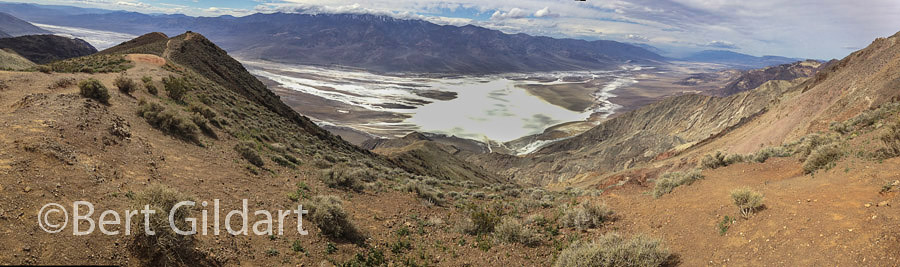
©Bert Gildart: For a photographer, I can not imagine a better spot to begin touring Anza Borrego State Park in California than Font’s Point. Noted for its views of the Borrego Badlands, the patterns therein provide a fascinating array.

If captured appropriately, the badlands leaves viewers wondering about the power of nature, the power of erosion, the difficulty of navigating such broken land. As