Favorite Travel Quotes

"Travel is fatal to prejudice, bigotry, and narrow-mindedness, and many of our people need it sorely on these accounts."
-- Mark Twain
Innocents Abroad

"Stop worrying about the potholes in the road and celebrate the journey." -- Fitzhugh Mullan

"A good traveler has no fixed plans and is not intent on arriving." -- Lao Tzu

Archive for the 'Travel' Category

Can Music Charm Kangaroo Rats?

posted: March 6th, 2010 | by:Bert

TonyFeather-4-1

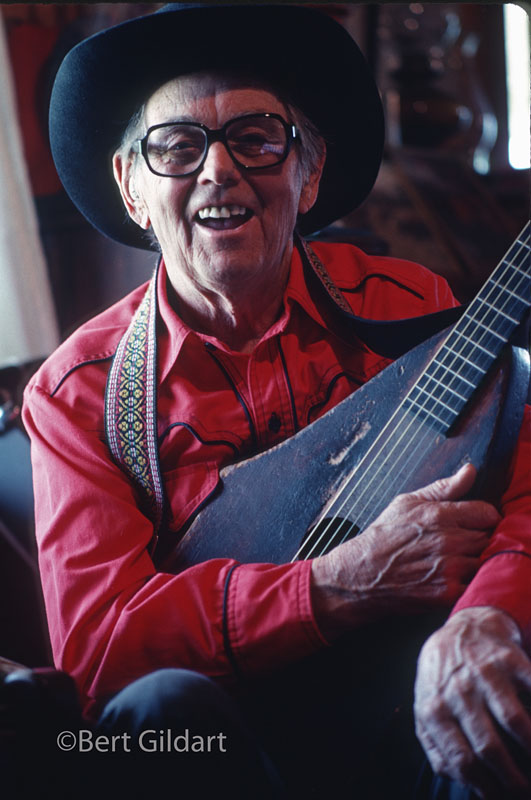
Could the soft soothing music from Tony Feathers' guitar be luring in our new friends?

©Bert Gildart:  Whether it was the superb guitar playing, the warmth from our night fire, or the small pieces of peanuts we had apparently dropped on the ground I can’t say for sure, but one of the factors must have been responsible for the stealthy appearance of one of the desert’s most secretive creatures.

Though Janie and I have seen kangaroo rats as we’ve hiked the various deserts environs, we’ve never seen them at our feet – crawling over our boots, scampering across our hands. But that’s the way it has been the past several times we’ve sat around one of our cheery fires. Curiously song writer and guitar player Tony Feathers has joined us on each of the nights, so maybe it has been the soft sounds of his instrument and voice that have coaxed in these mysterious creatures. He plays frequently on Public Radio and at coffee houses in his home state of Tennessee, so I’m not going to sell this possibility short. He’s good, and the rats could have been mesmerized.

CHANCE FOR FREE FOOD

Another factor, of course, is the warmth from the fire. Perhaps the light from the fire has helped drawn them in. Possible, I suppose, but with their large, light-gathering eyes I doubt the fire improved their vision, so more than likely because the fire has lured us out, it is something about our presence that has drawn them in.

From our presence there is the possibility of food, and perhaps they’ve learned that. We chow on peanuts as we sip our wine, and when we chow on the peanuts, we inadvertently drop hulls. Still, it’s amazing that these timid creatures will forsake their desert ways — even for the chance of some free food.

DESERT ADAPTATIONS

Kangaroo rats are extraordinarily well adapted to this life in which they’ve been placed. Look again at their eyes, which are huge and excellent for gathering light. Then look at their huge hind legs, the source of the name. With these powerful legs, they spring long distances, soaring in huge arcs from one life-saving hole to another, chased sometimes by a coyote – and, yes damn it! — sometimes by the cats that some RVers allow to wander free from their campers. But back to these charismatic desert denizens… look at their extraordinarily long tail, which enables them to adjust their trajectory in mid air with a powerful flick.


KangarooRat

With their huge hind legs Kangaroo rats can leap long distances and then, with their long tails, even change the trajectory of their flights.


There are yet other adaptations, and most have to do with the conservation of water. Scientists say their kidneys are extraordinarily efficient, capable of extracting life-giving moisture from tiny seeds. That’s just for starters, for scientists have tabulated many features that go on for pages.

KEEPING “KANGIE” WILD

Those, at any rate, are some of the characteristics of the visitors we’ve been enjoying the past couple of nights as we sit around our warm campfire listening to Tony Feathers play his guitar. So fearless have these creatures become that I actually had one crawling over the palm of my hand. They’re fastidious little creatures and because of the trait some people have actually tamed them as pets.


_MG_7917

Tug of War


We, however, like them where they are and will try and do our part to keep them wild, not always easy to do. The other evening I saw one of our new friends creeping toward the hull of a peanut. Trying to reach it before the small rodent did, I succeeded only in tying with the tiny animal, which resulted in a small tug of war.


_MG_7918

Large eyes placed on the sides of its head provide these tiny rodents with ample light-gathering capability.


“Kangie” won, and we all watched as the animal bounded off into the night. Several nights later, it returned again, but this time with several of its friends, all of whom we tried to ignore. That, at any rate, is a summary of another of our evenings here in Pegleg, America.


——————————————————————————-


THIS TIME TWO YEARS AGO:

Organ Pipe

ADS FROM AMAZON AND GOOGLE AUGMENT OUR TRAVELS:


Read Comments | 1 Comment »

For Enhanced Detail, Rich Charpentier Advises High Pass Filtration

posted: February 23rd, 2010 | by:Bert

©Bert Gildart: Here’s a technique I learned yesterday from Rich Charpentier, a good friend who provides informative photo seminars from his base in Prescott, Arizona. As well Rich has a print shop located not far from the town’s historic courtyard center.

Right now Rich’s class to Vulture Ghost Town is full, but you can still get into his next class, one which will center on an incredible area known as White Pockets. Rich, as I’ve discovered before (and from his blog), not only knows the areas around which he centers his class, but can convey this knowledge. He is a born communicator, a patient and persistent teacher.

HIGH PASS FILTER

The technique Rich shared with me by phone is intended to increase the definition of an image in a way no other technique can equal. You must have PhotoShop. To duplicate the technique create a new layer (Ctrl J), then use a High Pass filter on the layer, which will create a faint “etching” that seems foreign to the original.


Lily-14Lily-14HPass


THOUGH NOT PARTICULARLY DRAMATIC IN THESE SMALLER IMAGES, TRY “HIGH PASS FILTRATION” FOR ENHANCED DETAILED THAT WILL BLOW YOUR MIND WHEN ENLARGED. BEFORE ON L.


You’ll have to experiment with the pixel change, but I set mine to 9. Then blend the two layers (original and new) using Hard Light or Vivid Light, and behold, you’ve created an image whose impact has just been increased dramatically, particularly apparent with larger images.

HIGHLY RECOMMENDED BY MANY

The technique really helps to amplify the floral structures of wildflowers (as they’re now appearing in Anza Borrego!), and if your goal is to generate an appreciation of the natural world – or just the world around you –through the art of photography, Rich can help!

To learn more about PhotoShop, Lightroom and photography, and do so in unique settings, I join many others in recommending his photo seminars.


—————————————————————————–


THIS TIME THREE YEARS AGO:

*Anhinga Trail


ADS FROM GOOGLE AND AMAZON AUGMENT OUR TRAVELS:


Read Comments | 2 Comments »

Emerging Desert Lilies Suggest Spectacular Spring in Store for Anza Borrego

posted: February 21st, 2010 | by:Bert

Lily-10

One of Anza Borrego's most celebrated wildflowers now emerging and is abundant.

©Bert Gildart: One of the desert’s most celebrated wildflowers is now emerging in areas surrounding us here at Pegleg, a campground within the sprawling Anza Borrego Desert State Park.

Known as Desert Lily various people from our campground have surrounded sprouting leaves with circles of rocks to protect them from the many footfalls of local hikers. Their efforts have been rewarded for now emerging are undamaged specimens of what many describe as one of the desert’s most beautiful wildflowers.

Appropriately the generic name of the plant is Hesperocallis and it roughly translates from Greek as “west beauty.” (Greek hesperos, “west,” and kallos, “beauty.”) Indeed the flowers are beautiful and though I photographed one the other morning and posted it on a previous blog, the images here show more fully developed specimens and their most conspicuous features, and that is the fully opened large, cream-colored sepals and petals. Usually sepals are a different color but in the case of many lilies, sepals have become more like petals, and that’s true of the desert lily.

Though the plant is now abundant, individual specimens do not always bloom, requiring a sufficient amount of rain to activate the bulb, which can be buried several feet in the soil. Spanish called the desert Lily “Ajo (garlic) Lily” because of the bulb’s flavor.

Like the glacier lily of Glacier National Park (where I worked as a seasonal ranger), Native Americans sometimes harvested the bulb as a food source. In Glacier, grizzly bears still seek out the succulent bulbs and I have to speculate that when the California grizzly roamed this great area, it might have once sought out bulbs of this or a similar California lily, for bulbs of Montana’s glacier lilies and Anza Borrego’s desert lilies are similar. Certainly local tribes made use of the bulb, just as they made use of the agave plant, a species to which the desert lily is closely related.

FAMILY CONFUSION

Though called a lily, I find from the literature that there is much dispute as to whether the species really should be placed in the family Liliaceae. From botany courses I know that members of the lily family have the floral formula of 3-3-6-3, meaning they have three sepals, three petals, six stamen and three pistils. Our desert lilies conform to this formula, but with the advent of molecular science, taxonomists are finding molecular differences they now believe are more important than morphological features.

Lily-11

Desert Lilies now heralding what should be a colorful spring desert.


Now they say these features reveal that the Desert Lily is more akin to the agave and relegate it to the family Agavaceae. Adding to the confusion, yet others relegate it to the family Hesperocallidaceae, and that’s interesting as this family contains no other species but Hesperocallis undulate, our desert lily. And, yes, yet others leave it right where it’s been, and that’s in the lily family.

PHOTOGRAPHY & SPECIES IDENTIFICATION

Books on taxonomy say that to identify the desert lily, you should look for characteristic long, thin, narrow leaves that appear wavy or undulating, as suggested by the specific name undulate. You can see that feature in my photographs, but literature also says individual specimen might sometimes display thicker leaves with straight edges.

Look, too, for a flower which at times sports a stem one- to three-feet in height. At times, these structures may contain as many as 20 buds, though only a few may be open at any one time.

Some say the flower is similar to that of an Easter lily, and after spending time photographing it, must concur that the two appear somewhat similar. Photos incidentally were made during a strong wind, but my two strobes arrested leaf and flower motion. For depth of field, natural light setting had to be f-32 dropping shutter speed to 1/8th of a second.

Lily-13

Look for long narrow leaves that often appear wavy.


That, however, would not have worked and resulting images would have been horribly blurred. With strobes and the camera set to manual, I was able to change the shutter speed to 1/250 of a second; aperture remained f-32.

NOW’S THE TIME TO EXPLORE

Most people, of course, probably care little about the technicalities imposed by taxonomist and by camera buffs such as myself, and are probably looking for a plant that simply adds beauty to a desert setting that can sometimes appear drab. If you fit that category, now is the time to explore Anza Borrego’s spectacular desert. Wildflowers are beginning to emerge and that news is presaged by the desert lily, one of the most beautiful of all desert flowers.


———————————————————————–

THIS TIME THREE YEARS AGO:

*Badwater, Where An Entire River Disappears

ADS FROM GOOGLE AND ADSENSE AUGMENT OUR TRAVELS


Read Comments | 1 Comment »

More Phenomena at Anza Borrego Desert State Park

posted: February 14th, 2010 | by:Bert

Shrimp-8

Native Americans once gathered fairy shrimp in tightly woven baskets.

©Bert Gildart: Since my posting about fairy shrimp, I have learned more about this tiny crustacean by visiting with several of the volunteer naturalists at Anza Borrego Desert State Park. As I explained recently, rains dissolved the cyst that protects the species from the fiery sun and the desiccating winds. But what naturalists explained is that that all life-perpetuating functions are performed in a period of just two weeks.

Another interesting fact is that Native Americans once gathered fairy shrimp by the thousands collecting them in baskets woven so tightly that these half-inch long creatures could not escape.

Fairy shrimp then served as a source of food. Obviously the food source was marginal as rains sufficient to bring forth the large numbers Janie and I saw at Clark Lake several days ago only occur once every five or six years. This is one of those years.

SPRING FLOWERS

Rains in this park are also beginning to bring forth spring flowers, and there are two particularly showy species now blooming. One is a species of cacti known as the Fishhook Cactus, which can now be seen along the trail to the old Marshal South homestead in Blair Valley.

The other is a Gold Poppy and Eric Hansen and I photographed it yesterday while looking for sheep along the Palm Canyon trail. Eric and Sue are a husband wife writer/photographer team, also members of the Outdoor Writer’s Association of America, and Janie and I have known them for years. They’ll be here for a week or so.
To photograph the two species I used two different techniques. I photographed the cactus using two strobes lights, a technique described in other postings. I photographed the Gold Poppy by asking Eric to create a shadow over the plant, so reducing shadows that tend to be excessively contrast-y in the harsh desert light.
Eric and I are both interested in photographing the desert bighorn and, yesterday, we had some success, but it wasn’t easy. We departed our campground about six in the morning and were at the trailhead shortly thereafter. By sunrise we were a long way up the canyon when Eric spotted a ewe-lamb group on the side of Indian Head Mountain.


sheep-12Flowers-4


Bighorn sheep scurry along side of Indian Head Mountain; fishhook cactus now blooming along trail to Marshal South’s old homestead.


SHEEP WERE NONCHALANT

The sheep demonstrated but little concern and drifted toward us. Half an hour later we were close enough to perch on the side of a rock and allow them to acclimate further to our presence, which they did. Several minutes later several moved even closer toward us. Then, they began scampering around as though in play. Two of the young rams began a mock battle of head butting, but all that occurred behind a patch of creosote.


Flowers-2

Gold poppies now in bloom along Palm Canyon trail.


Though the images I did obtain were not exceptional, I was delighted that I could document these magnificent animals in the rugged setting which has been their home for centuries. It is my hope to amass a portfolio of desert bighorn and with ones taken here several years ago, believe I am beginning to achieve that objective.  Borrego, of course, means sheep, so while here the effort as a photographer seems appropriate.


————————————————————————————-


THIS TIME TWO YEARS AGO:

*The Dry Tortugas


ADS FROM GOOGLE AND AMAZON AUGMENT OUR TRAVELS:


Read Comments | Post a Comment »

The Slabs — For Some, It’s All In What You Make It

posted: February 2nd, 2010 | by:Bert

©Bert Gildart: During the Saturday night dance at the Slabs in southwestern California, which is nestled between a half-submerged wasteland of derelict buses and vehicles known as Bombay Beach and an environmental catastrophe known as the Salton Sea, Janie and I were paid an immense compliment. “You all,” said Solar Mike, “are Slabbers.”

The compliment followed a rousing song played by a band that might have performed here when “Alexander Supertramp,” the young man featured in the book and movie Into the Wild… lived here. He was befriended by Leonard Knight, the man who has spent the last 20 years of his life building Salvation Mountain. Last year I wrote about him in one of my blogs and was glad to see that although the torrential rains of last week slowed him down it didn’t destroy him.

L-Wright-1

Leonard Wright, architect of Salvation Mountain whom I interviewed last year.


Solar Mike paid us the complement after his splendid accompaniment on his harmonica with a local band. Upward would go his head when the band struck high notes and then down — when the band launched in some blues. And while he played, Janie and I danced, and immediately after his last performance he came over. “Wow,” he said. “You all dance like Slabbers. You’d fit right in.”

WE WERE SLABBING

No question, we were having a ball, and Mike was laughing, but the fact of the matter is that Slab City caters to folks from virtually every conceivable style of life you can imagine. For some it is the end of the road. Here’s where a large number of people come to park their run-down RVs at absolutely no cost. They have no other place to go, and all they need here are a few solar panels and a shovel to scoop out a big “gopher” hole.


Library-1Christopher-1Band-1SolarMike-1Don-1


CLICK TO SEE LARGER VERSION AND EXTENDED CAPTIONS. L to R: Slab City library, Christopher, Saturday night dance, “Solar Mike,” Don examining library books.


When the “gopher hole” is filled “residents” cover it and then the sun bakes out the odor. Several of the occupants include two sisters (now 91 and 92), and for them this is certainly the end of the road.  Still  they seem to love their life as it is.   Many fit into a similar category and it even includes a few PhDs who must have taken a wrong turn somewhere in another life.

Not everyone, of course, is at wit’s end, and Solar Mike is certainly not one of them. About 20 years ago Mike departed the state of Washington where he’d been employed as a social worker. Recognizing a need, Mike settled in with his Motorhome, began adding solar panels (they now number about 40) to his own evolving structure and began accepting business. Today, that business has garnered him a reputation as the Guru of everything that can be operated by solar power.

ENERGY TO MEET OUR NEEDS

For us this is a repeat visit. Last year we made the two hour drive from Pegleg (where we’re still based) and had Mike install a single solar panel which wasn’t quite enough. This time we sat down with Mike and reviewed our actual usage, which we had not adequately described previously. Mike concluded that we needed a three stage charger rather than the factory installed one. We also needed another panel and yet another battery. Though Airstream builds a good unit, we believe they equip their units for those who primarily want to stay in RV parks. That’s not us. Essentially, we stay in national parks and in out-of-the-way places — places that offer but few amenities.


Don&Nancy-1

And, so, after one month with us at Pegleg, Don and Nancy depart, leaving after an exhilarating weekend in the Slabs. (Note our new solar panels.)


After assessing our needs, Mike then turned the work over to several of his employees. One was a man named Christopher who had become an astute observer on life. He believes that Janie and I are better off in our Airstream than fifty percent of the rest of the world, and as we thought about it concluded he is probably right. Here in the Slabs, the analogy was appropriate, as a number of the people here are destitute.

LIBRARY AT THE SLABS

Yet another person whose life has impacted this eclectic community was the librarian who passed away about seven years ago at age 57. Her name was Peggy Sadlik and if you visit the library you’ll see her grave marker on the north side of the library, buried beneath a slab of concrete. She preferred to be called Rosalie and she began the library about 1995 by adding a few books to a shack build by a local character known as Goldman. Originally she stipulated that if you took a book you left a book, but now, because the library has grown, if you see something you like you can simply take it. The library is open 24 hours a day, but you’ll need a flashlight if you visit at night.

We spent three days at the Slabs and have to say we enjoyed it once again. We enjoyed the notion that there are still some places in the U.S. where you can pretty much do as you will. Of course there’s a down side, but if you can handle the problems that must arise from time to time then you can carve out a respected niche, one so respected that when such a man tells you that you could be a Slabber… why you believe you’re among the chosen.

———————————————————————


THIS TIME TWO YEARS AGO:

*Lessons From Yaquitepec


ADS FROM GOOGLE AND AMAZON AUGMENT OUR TRAVELS


Read Comments | Post a Comment »

Torrential Rains Generate Profound Thoughts at Pegleg

posted: January 25th, 2010 | by:Bert

©Bert Gildart:  The torrential rains, which I mentioned in my last posting – and that lasted for five full days – have finally ceased. They stopped three days ago leaving the ground saturated in a way they’ve not been in years. Mike the mechanic at a local garage said he’d lived here for 20 years, emphasizing “I’ve never seen the equal!”


Hike-1

Trails lead directly from Pegleg into surrounding mountains.


Though the rains have forced most of inside we Pegleggers are an industrious crowd and have found things to do. Charging batteries in the rain has been a problem, forcing us to rely on our generators. To keep them dry we placed generators on elevated blocks of wood beneath the lowered the tailgates of our pickups. To keep the contents in the bed of our pickups dry, we spread tarps over the opening and then Bungeed them in placed so the winds wouldn’t whip them around.

Made comfortable in that manner we then went about our various activities, which wasn’t a problem for me as the seclusion allowed me to work on stories and photographs.

VERBAL INTERCOURSE THAT WAS PROFOUND

But you can’t work all the time, so Janie and I have played cards with Fireman Ted and his wife Carol. Ted and Carol are both great readers and had introduced us to a book called The Road. Authored by Cormac McCarthy the book is listed on Oprah’s Book Club. By the time the rains had arrived we’d all read the profoundly dark master piece, which has a post-apocalyptic setting. None of us could put the book down and the bleak rains seemed to provide the proper setting for much verbal intercourse. Might McCarthy portend the future of mankind?

The rains provided yet more. One dark and bleak night Bruce the lawyer invited us to the VFW for taco night. The club was packed and the mood was so festive that the rains of the evening were themselves drowned out by all the bon home.


WindCaves4WindCaves7WindCaves


Click on each image to see enlarged version and to see extended caption.  L to R: Driving through Slot Mountain, “Wind Caves,” Badlands as seen from Wind Caves.


But now, after enduring such extreme hardships we’re delighted to report that all here at Pegleg have survived – and that all but a few remained. And these people should take note that we no longer view them as true Pegleggers, for they couldn’t tolerate a little inconvenience .

WindCaves5On the other hand we have proven to be more than just fair-weather Pegleggers. We remained, and can report that our Airstream didn’t float away. We’re safe and sound and now out hiking local trails accessed from our RVs and admiring the distant peaks some of which are now covered with snow! (see image of Janie above.)

And now we’re exploring a little more of this incredible park.

CAVES ETCHED BY WINDS

One of the places we’ve long wanted to see is an area accessed through Split Mountain known as Wind Caves. We joined Don the forest economist and his wife Nancy and, using their vehicle, drove about 20 miles to an area of the highway known as the “Texas Dip,” (probably because it is so big) and then on along a dirt road which we soon accessed through a series of immensely slotted canyons. After about an hour, we reached our trailhead and then struck out.

The climb was steep, but the hike worth the effort for, indeed, the area is appropriately named. Below badlands spread out, and off in the distance I saw a couple threading their way through an austere landscape created by hundreds of completely eroded hills. At this point, we were not far from the Mexican border.

MURKY THOUGHTS

A little more hiking and we came to a series of hills that contained caves, arches and windows all of which demanded exploration.  We explored these features then we sat and soaked up the scenery and ate lunch.

Several hours later we retraced our steps, and as Don and Nancy were descending the light was such that it etched the gully washers in a way that dramatized the rains not only of the past few days but also of the eons. Cast against this immense landscape of time and breadth Don and Nancy looked incredibly insignificant, reminding me once again that the universe is big and that we’re small — but hopefully not irrelevant.

Good Lord, I hope we remain rain free for the remainder of our encampment, else how will we Pegleggers ever survive the accretion of such murky thoughts?


——————————————————————–


THIS TIME TWO YEARS AGO:

*Gators On My Mind


ADS FROM GOOGLE AND AMAZON AUGMENT OUR TRAVELS:

Read Comments | Post a Comment »

Rains Saturate Pegleg

posted: January 20th, 2010 | by:Bert

©Bert Gildart:  Here at Pegleg (located in California’s Anza Borrego Desert State Park), Janie and I experienced another downpour of torrential rains, which  started yesterday about 3 in the afternoon. For over an hour, rain fell in buckets. When the rains did cease about an hour later, we went outside to survey the results, and they were impressive. Up on the hill, waters were literally streaming down the hill in what appeared to be genuine waterfalls. At the base of the hill, several “rivers” converged and then spread out over the campground. In places waters that were four- to six-inches deep engulfed our trailer and we joked about sandbagging and applying for relief funds.

Flood-1

Waters that were two to four inches deep engulfed our trailer.


We joked until we learned that just west of us heavy rains have created mudslides and are forcing people to evacuate their homes. According to a report I read in the Los Angles Times, the foothills to our west have received almost 5 inches of rain since Sunday. Another storm is predicated for today and that according to Department of Public Works Director Gail Farber who was interviewed by the L.A. Times,  will drop another 4 to 8 inches on the area.

MORE RAINS EXPECTED

The official went on to say that the ground is “really saturated right now from the two storms that came through the past two days.” Ms. Farber expressed concern for mountain residents about the storm that is predicted for today.  She said people in some places will be asked to evacuate.


Flood-1-3

Tentatively, Janie peers outside to watch the rising waters.


The storm is the result of a strong jet stream that is sending a line of storms ashore from the Pacific Ocean. Wet weather is apparently expected to continue through Thursday.

Though we’re obviously not escaping the torrential rains, here at Pegleg we’re about five miles from the mountains, where the brunt of the storm is being experienced. Nevertheless, we’re seeing several inches of water engulfing our trailer all of  which makes for interesting conversations and predictions that the desert will indeed be carpeted this spring with flowers. Several years ago the carpets of desert wildflowers were impressive, and with the rains this could provide an equal.

——————————————————–


THIS TIME TWO YEARS AGO:

*The Eyes of the Canyon (about desert bighorn)


ADS FROM GOOGLE AND AMAZON AUGMENT OUR TRAVELS:


Read Comments | 2 Comments »

Dateline Pegleg, America

posted: January 18th, 2010 | by:Bert

©Bert Gildart:

Dateline Pegleg, America! Our friend Richard is the purveyor of all the news at Pegleg that is important. Making the rounds throughout camp on his well-used  bicycle, he informs everyone who is up: “It’s Monday, January 18,” he heralds.  “What more do you need to know?”

Richard’s news really is news for some out here in California’s Anza Borrego Desert State Park who don’t even seem to know what month it is. Or at least they’re confused, and that should not be as surprising as it might seem. Some of us are from the north, such as Montana and Canada. Others, all the way from Vermont, and to be sitting outside in shirt sleeves and shorts in weather that is actually warm in January (or is it May?) is, well, just different.


Campfire

For us, campfires have added a new dimension to the Pegleg adventure, enabling us to share life experiences.


Pegleggers, we think, are an interesting group coming from all different walks of life. Right now there are about twenty of us, and we represent a variety of backgrounds, sharing in common several facts. All of us are a little on the cheap side, enjoying the fact that we’re saving about $600 a month by “boondocking,” meaning that we’re pretty much self-contained. We also share the fact that most of us are either self employed or retired. Here’s a quick breakdown:

DIVERSE GROUP

Bruce was a lawyer; Ted a fireman. Don has a PhD and worked as an economist for the Forest Service and served as a college professor. He’s now retired and he and Nancy travel in their Airstream to such places as Padre Island (Padre Island2, Padre Island3). Others we’ve met here at Pegleg include an airline mechanic, a plumber, a musician, and several teachers. As I say, Pegleg hosts people from all walks of life, and we’ve not met a single person whose company we don’t enjoy.

Over half in the group have been married more than once so some share pasts that require a little digging, but all eventually want to tell their story, and some are very spicy. We suspect some of the stories are edited for the audience. Others in Pegleg are widows or widowers, who acknowledge that at this stage of their lives they don’t want to be alone, and are very grateful they’ve found someone with whom they can bond.

But regardless of their past what all Pegleggers seems to share is a sense of curiosity and adventure – and some have lived exceedingly adventurous lives – and believe they’re still doing so.

Bruce once sailed the Pacific, and mostly by himself. Richard sailed, too, but generally as a member of a small crew on someone else’s boat. During those years, sailing adventures took them both throughout the Pacific, and in Richard’s case, to Australia and to New Zealand. Both have weathered “Perfect Storms.”

We enjoy hearing these stories and all seem to delight in hearing ours. We all believe that RVing as full-timers or as full-time part timers (nine twelfth-ers we like to say) continues the sense of curiosity and adventure and all of us can tally off remote parts of North America to which we’ve traveled. For instance, in the past few years we’ve been to such farflung places as Nova Scotia and the Dry Tortugas.

Speaking from a very personal point of view, photography remains a huge part of the adventures that Janie and I enjoy, and on that note, I’ll provide a few thoughts on the posted image.

PHOTO NOTES

Those who are not familiar with photography might think that the fire is providing the sum total of all the light used for lighting Don, Janie and Nancy, but that is not the case. Once again I’ve used my two SB-800s and have covered the face of the units with the red gel filter that came with each. So covered the strobes add a fire-like glow to the scene, and couldn’t be accomplished without the gel. Strobes were placed on tiny stands between the fire and the fire watchers.

All of us think the evening fire we’ve enjoyed this year helps to make Pegleg. Last year we had no fire and cold from the desert nights did little to encourage us to remain outside. Ted, the retired fireman from Canada, and I have been getting the wood, using his small portable chain saw and the back end of my truck for hauling. Now we’re warm and that encourages the sharing of life adventures in the evening.

STORM BREWING

Though we’re all self-contained, Janie and I weren’t so completely independent last year. That’s when we headed to the Slabs ( fascinating in itself) and had “Solar Mike” tie in another solar panel. It has served us and has continued to do so while we’ve been at Pegleg this year, but things are about to change. Heavy clouds are moving in and solar panels, of course, require sun. But that may not happen for the next few days, as several rain storms are forecast.

Rain in the desert? It happens every now and then, and when it happens, it paves the way for wonderful displays of flowers. That, of course, is weeks away, and in the meantime we’ll just bide our time, hoping Richard will continue to make his daily bike rides throughout Pegleg, keeping us informed of the day – and even the month.


————————————————————-

THIS TIME TWO YEARS AGO:

Year’s Favorite Photos


ADS FROM GOOGLE AND AMAZON AUGMENT OUR TRAVELS:

Read Comments | 1 Comment »

Smugggler’s Canyon Provides a Stroll Through Time

posted: January 15th, 2010 | by:Bert

SmugglersCanyon

Departing Smuggler's Canyon

©Bert Gildart: Smuggler’s Canyon overlook provides what many say is one of Anza Borrego’s most scenic vistas, which it certainly could be. It is reached following a hike of about a mile and a half, the last hundred yards of which threads through a maze of boulders and steep-sided walls. Historians caution, however, that Smuggler’s Canyon may be a misnomer, noting that smugglers could never use the area as there is simply no reasonable access.

In a round about way Bill and Polly Cunningham, friends of ours from Montana, explain as much in their their book Best Easy Day Hikes, Anza-Borrego.

They say that when you reach the overlook there is an abrupt drop-off above Smuggler’s Canyon, “so keep an eye,” they advise, “on overly adventurous members in your hiking party.”

The drop-off they’re referring to is also known as a “dryfall,” created by water, but which runs only following exceptional downpours. But they’re right, the drop off is substantial, descending about 150 feet. And because it does so abruptly people wonder how it could have ever been used successfully by smugglers?

From our readings of Marshall South’s various entries, we believe he was aware of the overlook as he spoke of other aspects of the vista, which includes the old Vallecito Stagecoach station all of which is back dropped by the rugged peaks of the Tierra Blanca, Jacumba, and Coyote mountains.

SPECTACULAR PICTOGRAPHS

Though the vista is worth a hike in itself initially we were drawn to this area because of the pictographs, which take you back hundreds of years. Pictographs differ from Petroglyphs in that the former are created from pigments while the latter by chipping and scraping. Both were, of course, created by Native Americans of the time, meaning these works of art date back hundreds of years.

According to Lowell and Diana Lindsay, in the informative book The Anza-Borrego Desert Region, the pictographs you’ll see along this trail are unusual for “their well executed red and yellow symbolic designs consisting of interlaced elements in a diamond-chain motif.”


PictographsPictographs6Pictograph7


Click on each image to see larger version and extended caption.


Janie and I have seen Petroglyphs and pictographs in many areas of the Southwest and concur that these images are extremely well preserved. No one has carved their name over them or destroyed them with bullet holes as have so many in other parts of country.

PHOTOGRAPHIC CHALLENGE

For photographers the images could represent a challenge, and I find most of the time they photograph best with strobe lights. Specifically, I use two, one of which Janie holds. The other is on my Nikon D300 and I set my SB-800s so the daylight exposure is about one stop less than the setting for my strobes.


SmugglersCanyon4

View from dryfalls of Vallecito Stagecoach stop and Vallecito Mountains, all of which is spectacular.


But you may not be concerned about photography, and if simply seeing beautiful country is your goal, this hike is a winner. Simultaneously, it exposes you to Rock Art and so to a bit of America’s earliest history.


————————————————-A———————–

THIS TIME THREE YEARS AGO:

Ranger Overboard

ADS FROM AMAZON AND GOOGLE AUGMENT OUR TRAVELS:


Read Comments | 1 Comment »

Fighting Sloth and Indolence At Anza Borrego Desert State Park

posted: December 21st, 2009 | by:Bert

©Bert Gildart: Unless you have high Christian vales that look askance at sloth and indolence I believe many might appreciate our current situation. At the moment we are camped (free) in our Airstream in the BLM section of California’s Anza Borrego Desert State Park, using our solar panels to absorb all that energy from the sun that so characterizes the desert. We’re at the base of a mountain, which this image doesn’t show.


PegLeg-2

Free camping at Peg Leg in Anza Borrego State Park. All you need are a few solar panels and access to water, which the park provides. Our Airstream is second from the very rear on the left.


On our portable outdoor cooker we are preparing lots of fatty foods, immersing our feet in the warm sands — extracting them mostly to rise and replenish my gin and tonic — Janie’s glass of wine. Otherwise we rise only when guilt sets in and then we try and write a Christmas card, keep up with various assigned magazine stories — or write my travel blogs. Temperatures in the day are in the mid 70s.

Aside from the indolence, which is extremely hard to overcome, we’re actually camped in Peg Leg and really trying to accomplish great things. I need about a month, maybe six weeks to catch up. At least that’s the goal. But Peg Leg is a delightful place to simply hang out, and the surrounding country provides lots of activities, when you can muster up the energy. Before long, I’m sure the prospective thrill of seeing incredible sights will spur us on, for in previous years, we’ve so enjoyed  the activities that characterize Anza Borrego Desert State Park.

LURE OF THE DESERT

Anza Borrego is one of the nation’s largest of all state parks, known for its populations of desert bighorn, incredible geology, its Native American artifacts, and for Marshall and Tanya South, a couple who attempted to live off the land in this park while struggling to turn out magazine stories and books.

Though successful as artists, the couple could not make their Spartan life style work and, ultimately, it ended in failure, with the couple separating after a 15 year attempt. But it could not have all been bad, as their three children emerged to create conventional lifestyles for themselves that were, by most accounts, very successful.

After we settle in a bit, and after our energy levels return, I expect we will strike out for the many areas in this beautiful park that we have not yet explored. Until then, we are content to continue our lazy lives, waiting for a sign that it is time to rise. Right now, the gin and tonic is helping me bridge that chasm.

Nature Notes: Several weeks ago I photographed Fajada Butte in Chaco Culture National Historic Park. The butte is famous for its solstice markers, which were recognized as such in 1982.

Fajada Butte

Known for its solstice markers, Fajada Butte in Chaco Culture Historic Park acquires a spiritual appearance at night, which is appropriate -- as it served as a paragon of astronomical indicators. Night photo taken at BELOW ZERO F temperatures, so I didn't linger for the much preferred longer time exposure.


Though visitation to the markers was subsequently restricted, today high-powered spotting scopes, permanently positioned, help visitors appreciate the marker’s presence. So, too, do night-time viewing activities, which as a photograph, tends to impart spiritual qualities to the massive edifice.


—————————————-


THIS TIME THREE YEARS AGO:

*Christmas On The Road

ADS FROM GOOGLE AND AMAZON AUGMENT OUR TRAVELS:

Read Comments | Post a Comment »

Photographers Photographing Photographers

posted: December 15th, 2009 | by:Bert

VultureG-town-1
We photographers, models and photo assistants gathered in Vulture Ghost Town, but spent much of our time photographing one another.

©Bert Gildart:  Sadly Janie and I have just departed the Prescott area  –  and the friends we’ve made through another friend we met a number of years ago associated with our love of Airstream travel and photography.

Rich Charpentier was the catalyst that brought us together and he did so at a most interesting place, Vulture Ghost Town. Our group included Rich, Robert, Igor, Chris, Jen, Sean, and Michael.

Rich and Robert are the photographers whose work I’ve been describing in recent posts, while the others formed a part of Robert’s crew. Igor is from Russia, had a wonderful sense of humor and also functioned as a part of Robert’s lighting crew.

MODELS EXTRAORDINAIRE

Sean and Jen served as models extraordinaire. Michael and Chris were two of Robert’s children and also served as models. You can see them all on Robert’s web site. Click and then go to “A Bit Of Everything.” That’s us!

As well, you can also see images of both Janie and me on Robert’s site which are highly stylized. You can  see images of me (but more significantly of our visit to Vulture Ghost Town) on Rich’s site. His work from the area forms the basis for an informative discussions on photo techniques, specifically, his use of Topaz. It’s well worth your time logging onto his blog.

Both Robert and Rich are way ahead of me when it comes to image manipulation, but I’ve picked up a little from our four night stay in Prescott at Point of Rocks RV Park where Rich has been living now for the past two years.

As well, I’ve been reading Scott Kelby’s book, which is the Bible when it comes to digital photography. He’s produced a number of books, and the one I’m currently glued to is his one on Lightroom2.

Some of these images I’ve manipulated, others I have not. The two images or Sean, the Native American, dramatize how an image can be greatly improved using Lightroom2.

Robert
Photographer Robert Jamason who is now creating a body of highly stylized work. I’ve posted a link to his website and it is well worth visiting.


The image of Robert just above shows how a single light can be positioned well off camera and used to dramatize the characteristics of a man who is a great photographer. The technique is one I’ve used often and Nikon’s system of wireless lighting makes the technique relatively easy.


SeanOriginalSean (1 of 1)-2

Two Images of Sean Vasquez  illustrating the degree to which Photoshop and Lightroom can transform a good image into a much, much better one.


LIGHTROOM2

Finally, the image of the ghost town (shown first, above) has also been manipulated using Lightroom2. Because the boards in the foreground were so light I darkened them  using a technique I just learned from Lightroom2. Though I could also use the burn tool in Photoshop it doesn’t’ work anywhere near as well as do tools from Lightroom.

I’m writing this blog from Quartzite, Arizona, but will be posting more about our travels from Chaco and from our stay with Rich in Prescott when we settle in at Anza Borrego. We expect to be there for almost a month. This huge California state park is one of our favorites and while there I have a number of assignment.


IMG_8611 (1)

Highly stylized image of me taken by Robert Jamason, later converted using PhotoShop to impart a gritty and perhaps even surrealistic appearance.


As well, I’ll be producing a cover for a travel magazine, so though it may sound like a vacation, we’ll be very busy. I’m also hoping to devote time to learning more about creating the stylized work such as that produced by Robert and Rich. Though I’m certainly  not abandoning conventional photography, I believe these relatively new programs provide tools that can  be used to better convey the feeling of a place.


———————————————————-


THIS TIME THREE YEARS AGO:

Kayaking Old Tampa Bay


ADS FROM GOOGLE AND AMAZON AUGMENT OUR TRAVELS:


Read Comments | 1 Comment »

Though Brutally Cold, The “Chaco Phenomena” Still Fascinated Us

posted: December 6th, 2009 | by:Bert


©Bert Gildart: Cold! That’s what much of this past week has been about, though we have nevertheless hiked through one of the nation’s best preserved series of ancient ruins, which are located at Chaco Canyon in New Mexico.


ChC301999

Various mansonery styles at Pueblo Bonito


Almost one week ago now to the day, we pulled our Airstream along a road that might best be described as one containing about 20 miles of continuous speed bumps. Some drivers departing Chaco choose to go “hell bent for leather,” but we value our tag-along-domicile, so put our Dodge in four-wheel-drive low, selected first gear and then crept the entire distance, taking almost two hours to navigate the road. It was worth the effort!

When we arrived our good friends, Sue and Eric Hansen, had already set up their camp. It was almost dark, but a full moon was rising, and it was illuminating our campground and an ancient pueblo, which formed part of our camping  atmosphere.  Soon a coyote began to howl. Certainly, this is a remote setting, and for the many people who’ve been trying to reach us, there is no communication here: no cell phone and no internet. Adding to the sense of remoteness has been the intense cold, which several days ago dipped to ten degrees below zero! Though the campground can accommodate dozens, we saw only one other couple – and they were tent campers!  But like us, we later learned, they, too, were anxious to explore this incredible park – and learn all they could despite the cold.

THE CHACO PHENOMENA

At Chaco Culture National Historical Park, located south of Farmington, New Mexico, North America’s most spectacular grouping of ruins rise from the landscape. From the many visits Janie and I have made here previously, we know that these incredible ruins have come to be known as the Chaco phenomena. Here at Chaco, a remarkable culture reached its zenith. But it didn’t happen overnight. Like other Hisatsinom (the term that has replaced the word Anasazi), Chacoans began their immense journey across the Four Corners living first in caves. With time, they learned they could shape the abundant stone and rock to their needs.


ChacoDoorsChC301998ChC30213


Click on above to see enlarged version and for extended captions


Initially, their structures were rudimentary. But beginning about 850 AD, these primordial people began to transform their moderate-sized structures into grand houses. Over the next 250 years, these ancients built dozens of great houses in and around Chaco Canyon. Some were so extraordinary that when the Spanish first saw them in the 1500’s, they endowed them with appellations such as Casa Grande and Pueblo Bonito—that “most elaborate of all ruins.”

EXPLORING BY HIKING

Possibly the best way to appreciate the sophistication of the Chacoan culture is to hike one of the park’s many trails. A many-storied trek departs from the parking lot near Kin Kletso ruin, and that is what Janie, Sue, Eric and I did. Among other things, the trail passes along an ancient road honed by Chacoans. Along the way the trail overlooks the Jackson Staircase, named for the famous photographer who documented the steps in the late 1800’s.

Once the steps provided Chacoans with access from the valley floor to the bench land overhead. Some of these roads were 30-feet wide and they led to many outliers spaced about a day’s walk apart. Incredibly, sections of these roads still exist, and their edges remain lined with rocks that Chacoans piled here 800 years ago—still telling their story!

PUEBLO BONITO

The trail also leads to an overlook that peers down onto Pueblo Bonito, meaning “house beautiful.” About 1200 A.D. Pueblo Bonito was the largest and grandest of them all, rising four or five stories and was honeycombed with more than 650 rooms and approximately 35 kivas.

What a sight it must have been to watch the day-to-day activities of the ancients applying their considerable masonry skills to the growing walls and family rooms. Each household, we’re told, consisted of a family of five to ten people, including children, parents and grandparents. Typically, room features incorporated a shallow fire pit, stone-lined hearths, pot rests, mealing bins, wall niches and elevated vents.

Chacco 145

Janie descending from bench land and down onto canyon floor

Still, the most impressive feature of Pueblo Bonito remains the great kiva—a huge circular depression sunk in the ground and fortified by hand-hewn bricks.  As the sun descended and the oblique light intensified, glorifying the kiva, it was impossible not to appreciate Hisatsinom spirituality.

WHY DID THE ANCIENTS LEAVE?

Why, then, did the ancients leave?

There are many theories, and one suggests the resources had been overused. Yet another theory suggests that there was evidence of eliticism, for some rooms within these ruins preserve only the remains of great chiefs (for lack of a better term), and some of the rocks suggest they secured this eternal rest forcefully. Perhaps with time we’ll learn more. Still, I like this theory as there is relevancy to today’s society, which I think is deteriorating. Perhaps their society had produced too many Bernie Madoffs and too many Kenneth Lays.

Again, this is a theory, but then history does tend to repeat itself. Regardless, for some reason, the culture began to decline.  And so, about 1300 A.D. Chacoans drifted toward Mesa Verde, where another Hisatsinom culture had evolved. But the migration of Chacoans there was followed by a period of severe and wide-spread drought, and so the Hisatsinom culture as a whole began to erode. Once again, The People wandered, returning to their beginnings as a cave-dwelling people. Yet others may have been absorbed by groups now calling themselves the Hopi,  Navajo and the Pueblo dwellers. With time, we may know more, for archaeologists are developing new investigative techniques.

In fact, interpreters may already know more, but because the cold has persisted we had to leave. Night before, the continuous cold diminished the capacity of our batteries, and we had run out of gas for our generator, never anticipating we’d have to use it so much. Our batteries were in fact so depleted that at three in the morning, Janie and I woke up learning that it was below zero and that we had no heat. That night some water in our lines froze and we could not even use the electric trailer jack to raise the tongue onto the truck.

STATE OF EMERGENCY

We declared an emergency and one park ranger (previously another ranger denied our request) very graciously gave us a gallon of gas to run our generator. I left a $5.00 donation, returned to the campground and started the generator, which powered up our system and enabled us to thaw everything out and then hook up. Apparently we caught things soon enough as there does not appear to be any damage.


ChC30206Chacco 162


Click on Above to see enlarged version and to read extended caption

Soon we were on our way and are now camped in a commercial establishment in Grants/Cibola, New Mexico.  We have electricity and are toasty warm. We intend to remain here for several days and catch up, meaning I’ll be writing a few more stories about Chaco – and some other things we learned. We’ve also sold lots of photographs mailed from home to magazines prior to departing so I must also send out invoices.


————————————————————


THIS TIME TWO YEARS AGO:

*Channel Islands NP Boasts Success Stories


ADS FROM GOOGLE AND AMAZON AUGMENT OUR TRAVELS


Read Comments | 3 Comments »

Combining Images with Photoshop

posted: November 12th, 2009 | by:Bert

©Bert Gildart: Several years ago, just about this time, Janie and I were in Nova Scotia, gathering material for a story on the tragic expulsion by the English of the French Acadians. The group was immortalized in an epic poem by Longfellow, entitled Evangeline, and that’s recounted at Grand Pre National Park.  My story and posting of this tragedy have been well received, and Janie and I were invited to attend a reunion in Nova Scotia by an Acadian family whose expelled ancestors eventually settled in New Orleans.  We wish we could have joined.

Because of the immense tragedy, Nova Scotia has developed what they call an Acadian Trail, and one night we found ourselves in Annapolis Royal at Fort Anne on the site’s very popular Graveyard Walk. The informative talk was conducted by Alan Melanson, himself a descendant of Acadians. Melanson had the perfect features to be conducting the walk all off set by his garb, which was that of a craggy-faced undertaker. This historian understood I was gathering material for a story about the Acadians and became a cooperative photographic subject.

PERFECT NIGHT

We all carried lanterns and it was an ideal night for a stroll in a graveyard. There was even a moon – and that’s what this posting is really about. The only problem was getting the moon in the right location for composition. Exposure, too, was a problem, so my only solution was to take a separate picture of the moon, go to PhotoShop and import it into the main image.


30253


As you’ll see if you compare my efforts of several years ago with this image, my first efforts weren’t all that good. The moon was too bright and there were no eerie clouds to add drama. What’s more, there’s a real art to combining images – and I don’t think I  came close with my first efforts.

Those thoughts have remained in my subconscious and the other night here in Montana, the clouds engulfed the moon, so I rushed to the porch with my tripod and Nikon D300. I took about a dozen moon/cloud photos and am now using them to create what I consider a better version of the scene in Nova Scotia. Though I’ve been collecting images of moons since that time several years ago – and have experimented with them – this one seems to work best.

PHOTOSHOP TECHNIQUE

Here’s the PhotoShop technique. Because the moon was too large to complement the image of Melanson, I reduced it to a quarter of the size. To get the proper fit, this takes a bit of trail and error.  The moon was still too bright so I darkened it, using brightness/contrast. After that I used the Move Tool and then positioned the moon with clouds where I wanted. Though I’m still not sure that this is the perfect combination, I believe it is much better.

I’ve used Photoshop to improve images before and here’s a link to another, this one of a bald eagle.

Some may say that photography should remain a documentary art, but I’m reminded of  Ansel Adams who said “it is the print,” implying he’d do whatever he wanted to create the feeling he wished to convey. To this end, he dodged and burned, added filters to create his incredible black and white images, which, is, of course, an abstract form of expression by virtue of its very nature.

I like experimenting when something stirs me and think it takes the art of photography to another level.

And now, although I am a day late, I want to give thanks to all the men in the military now serving our country.  Here’s a posting I made last year on Veterans’ Day about Memorial Day, but the message that the sacrifice of our men and women in uniform has been great is similar. It also provides a armchair tour of some of our Capitol Parks — and takes you to the grave of one of my relatives.


_________________________________________________


THIS TIME THREE YEARS AGO:

*Bewitched By Shenandoah’s Late Autumn Season


ADS FROM GOOGLE AND AMAZON AUGMENT OUR TRAVELS:


Read Comments | 1 Comment »

Pure Photography In Glacier National Park’s Many Glacier Valley

posted: November 2nd, 2009 | by:Bert

GNP6954

"Sometimes," said Eliot Porter, "you can tell a large story with a tiny subject."

©Bert Gildart: Often good photography requires the paring down of an immense landscape to something that has fewer elements, and that’s what I often try and do when I enter a place as beautiful as Glacier National Park’s Many Glacier Valley.

Contrary to what many say as part joke, you just can’t point your camera in any direction and shoot – even in a place as lovely as this mountainous valley. Instead you have to select and isolate, and do so critically. The famous photographer, Eliot Porter expressed my theme particularly well: “Sometimes,” said Porter, “you can tell a large story with a tiny subject.”

With those thoughts in mind, there’s an old snag about a mile or so from the Many Glacier Campground that I always stop to examine. It’s been there for a long time and provides cavity nesting birds with a home, and is another special component of a wild Glacier National Park.

On our trip of about 10 days ago, I again stopped as we entered, and found the old snag interesting — much potential, but in ways difficult to anticipate. However, those ways revealed themselves over the course of two days, for the lighting changed dramatically and did so in ways that can only be described as magnificent.

TIMING CRITICAL

The above scene is an early morning one, made just as the sun was rising. Timing was critical – for five minutes later the glow on the peaks behind the snag diminished. And then, a snow squall followed.

The second image was made again in the early morning (the next morning, in fact), but following a storm containing a mixture of rain and snow. The rainbow was associated with the storm and became one of the most magnificent I’d ever seen. I felt privileged to be there at that precise moment and recalled a quote from Ansel Adams:

“Sometimes,” he said, “I do get to places just when God’s ready to have somebody click the shutter.”

That’s exactly the way I felt last week, for the setting lasted but a few moments, but before the rainbow’s time on this primordial stage concluded, it expanded into a complete arc. But the arc also embraced man-made structures so lost some of its wilderness drama. As a result, I didn’t feel as though it measured up to what either Porter or Adams might have sought.

In both cases, the foreground consisted of the same old snag, but in the case of the rainbow, I chose a different location for this image so as provide a better arrangement for the two elements. (”A good photograph,” said Adams, “is knowing where to stand.”)


GNP7445

Ansel Adams believed that he often got to places "just when God is ready to have somebody click the shutter."


Together, I think the images make a nice statement and show the benefits of returning to the same setting time after time – in this case to an old snag – dead now for many years. You’ll find the gnarled trunk with its up thrust arms in the Many Glacier Valley of Glacier National Park, and I’m always surprised to see what “a huge story this tiny subject can often tell.”

_________________________________________________

THIS TIME THREE YEARS AGO:

*Valley Forge

ADS FROM GOOGLE AND AMAZON AUGMENT OUR TRAVELS:

Read Comments | 2 Comments »

Happy Halloween — We Have Just the Right Prescription to Make you Sleep and Sleep

posted: October 30th, 2009 | by:Bert

©Bert Gildart: Happy Halloween!

But who you may wonder is inside the trunk? Well, it could be one of my fishing buddies who consistently out fish me–and I concluded, well, enough is enough.

But whoever it is, we just wanted you to know that we are also thinking of YOU.

So make sure you stop by our house tonight. After all the excitement of Trick or Treating, we have just the PRESCRIPTION to assure that you will sleep and sleep and sleep…


Happy Halloween

HAPPY HALLOWEEN--Include us in your Trick or Treat route. We have just the handout to put you at rest


EAST COAST GOES ALL OUT

Though Halloween stirs the imagination of everyone, no where it seems does it manifest itself as it does in the East, and that includes places such as Nova Scotia, where we took in a very popular GRAVEYARD WALK. Everywhere we’ve traveled throughout the East in autumn, pumpkins, skeletons, and spider webs decorated front porches. Farms, in fact, are devoted to the production of oversize pumpkins, such as the one Griffin Polga is attempting to heft in one of the images shown below.


303213070730706DSC_0047DSC_0040


CLICK ON EACH IMAGE TO SEE A LARGER VERSION AND FOR A COMPLETE CAPTION

In Sturbridge, Massachusetts, Old Strubridge Village produces huge pumpkins as well it decorates the front lawn of civic buildings, while residents follow suit.

But then there’s the Connelly family in New Jersey along Shades of Death Road and they take Halloween to dazzling heights. For many years they’ve been hosting an annual Halloween party, and each year the celebration just gets better and better.

HAND CREEP ACROSS THE FLOOR

Two years ago their entire double garage was walled off in black paper. Suspended from the ceiling were complete skeletons-or structures that appeared to be skeletons. On the floor a battery-operated hand crept across the cement, while in one particularly dark corner hung yet another skeleton, and when you passed, it began to speak.


ET30712DSC_0053DSC_0097DSC_0043


CLICK ON EACH IMAGE TO SEE A LARGER VERSION AND FOR A COMPLETE CAPTION


Over 70 people attended, presumably to help the disembodied spirits of all those who had died throughout the preceding year find a living body that they might possess. Originally, that was a big part of the reason for celebrating Halloween in such a bizarre way.

So how will we celebrate it here in Montana? Stop by, we’d be ever so happy to show you. We have just the right PRESCRIPTION to put you at rest.

HAPPY HALLOWEEN EVERYONE!

__________________________________________


THIS TIME THREE YEARS AGO:

*Learning From the Acadians and Their Tragic Deportation


ADS FROM GOOGLE AND AMAZON AUGMENT OUR TRAVELS:


Read Comments | 1 Comment »

Glacier National Park’s Kintla Lake

posted: October 14th, 2009 | by:Bert

©Bert Gildart: Four years ago I posted a blog about Lyle Ruterbories, a man who has served since 1994 as a ranger at Glacier National Park’s Kintla Ranger Station. Because there are few amenities, that’s no mean feat even for a young man.

Kintla Ranger Station has no running water, no telephone and no electricity. Located just a few miles from Canada, it is the most northern of any border ranger station in the U.S. — and it is remote! You reach it only after driving a series of dirt and gravel roads to Polebridge, Montana, and then by driving yet another 15 miles along a rutted road to the ranger station. But because of its beauty, many do make the drive.

ANOTHER MILESTONE

For all those reasons, the story of a ranger at Kintla might interest many, but what has made my post of several years ago particularly popular is that Lyle is an octogenarian, though not for long. This coming February Lyle will turn 90, the same year Glacier turns 100. As a result, I wanted to catch Lyle before he signed off for the season, which I did just this past Monday.

BRUTAL WEATHER

Though it was the man’s last day – and despite the fact that temperatures that morning had registered -8°F – still Lyle agreed to give me a little time. I wish he and I could have spent the day, but I was happy for the chance to visit again with the man so many have come to admire.


GNP-52067

Early morning October 12, 2009 at Glacier National Park's remote Kintla Lake, where nearby weather station reported low of -7 degrees F.


I’ll be providing an update about Lyle in a week or so. In the meantime, here’s a look at the way Kintla Lake appeared about 10 a.m. October 12th. The ranger station is just out of the photo to the right and is one at which I also worked, though that was back in the 1960s, when I was in college.

Many chances have occurred since my days there, but not the beauty (see kayaking Kintla) so well protected by Lyle. As we departed, Lyle said he would be back next May, and as I watched him scurry around I had no doubt.

NOTE: For the next five to six days we’ll be in Glacier and presume access to the Internet will be limited.


__________________________________________________


THIS TIME TWO YEARS AGO:

*Mississippi Burned and I Saw It


ADS FROM GOOGLE AND AMAZON AUGMENT OUR TRAVELS


Read Comments | Post a Comment »

Airstream, And Our 100,000 Miles On the Road

posted: October 11th, 2009 | by:Bert

_DSC7004

LET THE ADVENTURE BEGIN. The Italian fashion magazine IO Donna paid Janie and me a very substantial day rate for posing models with our Airstream.

©Bert Gildart: With the odometer on our 2004 Dodge Diesel engine about to push past the 100,000 mile mark, and our second Airstream logging in half that number of miles, it seems like a retrospection of our travels as Airstream enthusiasts might be in order. Pictures you see here are from all corners of North America and if you want a precise location, click on each image and that will link you to a larger version and to an extended photo caption.

For the past seven years Janie and I have been on the road, searching for stories, many of which have appeared in RV magazines, such as Airstream Life and those produced by the Affinity Group.

Others have appeared in publications that produce conservation stories such as The Wilderness Association, Christian Science Monitor, Native Peoples Magazine, National Wildlife. As well, we’ve written a number of books for Falcon Press and other publishers. To say that we cherish the lifestyle is an understatement. WE LOVE LIFE ON THE ROAD.

ARMY BRATS

Both Janie and I are army brats so it is safe to say we came by our nomadic makeup honestly. By the time I was a senior in high school, I had traveled in most of the European countries and many of the states in the U.S. and have never grown tired of the lifestyle.

When Charles Kuralt was alive I tuned into his “On The Road” each Sunday morning, always lusting for his way of life. And, of course, we read works by some of our favorite authors and took much of what they had to say to heart. For instance, Robert Louis Stevenson once observed:

“For my part, I travel not to go anywhere, but to go. I travel for travel’s sake. The great affair is to move.”

That’s a fairly accurate summation of our penchants, but I would add that we also like to get something out of our travels, and that comes from reflecting at night about what we’ve seen – and also from the many people we’ve met. And that’s something easy to do with an Airstream: No matter where we are, people want to know how we like our trailer, and many ask if they can take a peak inside.


PEOPLE WE’VE MET — A FEW BUMPY ROADS

We’ve met wonderful people in the course of our travels. In Quebec we met a Royal Canadian Mounted Policeman in Old Quebec City who before retiring and purchasing a 34-foot Classic had ventured to Old Crow and some of the other remote areas Janie and I traveled to in the Yukon Territory by boat. Amazing to us how people who own Airstreams always seem to have been afflicted by the adventure bug.


43795303491313030502


L to R: National Parks around the country: Mojave National Preserve, Shenandoah, Apostle Islands National Lake Shore, Cabot Drive.


We met a couple from Maine whose doctor told him his outlook for the future was not good, so he purchased an Airstream and is now touring the country. Thankfully, the doctor has backed off on his first assessment.

Some of our excursions have taken us to places we never intended to go. Once, while trying to find the retirement home in which my dad lived we were skirting Washington D.C. and took a wrong turn.  Our mistake took us along River Side Road, and eventually down Massachusetts Road and around several traffic circles — all during rush hour. Try pulling an Airstream there!

Eventually, we arrived at Knollwood, a military retirement home near Rock Creek Park in the Capitol City, and because we were there to help my dad, managers allowed us to set up in their rather exclusive parking lot. But then, why not?


30321Airstreams1368290161


L to R: Pumpkins, Aerial of Airstream Convention, Natchez Trace, Oregon Pipe National Monument

On the other side of the continent, in Kenniwick, Washington, once Janie had to be hospitalized, and doctors there said they had a special place all picked out for people in our situation. Janie said that being able to look out the hospital window and see the Airstream was very reassuring.


BLOGS AN OUTGROWTH OF TRAVEL

Since 2006 we’ve been posting blogs about our Airstream travels and those blogs have covered Alaska, Canada — to include the Maritimesall four corners of the United States and dozens of destinations in between. Making short forays from our trailer we’ve watched as the sun’s first rays touched Cadillac Mountain in Acadia National Park; met Secretary of Interior Gayle Norton just after she dedicated the new Indian Memorial at Little Bighorn Battlefield; visited the Dry Tortugas south of Key West, Florida; watched whales in Nova Scotia; traveled the Alaska Highway. Last year the Italian fashion magazine, IO Donna, paid us a day rate of over $500 so that they could pose models in front of our trailer. Andrea, the photographer, said “Airstreams have cachet.”


5401890230913729152


Out-of-the-way-places. L to R: Natchez Trace National Parkway, Padre Island, Dawson City, Jasper National Park.

Since owning our Airstream we’ve traveled to every state except Hawaii, meaning we may at times have lived more by Robert Louis Stevenson’s observation then we should have. And that brings to mind another travel quote, which I found in James Michener’s book, The Drifter. Wrote Michener:

“The fool wanders, the wise man travels.” Now that’s something I want to think about.

We bought our first Airstream in 2002, a 25-foot Safari which we kept for two years. We sold it because we soon realized we needed something a little larger to facilitate work, so we traded up to a 28-foot Safari with slideout. For us, it has proven ideal and were sorry to learn that the model was discontinued as it seems so perfect. In one corner, there’s a fold-up table and I use it as an office. To make it work a little better, I added an inverter into the electrical system above my head so that I can work with or without hookups, the later of which we try and avoid.

EQUIPMENT

Because the outdoor is our beat, we carry kayaks, bicycles, backpacks and day packs. And because we travel so much and want to do so under the safest of conditions, we added a Hensley Hitch, which has absolutely eliminated all sway. In fact, once as we were approaching Glacier National Park from the east, we found ourselves in a brutal windstorm. Gusts, we later learned, had been blasting us at 70 mph. Still, there was no sway, but that’s not to say we weren’t looking for shelter, which we found behind the barn of a most gracious member of the Blackfeet Indian tribe in Browning, Montana. The man even offered to hook us up. “Like your trailer,” said the man.


9162641209AS-0097AS-91380


Travels can all season and extreme places. L to R: Minnesota produce big fish, winter in Yellowstone, New Brunswick covered bridge, Out Banks of North Carolina.

Airstreams have been our homes for about 9/12th of each year (we’re not quite full-timers) and we have had only a few minor complaints, and not all of them derived from our Airstream. For instance, we bought a Dodge ¾ ton and with the Cummings Diesel engine it is wonderfully powered for our needs. Pulling an Airstream we get about 15 miles per gallon, driving about 60, meaning that the combination might be good for those who think Green.

Beware, however, if you buy a Dodge, and note that the wheels stick out beyond the vehicle’s body. If you don’t want dings on your trailer, purchase the aftermarket wheel flares, your first line of defense against flying rocks. As a second line, add a solid mud flap that stretches down from the rear bumper the width of the rear tires and almost touches the ground.

AIRSTREAM COMPLAINTS? MAYBE ONE

But all Airstreams have a small but easily remedied construction problem. When driving on gravel roads (unavoidable as much as we travel) rocks kick up and will invariably break the petcock controlling water in your fresh-water storage tank. Initially, we had that problem but an RV dealer corrected the situation by building a small shroud that hinged around the petcock. When we bought our second, we had the dealer duplicate the shroud installed on the first. I mention the condition as we’ve met so many others in the course of our travels who were not so protected and found themselves without water. They were grateful to learn about our remedy.


2028791625


Family camping and Waiting out a Storm: L to R: Flathead Valley, January at Montana’s Monida Pass.


Recently we’ve attended to a number of normal maintenance concerns. We purchased new tires for the Airstream, had brakes repaired and replaced, had our truck thoroughly checked out and believe we’re ready for our next 100,000 miles. Though we’ve covered so much, there is so much more to see. America is a big place. Thoreau never ventured far from his Walden Pond because he felt he had not learned all his area had to offer. That’s a good philosophy, particularly in these new times, and we may take some of his advice and apply it to our travels.

In so doing, we may also listen to Charles Kuralt.

“Thanks to the Interstate Highway System,” said the veteran traveler, “it is now possible to travel across the country from coast to coast without seeing anything.”

Because we so thoroughly enjoy visiting national parks, we’ll apply his advice and spend less time driving and more time at each of the many areas that have so inspired us. That should work, for with our Airstream we have a mini apartment, and find that we can be comfortable in the snows of Yellowstone in the winter and heat of Death Valley in the spring.

AS-2710

"And here's to the next 100,000 miles."


And now, in about a month, we’ll be striking out, gathering, among other things, images for our next 100,000 mile retrospective on Airstream travel, which you should expect to see several years down the road.

________________________________________________


TWO YEARS AGO AT THIS TIME:

*The Raven, My Good Luck Bird

ADS FOR GOOGLE AND AMAZON AUGMENT OUR TRAVELS:


Read Comments | 6 Comments »

Chicken Gold Camp and Mike Busby’s Historic Pedro Dredge

posted: October 5th, 2009 | by:Bert

©Bert Gildart: Over the years of exploring Alaska Janie and I have met a number of people who have managed to forge a life in some of the state’s most unlikely areas. One such settlement is Chicken, and not just anyone could have succeeded here; but forty years ago Mike Busby began generating experiences that would enable him to establish his “Chicken Gold Camp.”

91333

Chicken Gold Camp and Mike Busby's historic Pedro Dredge

Located about 70 miles along the remote Taylor Highway from Tok, Alaska, Janie and I parked our Airstream at his RV park and can now say that we could have spent the summer and not done it all. As it was, we camped a week — panning for gold and enjoying several tours of his Pedro Dredge, which is now on the National Historic Register. We photographed moose, biked and hiked, and we ate Lou’s (Mike’s wife) delicious homemade meals at their “Outpost.”

We listened to stories of how this improbable business came to be – and a little about how Mike Busby “came into the country.”

BACKGROUND OF ADVENTURE

Mike has always loved the outdoors as is apparent from his early background in Colorado. In 1972, after spending a couple years enrolled at CSU, he signed up with National Outdoor Leadership School for a 35 day kayaking trip of Prince William Sound in Alaska.

AK-5627

Probably more moose are "shot" now with a camera than with a gun, but once moose meat was a much needed part of a miner's diet.

In September, he hitched back to Colorado to return to CSU but after one semester left for a NOLS winter mountaineering course in the Wind River Mountains of Wyoming. He stayed on and became an instructor. The following winter, tragedy struck on an attempted ascent of the Grand Teton and a massive snow slide killed three people, one a good friend. Saddened by the deaths, several months later Mike escaped to Alaska, traveling up what was then a rutted, twisty, snow-packed Alcan Highway arriving in Fairbanks at Thanksgiving amidst the Alaska pipeline boom.

Having no interest in living in construction camps, he enrolled at the University of Alaska (we toured it this summer) to continue his studies in anthropology which provided an opportunity to participate in a bowhead whale study in the Eskimo village of Point Hope.

Upon completion of the study, Mike joined two fellow researchers to float the Fortymile and Yukon Rivers from Chicken to Eagle. Upon returning to Fairbanks and the university, he ran into a close friend, Professor Ernie Wolfe, who convinced Mike to accompany him to a placer mine in the Circle District for which he was consulting. The lust for gold and lure of outdoor adventures grabbed hold and he worked in several gold camps from the Brooks Range to the Yukon Territory.

During the winter he would drive back to Colorado to visit family and friends always to return before spring. One cold trip north in December was made in a ragtop Jeep with his sidekick “Kutchin,” a Great Pyranees who provided more windshield frosting than the defroster could keep up with, so most of the trip was made with an ice scraper in gloved hand. In 1978, Mike returned to Colorado, and in December of that year he married Lou.

One month later the couple loaded their possessions in the back of a 1975 Ford truck and trailer and, again, struck out for Alaska along the winter Alcan. This man you might say is either stubborn or he’s determined!

GOING INTO THE COUNTRY

In those days, travel along the Alcan was slow and their timing as he recalled, wasn’t the best. “We hit Tok, Alaska, in February,” recalls Mike, “and that’s often the season’s coldest month. Temperatures dropped to 50 and 60 below but the endless winds made it seem 120 below.”


AK-2504AK-2529AK-91331

CLICK TO SEE ENLARGED VERSION AND MORE INFORMATION. L to R: Gary and grandson Josh mined enough gold on Meyers Fork to pay for a year of college; example of month’s take; Gene Gildart shows his yield.

Destination was Homer, Alaska, where he had built a cabin. After settling in for a week, the two newlyweds were off chasing gold stories from one prospector’s cabin to another across the state in search of a possible prospect of their own. “At the time,” said Mike, “we lived in back of a topper – and that was really an experience. Cold, that’s what I remember most, the cold.”

Later that winter, at the instigation of Professor Wolfe (his mining mentor), Mike began work on Willow Creek, which is 30 miles west of Chicken. At times, he hunted, and moose and caribou formed a portion of their diet.

AK-57589133891347


CLICK TO SEE ENLARGED VERSION AND MORE INFORMATION: L to R: From control room, Mike explains how levers function to control buckets and the gross movements of the dredge; old tools of the trade symbolize 75 years of toil; evanescent fire weed contrasts with historic structure that continues to endure the seasons.

Fast forward now a few more years, and with a background of mining and outdoor recreation and the addition of two children, we find that Mike has made several mineral purchases and, then, a little later, launched full scale into his Chicken Creek Gold Camp mining business, which contains several components. For those who want something quick, we found you can pan at stand-up troughs with pay dirt provided from his operation adjoining the RV park.

If you want something more promising, but which requires more effort, visit Myers Fork. That’s what we did and as reported previously, we found a little gold and learned how the area has treated Gene Gildart, a distant relative. As well Mike offers shuttle services for river adventures and if kayaking and canoeing are of interest, this is the man you’ve gotta’ visit.

91335

As Mike says, "The Pedro Dredge is the most complete bucket line dredge in Alaska, and maybe North America." It's on the National Historic Register.

In fact, we’ll be staying in touch with Mike as his adventures on the Forty Mile sound outstanding. Want to catch fish; or watch moose along the banks? Chicken and the surrounding wilderness sound like the perfect place to stake a claim. But just wait ‘till winter when the summer population of hundreds drops to about seven. That’s when you’ll really learn about yourself – and what it takes to come into the country.

PEDRO DREDGE

Most conspicuous of Mike’s investments is his Pedro Dredge, which now helps to recount a significant aspect of Alaska’s gold mining heritage. As Mike says, “It’s the most complete bucket line gold dredge in Alaska and perhaps North America.”

We joined one of Mike’s tours and soon learned the huge old structure was originally owned by the Fairbanks Exploration Company, and shipped to Pedro Creek north of Fairbanks in 1938, where it operated until 1958. The following year it was disassembled, trucked to Chicken over an old dirt road, and then reassembled. Here, two to three men operated the huge 500-ton dredge until October 1967, at which time “it produced its final cleanup.”

For 31 years this “tired old workhorse” sat idle, but in 1998 Mike and his partner bought the Pedro Dredge and moved it to its present location at the Chicken Gold Camp & Outpost, where the dredge was quickly recognized as one of the state’s more significant artifacts from the mining era.  In 2006 Mike held a Grand Opening of the Pedro Dredge and the same year the dredge was listed on the National Register of Historic Places, rounding out some of his major business objectives.

You can access the Chicken Creek Gold Camp from the Taylor Highway from Tok, Alaska, or by departing Dawson City in the Yukon Territory and then driving over the Top of the World Highway. That’s another adventure, one we’ve reported on, and which serves to reinforce the notion that this is a remote part of the world requiring a special type of person to succeed.

Certainly Mike and Lou and their Chicken Gold Camp fill the bill, for they’ve not only come into the country, but they’ve stayed in the country.

______________________________________________________


THIS TIME TWO YEARS AGO:

*Natchez Trace National Parkway

ADS FROM GOOGLE AND AMAZON AUGMENT OUR TRAVELS:

(Note, we’ve been promoting books penned by other writers; here, then, are some of OUR BOOKS. Buy them from Google and we make a little extra, unless, of course, you buy them directly from us!)


Read Comments | Post a Comment »

Jewel Basin Hiking Area

posted: September 21st, 2009 | by:Bert

91623

Birch Lake (foreground), one of the "jewels" in Montana's Jewel Basin Hiking Area. It is backdropped by Squaw and Crater Lakes.

©Bert Gildart: Whenever we return from a long trip, after settling back in our home, one of the first things we want to do is make the short drive to the Jewel Hiking Area. The lure is overwhelming as we can see it from our picture window, to include Mount Aeneas, the area’s highest peak. Hiking the Jewel also recalls the wonderful time Janie and I had creating our book Exploring Glacier National Park and the Flathead Valley, published by Falcon Press. For all these reasons we decided to take our book and climb to the top of Mount Aeneas.

Though distance-wise it is only about 10 miles to the Forest Service parking lot, known as Camp Misery, getting to the hiking area requires about 30 minutes, as the last stretch of the drive is over a bumpy logging road. But the views are spectacular.

The hiking area was created in the early 1950s, and as we hiked, we marked out sections from our book that either established background information or established a setting:

HIKER’S DREAM

“The Jewel” straddles the Swan Range within sight of Flathead Lake to the south, Hungry Horse Reservoir to the east and Glacier to the north.  It’s a hiker’s and backpacker’s dream and has more than fulfilled the promise which the Forest Service envisioned…”

That entry established a setting while the next paragraphs tell of features we commonly encountered:

“The area is characterized by glacier-carved peaks and cirques, which surround valleys dotted with 37 alpine lakes.  Fifty miles of hiking trails connect most of the lakes, and aside from getting from the valley floor to the basin rim, most of the hiking is not too strenuous.”

HAVEN FOR WILDLIFE

“Mountain goats are commonly seen and inhabit the region along with elk, mule deer and a few whitetail deer.  Black bear and grizzly and an occasional mountain lion are also known to live in the Basin.  As well, you may see upland game birds like the Franklin grouse, blue grouse and the ruffed grouse.

Furbearing mammals in the region include pine marten, weasel, and coyote.  There is also a sparse population of lynx, mink, beaver, and badger…”

Though we generally see mountain goats most every time we venture into the Jewel, such was not the case this past weekend. However, we did see grouse. About midway along the hike we came to a saddle and the final leg of our hike to 7,528 foot-high Mount Aeneas. And so a description:

MAN WITHOUT A COUNTRY

“Named for an Iroquois Indian, Big Knife arrived in the Flathead valley sometime in the 1870’s and was adopted by the Kootenai people.  Somewhere along the way, his was changed to Aeneas, borrowed from the Greek and Roman, meaning ‘Man Without a Country’.

Also included in our book were quotes from one of the area’s noted hikers, who is also a good friend.

“Elaine Synder, a volunteer hike leader with the Montana Wilderness Association, says that from the top you can see in several directions and that your sweep includes vistas of early Indian settlements, some thousands of years old.  “There are places,” says Synder, “that were used in the last century by Native Americans who camped, hunted, and gathered in the valley.” Synder says that there is good evidence that the peak itself was an important perspective point for early day hunters, just as it often is for us.

20292

Mount Aeneas backdrops goats and hikers (file photo).

Snyder also says that Bob Marshall once hiked the area, noting that he walked through what is now the Bob Marshall Wilderness country in late August, 1928.  She also said that according to his trail diary Marshall climbed to the summit of Mt. Aeneas at 11:10 am, stayed for “for seven minutes” and then headed on, covering 30 miles, an impressive distance in the Swan Mountain range.

NOSTALGIC CLIMBS

This past weekend we reached the top of Aeneas in about two hours. Several other people were there and we all pointed to familiar features.


91622

Looking east from atop Mount Aeneas, one can see Great Northern Mountain, the tan-colored hump along the skyline on the far left -- and one my son and I climbed when he was 15.

We could see our house and the Flathead River behind it. In the other direction, we could see Great Northern Mountain and I was reminded that when my son was 15, we climbed to the top. Great Northern is the huge tan-colored hump on the far left of the last picture included here. Our trip coincided with the southern migration of many falcons and hawks, and their numbers had attracted a local ornithological club.

All together our outing required about six hours, but the hike accomplished our purpose in that we felt invigorated from our long drive to Alaska.

________________________________________________


THREE YEARS AGO AT THIS TIME:

*Kayaking The Bay of Fundy


ADS FROM GOOGLE AND AMAZON AUGMENT OUR TRAVELS (Note, we’ve been promoting books penned by other writers; here, then, are some of OUR BOOKS. Buy them from Google and we make a little extra, unless, of course, you buy them directly from us!)


Read Comments | Post a Comment »

Satisfying Life’s Basic Needs Is Often A Challenge – Even in National Parks

posted: September 14th, 2009 | by:Bert

91521

Shelter, plus food and water are required to sustain life.

©Bert Gildart: Long ago in a wildlife management course, I learned that all life has three basic needs. It must have food, water and shelter.

In Canada’s Jasper National Park, for some species, these needs are met, but not without some difficulty.

To acquire the much-needed water bighorn sheep must wade through a maze of traffic, and it is to the credit of the majority of drivers that most of the animals survive.

As we watched, virtually all motorist slowed down, even the huge truckers. In fact, one stopped and moved clear off the road while the herd crossed. That’s probably something you don’t often see.

TRIP’S END

Our fabulous trip to Alaska has ended and though we’re off the Alcan, the drive from Jasper and Banff back to Montana is often one of the most rewarding.

Last year, about three weeks later, we were here when the elk were deep into the rut. Right now, Canadian campgrounds are still filling, but with children back in school, that will soon taper off, leaving only the more dedicated nature lovers.

However, we’re anxious now that we are back home to sort everything out. I have a number of stories I must soon complete for various magazines, and the front end of our Dodge is making a ticking sound, which could well be the U-joints.

Our Airstream seems to have weathered the drive, but we’re anxious to give it a major cleaning. As well, the left hand side of our sofa, which I use in combination with the swing-up table as an office, has lost its elasticity. The local furniture shop says they can replace the springs.

91520

Threading traffic after satisfying need for water, sheep hope to safely return and find cover, one of the other two basic needs needed to sustain life.

In several weeks we’ll also be checking out fall colors in Glacier National Park, pulling our Airstream to the park’s east side. From all reports, this could be a banner year.


________________________


THIS TIME THREE YEARS AGO:

*Bay of Fundy — World’s Most Extreme  Tides

ADS FROM GOOGLE AND AMAZON AUGMENT OUR TRAVELS:


Read Comments | 2 Comments »