Favorite Travel Quotes

"Travel is fatal to prejudice, bigotry, and narrow-mindedness, and many of our people need it sorely on these accounts."
-- Mark Twain
Innocents Abroad

"Stop worrying about the potholes in the road and celebrate the journey." -- Fitzhugh Mullan

"A good traveler has no fixed plans and is not intent on arriving." -- Lao Tzu

Archive for the 'Outdoors' Category

Twenty Hours of Photo Ecstasy

posted: April 24th, 2013 | by:Bert

©Bert Gildart:  The past 20 hours have been filled with photographic highlights.  This time frame began Monday night about 6 p.m. when Don, Nancy, Janie and I made a drive from our Chula Vista campground to the ferry crossing on Coronado Island – immediately across from San Diego.  However, we stopped first at Coronado Beach where we encountered Nilaja Gardner accompanied by her promoter and camera crew (see photo below).

Seldom have we ever stumbled across a more engaging group, inviting us to watch Nilaja’s video recorder as he filmed her lip-syncing one of her pre-recorded songs back dropped by the sun sinking into Pacific Ocean.  The young lady was extraordinarily talented and I knew I would kick myself if I didn’t ask permission to take her picture.

“Thank you,” said Nilaja, “Please do.” Later she gave all of us big hugs and then asked if they could photograph us?  How gracious can a person be?  She said her style of music has been inspired by R&B icons such as Beyoncé, Mary J. Blige, Tina Turner, and Etta James. But Gardner also says that life, her own and others, is the main inspiration for development of her soulful voice.

ICONIC EMERALD PLAZA

Half an hour later we made the five-minute drive from the ocean to the ferry landing where I set up my tripod-mounted camera.  I pointed it toward San Diego Bay and the ferry dock – and, of course, toward the city’s magnificent array of lights.  I was so pleased with the results that I sent the image to photographer friend Bill D, who wrote back saying he liked the picture and then explained in his email letter to me that the green lights emanate from “the iconic Emerald Plaza,” and that it is the most distinctive building to shape the San Diego skyline.


Night (31 of 2)

City lights of San Diego showing iconic Emerald Plaza


Bill explained that the hexagonal green neon halos glow each night acting as a beacon for visitors intrigued by the city’s revitalization. He said views from the building offer panoramic images of the Pacific Ocean, San Diego Bay, Coronado Island, Point Loma and the Cuyamaca Mountains.  In his email Bill also provided a link which further explained that the tallest tower was 30 stories and 400 feet tall and that the structure’s eight rooftops are all angled at 33 degrees to match San Diego’s latitude.

Some may be interested in the technical data required to make this picture, which includes a 20-second time exposure, an aperture setting of f-20, an ISO of 150 – and the obligatory setting of the camera’s “High Noise” reduction program.  Without it, the image would have contained unwanted “points” of light, which result from long time exposures.

WHALE WATCHING PROVIDES THE UNEXPECTED

The last part of my 20 hours of photo Nirvana included a whale watching trip.  Yesterday morning we drove to Mission Bay and hopped aboard the 60-foot “Eclipse” whale watching boat, which made its way  toward the five Mexican owned Coronado Islands.  Though March is said to be the end of the whale migration, which transports several species from Baja to Alaska, nevertheless, our luck was incredible.  In the course of our five-hour trip we saw a fin whale, several minke whales and, finally, and most dramatically we saw the breaching of a Blue Whale.


Dolphin (40 of 1) Night (30 of 2) SeaLion (30 of 1)


CLICK ON EACH IMAGE FOR LARGER VERSION


L to R:  Bottle-nose dolphin caught at apex of its “flight”; the extraordinarily talented Nilaja Garder who we think is on a fast track to becoming a house hold name when
R&B music is mentioned; small group of seal lions lounge on marker buoy in Mission Bay
.


As the world’s largest animal, Blue whale facts are impressive.  A full grown blue can reach 100 feet in length and weigh up to 200 tons, which is huge, as Melissa, our “ship’s” on-board naturalist, tried to dramatize.  Melissa said a blue whale heart can exceed the size of a Volkswagen and that the spray from a blue whale’s blowhole can spew as high as a three-story building.  She said a toddler can fit into the creature’s blowhole. She continued, and we whale watchers remained enraptured.

Though seeing whales was a highlight the creatures are difficult to photograph.  For one thing, they can outpace most whale-watching boats.  Nevertheless, I thought I made up for it by virtue of the photographs I managed to get of several bottle nose dolphins – and of the sea lions lounging near the entrance to our dock.

As I implied, for a photographer the past 20 hours have been exhilarating.


————————————————————

THIS TIME LAST YEAR:

*In Beauty We Walked


————————————————————


4th ed. Autographed by the Authors

Hiking Shenandoah National Park

Hiking Shenandoah National Park is the 4th edition of a favorite guide book, created by Bert & Janie, a professional husband-wife journalism team. Lots of updates including more waterfall trails, updated descriptions of confusing trail junctions, and new color photographs. New text describes more of the park’s compelling natural history. Often the descriptions are personal as the Gildarts have hiked virtually every single park trail, sometimes repeatedly.
$18.95 + Autographed Copy


Big Sky Country is beautiful

Montana Icons: 50 Classic Symbols of the Treasure State

Montana Icons is a book for lovers of the western vista. Features photographs of fifty famous landmarks from what many call the “Last Best Place.” The book will make you feel homesick for Montana even if you already live here. Bert Gildart’s varied careers in Montana (Bus driver on an Indian reservation, a teacher, backcountry ranger, as well as a newspaper reporter, and photographer) have given him a special view of Montana, which he shares in this book. Share the view; click here.
$16.95 + Autographed Copy


What makes Glacier, Glacier?

Glacier Icons: 50 Classic Views of the Crown of the Continent

Glacier Icons: What makes Glacier Park so special? In this book you can discover the story behind fifty of this park’s most amazing features. With this entertaining collection of photos, anecdotes and little known facts, Bert Gildart will be your backcountry guide. A former Glacier backcountry ranger turned writer/photographer, his hundreds of stories and images have appeared in literally dozens of periodicals including Time/Life, Smithsonian, and Field & Stream. Take a look at Glacier Icons
$16.95 + Autographed Copy


Read Comments | 2 Comments »

California Condor Milestone

posted: April 19th, 2013 | by:Bert

©Bert Gildart:  April 8th, 2013 – this past Tuesday – marked a milestone in the history of both the California Condor and in the role the San Diego Zoo.

Thirty years ago four California condors hatched in the zoo and soon came to form the foundation of a breeding program.  The fate of one of the condors remains a mystery, but officials named the other three Sespe, Sisquoc and Almiyi.  However, Sespe is still exhibited at the San Diego Safari Park, which is located in Escondido.  This facility is huge and is an affiliate of the San Diego Zoo.  In addition to exhibiting a variety of animals in realistic habitats, Safari Park conducts much research and engages in various experimental programs to include a condor breeding program. The park is joined in their condor research efforts by several other wildlife centers, to include the U.S. Fish & Wildlife Service.

Though I have no way of knowing which of the several condors I photographed this past week, I have to assume that one of the birds might have been a descendent of this original group.  The bird shown here appears to be relatively young, but it really makes no difference to me which I photographed, for all are magnificent – and their presence represents the best of qualities in humans. Just a few years ago, the species was extinct from the wild.  Apparently not a single bird remained from a land in which it had once been prominent.

Condor5 ZooSafari (37 of 18) Condor3


L to R:  Immature California Condor; condors have a wing span that approaches 10 feet, largest of any North American
birds; mature — or breeding — plumage of adult condor, showing light red head.


Still, the California Condor remains one of the world’s rarest bird species. In May 2012 population counts put the number of known condors at 405, including 226 living in the wild and 179 in captivity.  The successful reintroduction derives from the cooperative – and successful – work of four wildlife organizations working together, which is the reason we are now seeing the magnificent California Condor in the Grand Canyon and Zion national parks.

CONDOR CHARACTERISTICS

As you can see Condors are quite large, and at well over nine feet, the species has the greatest wingspan of any North American bird.  Typically, the head of young birds is grey while that of older breeding birds range from yellow to bright orange.  Several other birds were displayed at Safari Park and one of them had a head that was colored a bright orange.

DIFFICULT TO PHOTOGRAPH

Though the Safari Park provides a huge enclosure for their condors, they are confined by a mesh cage which makes photography difficult.  The secret is to use a telephoto lens and then open it to the widest f-stop your camera will allow.  You must then position yourself so the eyes of the bird are not covered by the mesh, then selectively focus on the bird’s eyes.  Everything else will most likely have a soft focus appearance, but no matter.  Just so long as the eyes of the bird are clear there will be no clue that the bird is caged – and not wild and free.

Condors are long lived and may reach the age of 60, but because of the history of successful reintroduction, this birthday was special. In commemoration of the bird’s birthdays a local newspaper reported that handlers at Safari Park filled a cardboard box with treats for the birds to tear open and enjoy.  Tidbits included mice, rats, meatballs and beef spleen.  Kudos should also go to the dedicated wildlife managers for without them, the world would now be bereft of this magnificent bird.


———————————————-


THIS TIME LAST YEAR:

*Lower Antelope Canyon


———————————————-


BOOKS FOR SALE:


4th ed. Autographed by the Authors

Hiking Shenandoah National Park

Hiking Shenandoah National Park is the 4th edition of a favorite guide book, created by Bert & Janie, a professional husband-wife journalism team. Lots of updates including more waterfall trails, updated descriptions of confusing trail junctions, and new color photographs. New text describes more of the park’s compelling natural history. Often the descriptions are personal as the Gildarts have hiked virtually every single park trail, sometimes repeatedly.

$18.95 + Autographed Copy


Big Sky Country is beautiful

Montana Icons: 50 Classic Symbols of the Treasure State

Montana Icons is a book for lovers of the western vista. Features photographs of fifty famous landmarks from what many call the “Last Best Place.” The book will make you feel homesick for Montana even if you already live here. Bert Gildart’s varied careers in Montana (Bus driver on an Indian reservation, a teacher, backcountry ranger, as well as a newspaper reporter, and photographer) have given him a special view of Montana, which he shares in this book. Share the view; click here.

$16.95 + Autographed Copy


What makes Glacier, Glacier?

Glacier Icons: 50 Classic Views of the Crown of the Continent

Glacier Icons: What makes Glacier Park so special? In this book you can discover the story behind fifty of this park’s most amazing features. With this entertaining collection of photos, anecdotes and little known facts, Bert Gildart will be your backcountry guide. A former Glacier backcountry ranger turned writer/photographer, his hundreds of stories and images have appeared in literally dozens of periodicals including Time/Life, Smithsonian, and Field & Stream. Take a look at Glacier Icons
$16.95 + Autographed Copy


Read Comments | 2 Comments »

Brave New World In a Desert Heartland

posted: February 26th, 2013 | by:Bert

©Bert Gildart: In 1932, on top of a remote mountain, deep in the heart of a wilderness desert, Marshal and Tanya South built an adobe home which they occupied for 17 years.  They called their home Yaquitepec and there, in this austere setting of southeastern  California, though they had no artificial light, no conventional fuel for staving off the cold winter weather, Tanya gave birth to three children.


M-South-HDR

The land absorbs Marshall South's homestead. Colors -- and detail in shadows and highlights -- enhanced with HDR.


The family endured what we call hardships today, but it was that unconventional lifestyle that provided them with the independence to pursue their respective forms of art.  From atop Ghost Mountain, this “savage wilderness of rock,” as Marshall called their homestead, Tanya painted, while Marshall wrote novels — and contributed hundreds of stories to some of the nation’s leading magazines of the time.  Certainly their lifestyle represented the creation of a Brave New World.

Though Janie and I have hiked often to Yaquitepec, we never tire of the mile-long uphill grind, especially when we can examine with others the results of the couple’s occupancy. About 1948 the land was designated as Anza Borrego Desert State Park, and the hike always provides an opportunity to examine what remains of their old homestead.


FontPoint FontPoint6 MarshalSouth-5


L to R:  Watching as last rays of sunlight cast glow over Borrego Badlands; Borrego Badlands; Susan, Greg and Janie descend from Ghost Mountain.


This past weekend Greg and Susan, Janie’s brother and her sister in-in-law, were our hiking companions, and together we attempted to evaluate the struggles the South’s endured each time they left and then returned to their home. As well, we examined the degree to which the old homestead has endured the ravages of time.  Finally, as a last minute thought, just prior to returning to our Airstream now parked in the Springs of Borrego, we took a quick trip to Font’s Point, which offers one of the nation’s best examples of Badlands formation.

At the end of our hike to Yaquitepec, we concluded that the old homestead might be on its last legs.  Cholla, ocotillo and mesquite are slowly rooting out the metal frame of the old bed as well as the arch that once provided egress to their small home.  The adobe forming the old cistern from which the family scooped up water is beginning to crumble, and the sun dial seems to have lost its “face.”


FontPoint2

View From Font's Point


Of course the Badlands (shown above) have also changed, but they are a reflection of the erosional forces present here in this premier desert state park.  Looking at it from another point of view, one could also conclude that the associated badlands epitomize the extreme challenges of coping with desert life.  Nevertheless, for a time, the South’s rose to the occasion, and for a while, created a life few others could have managed – had they wanted.  Certainly, it was a Brave New World.


NOTE:  Clicking on above links will provide thoughts and descriptions about previous journeys to Ghost Mountain and the Borrego Badlands.


——————————————————————————————————

THIS TIME FOUR YEARS AGO:

*The Slabs (Partially an account of Leonard Knight who befriended Christopher “Supertramp,” the young man described by Jon Krakauer in his book Into the Wild.)


——————————————————————————————————-


BOOKS FOR SALE:


4th ed. Autographed by the Authors

Hiking Shenandoah National Park

Hiking Shenandoah National Park is the 4th edition of a favorite guide book, created by Bert & Janie, a professional husband-wife journalism team. Lots of updates including more waterfall trails, updated descriptions of confusing trail junctions, and new color photographs. New text describes more of the park’s compelling natural history. Often the descriptions are personal as the Gildarts have hiked virtually every single park trail, sometimes repeatedly.

$18.95 + Autographed Copy


Big Sky Country is beautiful

Montana Icons: 50 Classic Symbols of the Treasure State

Montana Icons is a book for lovers of the western vista. Features photographs of fifty famous landmarks from what many call the “Last Best Place.” The book will make you feel homesick for Montana even if you already live here. Bert Gildart’s varied careers in Montana (Bus driver on an Indian reservation, a teacher, backcountry ranger, as well as a newspaper reporter, and photographer) have given him a special view of Montana, which he shares in this book. Share the view; click here.

$16.95 + Autographed Copy


What makes Glacier, Glacier?

Glacier Icons: 50 Classic Views of the Crown of the Continent

Glacier Icons: What makes Glacier Park so special? In this book you can discover the story behind fifty of this park’s most amazing features. With this entertaining collection of photos, anecdotes and little known facts, Bert Gildart will be your backcountry guide. A former Glacier backcountry ranger turned writer/photographer, his hundreds of stories and images have appeared in literally dozens of periodicals including Time/Life, Smithsonian, and Field & Stream. Take a look at Glacier Icons
$16.95 + Autographed Copy


Read Comments | Post a Comment »

Airstream Photo Seminars

posted: January 12th, 2013 | by:Bert

©Bert  Gildart:  In about a month (February 5 to February 10), Janie and I will be camped at Lazy Days RV Resort in Tucson, AZ, where I will be giving presentations on photography at an Airstream gathering.  At the moment we’re in Anza Borrego.


GrandCanyon1

Grand Canyon


During the gathering I’ll provide an hour-long digital slide show and that will be followed on subsequent days with several instructional photo walks.

My slide show will attempt to inspire the photo talents of those with Airstreams, using some of my best photography.  Subscribers to Airstream Life have seen many of these images in stories which I’ve been providing since the magazine’s inception.  Other images in the program have appeared in National Geographic books, Time/Life, Native Peoples Magazine, Field & Stream as well as many others.


Kayak10 N-Photo1 Desert View


L to R:  Greeting the day at Apostle Islands NP; start trails at Chief Joseph; HDR image from Grand Canyon’s Desert View.


Most recently I have authored three books to include ones on Glacier, Montana and Shenandoah.

LIGHTING & COMPOSITION

In addition to promoting national parks as ideal settings for photography, my talk will discuss lighting, composition and some brief discussions on manipulating photos using both Lightroom and PhotoShop.  The intent here is simply to show the possibilities now made possible with digital photography.  We’ll discuss depth of field, shutter speeds and the use of increased ISO’s (like 100 to 3,000) for action, wildlife and even for some night time photography.

The two photo walks will encourage participants to actively engage in the taking of photographs, and the setting will most likely be beautiful Saguaro National Park. I’m considering the idea of creating an “assignment list,” and then seeing what we might come up with.

Bryce2 BigBend18 OrganPipe9


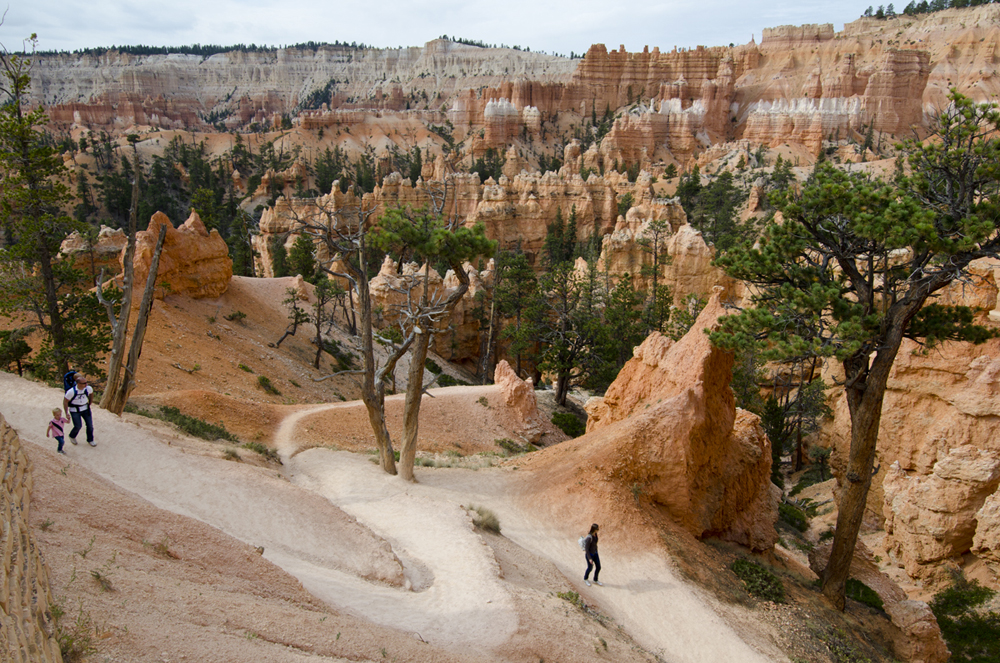
L to R:  Trails into the Hoodoos, Bryce Canyon NP; illegal immigrants crossing the Rio Grande this past December; cactus, Organ Pipe National Monument, showing close-up photo techniques.


Yes, I’ll carry a camera and tripod, and thought I may take a few photographs of willing participants, essentially I’ll be helping participants by holding reflectors and by offering suggestions for improving composition.

HOPE TO HAVE GOOD TIME

The overall intent is to have a good time and to learn more about the art of photography by the mutual sharing of ideas.  I’m hoping my 40-plus years of photo experience will work to the benefit of Airstream participants.


——————————————————————–

This Time Three Years Ago:


*Grand Transitions, Zion NP


———————————————————————


4th ed. Autographed by the Authors

Hiking Shenandoah National Park

Hiking Shenandoah National Park is the 4th edition of a favorite guide book, created by Bert & Janie, a professional husband-wife journalism team. Lots of updates including more waterfall trails, updated descriptions of confusing trail junctions, and new color photographs. New text describes more of the park’s compelling natural history. Sometimes the descriptions are personal as the Gildarts have hiked virtually every single park trail, sometimes repeatedly.

$18.95 + Autographed Copy


Big Sky Country is beautiful

Montana Icons: 50 Classic Symbols of the Treasure State

Montana Icons is a book for lovers of the western vista. Features photographs of fifty famous landmarks from what many call the “Last Best Place.” The book will make you feel homesick for Montana even if you already live here. Bert Gildart’s varied careers in Montana (Bus driver on an Indian reservation, a teacher, backcountry ranger, as well as a newspaper reporter, and photographer) have given him a special view of Montana, which he shares in this book. Share the view; click here.

$16.95 + Autographed Copy


What makes Glacier, Glacier?

Glacier Icons: 50 Classic Views of the Crown of the Continent

Glacier Icons: What makes Glacier Park so special? In this book you can discover the story behind fifty of this park’s most amazing features. With this entertaining collection of photos, anecdotes and little known facts, Bert Gildart will be your backcountry guide. A former Glacier backcountry ranger turned writer/photographer, his hundreds of stories and images have appeared in literally dozens of periodicals including Time/Life, Smithsonian, and Field & Stream. Take a look at Glacier Icons
$16.95 + Autographed Copy


Read Comments | Post a Comment »

West Texas Towns Remain Magnets – And Not Just For Hollywood

posted: January 2nd, 2013 | by:Bert

©Bert Gildart:  Because of an overwhelming amount of work and other obligations I have gotten way behind on my normal blog postings.  That’s to my detriment as postings later serve to trigger my thoughts when I write magazine stories.  In the past few years, blogs have also helped with the creation of books.


JamesDean (3 of 7)

Janie Gildart admires cutout of movie icon James Dean, celebrated in the Paisano Hotel in the west Texas town of Marfa


Despite my negligence, Janie and I have recently visited some fascinating areas in American, areas certainly worthy of comment.  Specifically these include the small dusty towns of Alpine, Fort Davis – and, now, Marfa – all located in the high plains of west Texas. Once these settings were Hollywood magnets.

MOVIE ICONS

Marfa is, according to Internet research,  “…a tiny town in West Texas with just 2,000 residents, about 60 miles from the Mexican border and nearly three hours by car from El Paso. But it’s been the backdrop for some of Hollywood’s most notable movies.”  It was, according to signs posted throughout the town, a site for production of the 1956 epic Giant, which starred James Dean, Elizabeth Taylor, and Rock Hudson.  As well, the town more recently served as the setting for Oscar winners, No Country For Old Men and There Will Be Blood.  Over the years I’ve seen all these movies and was delighted I could tour the town with friends mentioned in my next-to-last posting.


JamesDean (7 of 7) JamesDean (5 of 7) JamesDean (2 of 7)


L to R:  Lee, Janie and Marie; Janie standing in archway of Hotel Paisano, the hotel which served as summer residence during filming of movie “Giant”; Janie examines poster
recalling postage stamp that commemorated famed actor James Dean.


In the summer of 1955, production of the movie Giant consumed Marfa, and vestiges of Hollywood’s presence remain. The Hotel Paisano, where the cast and crew stayed, has a room off the lobby with Giant memorabilia and a DVD of the film on a continuous loop. To further commemorate the presence of Dean, Taylor, and Hudson the Paisano renamed the rooms after the stars.  The hotel continues to retain a décor reminiscent of those times.  The hotel also provides background information on James Dean, who was an icon for many of us back in the ‘60s.

DEAN’S ENDURING FAME

Dean, as many may recall, personified the image of teenage disillusionment, as expressed in the title of his most celebrated film, Rebel Without a Cause.  He also stared in East of Eden, the John Steinbeck novel which focused on Cal Trask, a troubled loner.  Dean’s enduring fame and popularity rests on his leading performances in just these three films. His premature death in a car crash cemented his legendary status

West Texas has always been a Hollywood magnet, and the question, of course, is why?  Critics respond by saying that Texas is a land of limitless desolation and possibilities…  “onto which they [the directors] can project greed, lust and violence.]” And that is exactly what they did, in ways that have endured in these epic films.

David and Lee, Brian and Marie, Janie and I have enjoyed the backdrop of these west Texas towns as we continued to recall memories which we’ve shared over the years. In fact, we’ve enjoyed it so much that we all agree West Texas would work well for another reunion.


——————————————————————————-


THIS TIME FOUR YEARS AGO:

*Ranger Overboard

——————————————————————————-


4th ed. Autographed by the Authors

Hiking Shenandoah National Park

Hiking Shenandoah National Park is the 4th edition of a favorite guide book, created by Bert & Janie, a professional husband-wife journalism team. Lots of updates including more waterfall trails, updated descriptions of confusing trail junctions, and new color photographs. New text describes more of the park’s compelling natural history. Sometimes the descriptions are personal as the Gildarts have hiked virtually every single park trail, sometimes repeatedly.

$18.95 + Autographed Copy


Big Sky Country is beautiful

Montana Icons: 50 Classic Symbols of the Treasure State

Montana Icons is a book for lovers of the western vista. Features photographs of fifty famous landmarks from what many call the “Last Best Place.” The book will make you feel homesick for Montana even if you already live here. Bert Gildart’s varied careers in Montana (Bus driver on an Indian reservation, a teacher, backcountry ranger, as well as a newspaper reporter, and photographer) have given him a special view of Montana, which he shares in this book. Share the view; click here.

$16.95 + Autographed Copy


What makes Glacier, Glacier?

Glacier Icons: 50 Classic Views of the Crown of the Continent

Glacier Icons: What makes Glacier Park so special? In this book you can discover the story behind fifty of this park’s most amazing features. With this entertaining collection of photos, anecdotes and little known facts, Bert Gildart will be your backcountry guide. A former Glacier backcountry ranger turned writer/photographer, his hundreds of stories and images have appeared in literally dozens of periodicals including Time/Life, Smithsonian, and Field & Stream. Take a look at Glacier Icons

$16.95 + Autographed Copy


Read Comments | 3 Comments »

Christmas Past

posted: December 25th, 2012 | by:Bert

MERRY CHRISTMAS

From Bert and Janie


NorthernLights

Merry Christmas


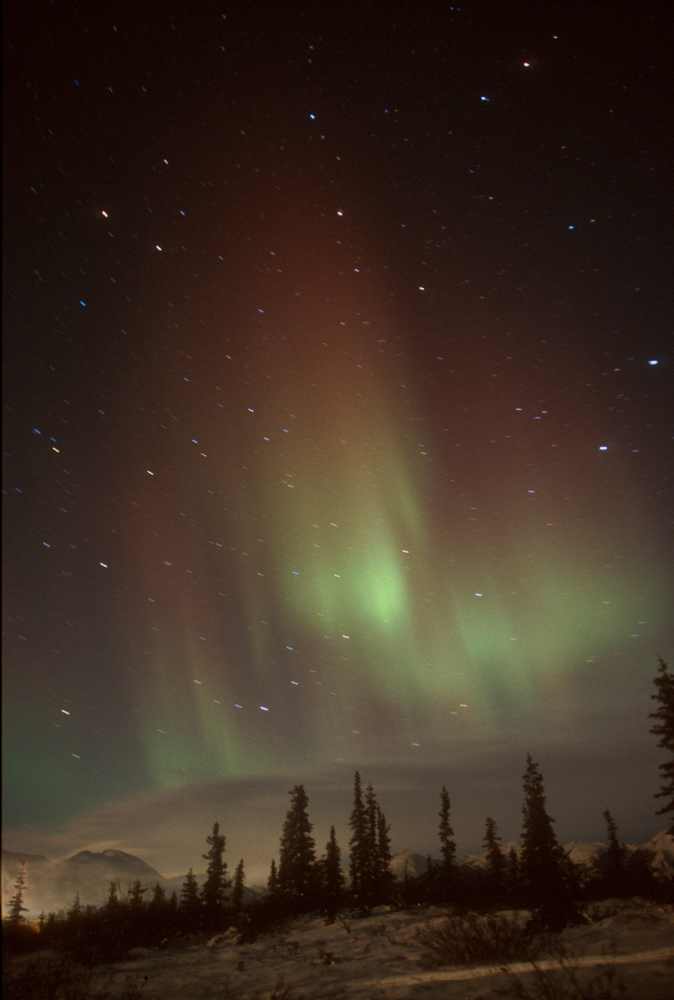
The image of northern lights makes us think of Christmas and of family and good friends we’ve know around the country.   With that thought in mind I’ve posted links to good times from the past.  Most focus on Christmas but several include celebrations from other season.  The list includes not only people in the Arctic but from all over the Lower 48. We wish this group of links linked to all of our friends, but with the exception of a few, these were all taken at Christmas Time.


Merry Christmas From 2010

Bullhead City

Arctic Village

Christmas at Bill & Larry’s (Anza Borrego)

Christmas at Prescott, AZ

Christmas in Bigfork *2008

Christmas Fun in Glacier’s Winter Wonderland (Skiing with Will, Hallie and Granddaughter Hallie)

Poke Salad at the Anderson’s (This was almost like Christmas)

Christmas on the Road

Christmas in Bigfork


AGAIN, MERRY CHRISTMAS TO ALL OUR FRIENDS AND FAMILY MEMBERS WHERE EVER YOU MAY BE.
WE MISS YOU ALL!!


Read Comments | 2 Comments »

Transforming Beauty to Exquisite Beauty

posted: December 12th, 2012 | by:Bert

©Bert Gildart: Fort Davis, Texas, is surrounded by dozens of miles of absolutely gorgeous columnar rock whose evolving beauty was initiated millions of years ago by the rapid cooling of basaltic rock as it intruded onto the earth.  Essentially, that’s geology 101 and it contains information most everyone appreciates as they drive along country road 118 in this high desert landscape.


Fort Davis

Autumn transforms the beauty surrounding Fort David into exquisite beauty.


The rest of the story is brief and continues, explaining that massive forces in the Earth’s core forced molten rock upward, and when it found a fissure — a weakness in the earth surface — it intruded, and began covering the land.  Immediately the molten rock cooled and when it did, it was transformed into huge crystalline structures that soon became all those interesting columns now lining the road and back dropping the old fort itself.  The result is that you have a number of beautiful settings that stand, independent of the season.

But wait!  Now enter fall, and when you see a cottonwood dressed in yellow, one that graces the forefront of a column of dark basaltic rock, then one of the seasons has transformed a beautiful setting to one that is absolutely exquisite.  That at any rate is what I thought as I drove along the almost deserted highway on this morning of 12/12/12).

The setting is magnetic, compulsory if you will, so we’ll be staying yet one more day at the Overland Trail RV Park.  We also want to take a little time out from travel to work on Christmas cards.


————————————————————————-


AIRSTREAM TRAVELS SIX YEARS AGO:


*Sanibel Island, Florida


*Ranger Overboard


————————————————————————-


4th ed. Autographed by the Authors

Hiking Shenandoah National Park

Hiking Shenandoah National Park is the 4th edition of a favorite guide book, created by Bert & Janie, a professional husband-wife journalism team. Lots of updates including more waterfall trails, updated descriptions of confusing trail junctions, and new color photographs. New text describes more of the park’s compelling natural history. Sometimes the descriptions are personal as the Gildarts have hiked virtually every single park trail, sometimes repeatedly.

$18.95 + Autographed Copy


Big Sky Country is beautiful

Montana Icons: 50 Classic Symbols of the Treasure State

Montana Icons is a book for lovers of the western vista. Features photographs of fifty famous landmarks from what many call the “Last Best Place.” The book will make you feel homesick for Montana even if you already live here. Bert Gildart’s varied careers in Montana (Bus driver on an Indian reservation, a teacher, backcountry ranger, as well as a newspaper reporter, and photographer) have given him a special view of Montana, which he shares in this book. Share the view; click here.

$16.95 + Autographed Copy


What makes Glacier, Glacier?

Glacier Icons: 50 Classic Views of the Crown of the Continent

Glacier Icons: What makes Glacier Park so special? In this book you can discover the story behind fifty of this park’s most amazing features. With this entertaining collection of photos, anecdotes and little known facts, Bert Gildart will be your backcountry guide. A former Glacier backcountry ranger turned writer/photographer, his hundreds of stories and images have appeared in literally dozens of periodicals including Time/Life, Smithsonian, and Field & Stream. Take a look at Glacier Icons
$16.95 + Autographed Copy


Read Comments | 1 Comment »

Illegal Aliens? Our Encounter was Unnerving

posted: December 8th, 2012 | by:Bert

©Bert Gildart:  With a look of great concern, Janie suddenly stopped, turned and tried to make hidden pointing gestures.   “There’s a man,” she whispered.    “A Mexican and he’s carrying a backpack.  I think I hear more.  I think we’re in trouble.”

Searching for a parallel experience I don’t believe I’ve seen my wife quite so upset since running into two grizzly bears in Glacier National Park.


AlamoCanyon (1 of 6)

Written in English, Spanish and a local Native American tongue, this is one of many signs alerting visitors to the presence of illegal aliens.


At the moment Janie and I were hiking Alamo Canyon in Organ Pipe National Monument and I had stopped to take a few photographs.  We had completed the goal of our hike which was to follow a one mile long trail to an old homestead used by rancher Birdie Del Miller before creation of the park in 1937.  The old brick structure was about eight miles from the Mexican border and before striking out we had seen a sign near the trailhead (also the Alamo primitive campground) explaining that if we need help we should “push the red button.”  Continuing the sign exclaimed:

“Rescue personnel will arrive shortly to help you. 
Do not leave the area.”

And now I must confess that I too was unnerved, and quickly gathered up my camera gear, joined Janie and began marching out.  Simultaneously we watched the brush along the south side of the wash and again, about 30 yards away we saw the man, as well as the movement of others..  Apparently he didn’t want us to see any more of him, for he began sneaking through the brush.  But we continued to see him, and we saw the constant movement of the brush.  Suddenly, I remembered I’d left my $75 trekking pole, and explained that I needed to run back, quickly  and get it.

“If you do,” said Janie, “I’ll shoot you!”


AlamoCanyon (6 of 6) AlamoCanyon (3 of 6) AlamoCanyon (2 of 6)


L to R:  Three miles on a dirt road to the trailhead into Alamo Canyon; unusual growth of organ pipe along trail; one trail mile to the  old brick home of
Birdie Del Miller, where Janie spotted an illegal Mexican.


An hour later we reported our experience to headquarters, something park officials ask everyone to do when they encounter illegals.  But as we talked with the ranger we began to get the feeling that we were filing a wildlife report, similar, let’s say, to seeing a wolverine in Glacier, which is just a little more than routine.  I also explained that I had left my trekking pole at the rock shelter and said I was going back to get it.

“Your call,” said the ranger – and that set into motion yet another experience about illegals that now has me thinking.

Yes, I retrieved my pole, and when returning to the trailhead I encountered a camper from Nebraska who said that only yesterday he had encountered an illegal Mexican immigrant who was about 20 years old.  Mr. Nebraska said the young man was starving, out of water and needed help.  “That,” said the farmer from Nebraska, “is when we sat him down and fed him.  Then, following his insistence, we pushed the red button, which quickly brought in the Border Patrol.”

And now I’ve got to wonder:  Are we making too much of the danger imposed by these “undocumented immigrants?”  No visitor has ever been hurt.

Most of the illegals must  come from desperate financial situations and are simply looking for a better way of life.  To stop such traffic (and it must be stopped because the park is suffering!)  the solution may be to impose heavy fines on the farmers, ranchers – business people – who hire these illegals – or consider legalizing marijuana, the other reason that illegals risk the hardships of crossing our border.


———————————————————————-


AIRSTREAM TRAVELS FIVE YEARS AGO:

*The Dry Tortugas


———————————————————————–


4th ed. Autographed by the Authors

Hiking Shenandoah National Park

Hiking Shenandoah National Park is the 4th edition of a favorite guide book, created by Bert & Janie, a professional husband-wife journalism team. Lots of updates including more waterfall trails, updated descriptions of confusing trail junctions, and new color photographs. New text describes more of the park’s compelling natural history. Sometimes the descriptions are personal as the Gildarts have hiked virtually every single park trail, sometimes repeatedly.

$18.95 + Autographed Copy


Big Sky Country is beautiful

Montana Icons: 50 Classic Symbols of the Treasure State

Montana Icons is a book for lovers of the western vista. Features photographs of fifty famous landmarks from what many call the “Last Best Place.” The book will make you feel homesick for Montana even if you already live here. Bert Gildart’s varied careers in Montana (Bus driver on an Indian reservation, a teacher, backcountry ranger, as well as a newspaper reporter, and photographer) have given him a special view of Montana, which he shares in this book. Share the view; click here.

$16.95 + Autographed Copy


What makes Glacier, Glacier?

Glacier Icons: 50 Classic Views of the Crown of the Continent

Glacier Icons: What makes Glacier Park so special? In this book you can discover the story behind fifty of this park’s most amazing features. With this entertaining collection of photos, anecdotes and little known facts, Bert Gildart will be your backcountry guide. A former Glacier backcountry ranger turned writer/photographer, his hundreds of stories and images have appeared in literally dozens of periodicals including Time/Life, Smithsonian, and Field & Stream. Take a look at Glacier Icons
$16.95 + Autographed Copy


Read Comments | 2 Comments »

What Would Organ Pipe Ranger Kris Eggle Think Now?

posted: December 5th, 2012 | by:Bert

Chris Eggle Visitor Center


©Bert Gildart:  When you park your vehicle at the Kris Eggle Visitor Center in Organ Pipe Cactus National Monument, the first thing you see is a gravestone (a boulder) adorned with a plaque.  Just above it two hawk feathers have been affixed to the stem of an organ pipe cactus, and when the wind blows, the feathers flutter gently suggesting a moment of great peace.

The marker, the plaque and the feathers are all back dropped by bold letters near the roof of a substantial building and they read Kris Eggle Visitor Center.  The combination of features reminds visitors that not too long ago a man was killed by a drug runner in this National Park Service administered national monument.

On that fate full day Kris Eggle was on the trail of a man who had illegally crossed the U.S./Mexican border less than five miles to the south with the intent of selling drugs.  A radio message from an overhead helicopter had alerted Chris that the man was hiding behind a huge Saguaro, and when Chris turned the man shot and fatally wounded him.


ChrisEggle (3 of 6) KrisEggle (4 of 6) ChrisEggle (2 of 6)


L to R:  Hawk feathers drape from organ pipe branch and often flutter in desert winds; image of Kris Eggle near grave marker; hat, plaque and flowers back dropped by organ pipes.


Today the park recalls the service of the 28 year old ranger not only with a namesake visitor center but with a plaque positioned in front of that Visitor Center.  The plaque reads:

On August 9, 2002
While protecting visitors from harm
United State Park Ranger
Kris Eggle 
Was slain in the line of duty.
His service and sacrifice

To the National Park Service
And the people of this country
Will never be forgotten.

Tragically, the conditions that resulted in Eggle’s death still exist.  Thousands of illegal immigrants still cross the borders bringing drugs, and I know this is true as I overheard a conversation the other day in which a park volunteer described an incident that occurred at Victoria Mine just a few miles from the Twin Peaks Campground.  Five days ago,  Janie and I had hiked to that area so the narration was of particular interest.

The volunteer had been looking down from a ridge when he saw four Mexicans.  Shortly thereafter they picked up huge packs, which later (after being apprehended by park rangers) proved to be filled with drugs.  With a street market for these drugs in the thousands, these men were dangerous.


BullPasture3

Looking towards Mexico from Bull Pasture, an area that remains open.


Sadly the incident is not isolated, and certainly I don’t know the solution.  Nor do I know what Kris Eggle would think.  The only thought I have is to create a penalty that would be so severe for such transgressions that illegal immigrants of all kind will give more serious thought to stealing across the border here in Organ Pipe.

This park contains natural history features found nowhere else in North America and they are so unique that Organ Pipe has been designed by UNESCO as a World Heritage Park.  Right now over 60 percent of the park is closed to Americans, and that is a travesty.


—————————————————-


AIRSTREAM TRAVELS SIX YEARS AGO:

*Ranger Overboard


4th ed. Autographed by the Authors

Hiking Shenandoah National Park

Hiking Shenandoah National Park is the 4th edition of a favorite guide book, created by Bert & Janie, a professional husband-wife journalism team. Lots of updates including more waterfall trails, updated descriptions of confusing trail junctions, and new color photographs. New text describes more of the park’s compelling natural history. Sometimes the descriptions are personal as the Gildarts have hiked virtually every single park trail, sometimes repeatedly.

$18.95 + Autographed Copy


Big Sky Country is beautiful

Montana Icons: 50 Classic Symbols of the Treasure State

Montana Icons is a book for lovers of the western vista. Features photographs of fifty famous landmarks from what many call the “Last Best Place.” The book will make you feel homesick for Montana even if you already live here. Bert Gildart’s varied careers in Montana (Bus driver on an Indian reservation, a teacher, backcountry ranger, as well as a newspaper reporter, and photographer) have given him a special view of Montana, which he shares in this book. Share the view; click here.

$16.95 + Autographed Copy


What makes Glacier, Glacier?

Glacier Icons: 50 Classic Views of the Crown of the Continent

Glacier Icons: What makes Glacier Park so special? In this book you can discover the story behind fifty of this park’s most amazing features. With this entertaining collection of photos, anecdotes and little known facts, Bert Gildart will be your backcountry guide. A former Glacier backcountry ranger turned writer/photographer, his hundreds of stories and images have appeared in literally dozens of periodicals including Time/Life, Smithsonian, and Field & Stream. Take a look at Glacier Icons
$16.95 + Autographed Copy


Read Comments | Post a Comment »

Organ Pipe’s Humane Borders — But Are they Too Humane?

posted: December 2nd, 2012 | by:Bert

©Bert Gildart:  Shortly after Don and Nancy Dennis and I turned our bicycles onto the Puerto Blanco road in Organ Pipe National Monument, a patrol car passed us to be followed a few moments later by a surveillance helicopter. Quickly they assessed our presence, and satisfied that we were not undocumented immigrants or drug runners, they accelerated on.


PuertoBlanco (9 of 5)

Only five miles of the 50-mile-long Puerto Blanco road are open now to legal American residents. Unfortunately the rest is closed.


For a while, we watched the helicopter, for it seemed focused on a low pass in the surrounding mountains.  Back and forth the helicopter flew, and my companions and I discussed the difficulty of their work as we rode.  If  immigrants — or drug runners — were camouflaged, it seemed they could evade rangers and the border patrol, and apparently many do, for the internet suggests that hundreds stream through the park on an annual basis.  On a national basis, along our entire border, the internet reports that over a million Mexicans attempt to enter the United States — illegally. (Note: I know my opinion on this seems to shift, but conditions here are persuasive and in your face. Other thoughts may be needed now for balance.)

CLOSED TO LEGAL AMERICANS

America has its problems and this beautiful park epitomizes the complexities, for it has experienced some tragic moments.  In 2002 a drug runner killed a much admired ranger and, then, over the years undocumented immigrants  have perished from lack of water.  That, too, is tragic, but of course, they should not have been here in the first place.  Because of their activities vast portions of this once accessible park have been closed, and that doesn’t seem right, for Organ Pipe is such a unique portion of America that it has, in fact, been declared a world heritage center, meaning that there is no place else in the world like it.  (Night Photography in Organ Pipe.) But as unique as this park may be, sections are considered dangerous and you can no longer  visit these  beautiful sections of this the Sonoran Desert.


PuertoBlanco (11 of 5) PuertoBlanco (24 of 5) PuertoBlanco (22 of 5)


L To R:  Compassionate water tanks help create “humane borders.”  Sign at water tanks about man who perished.  Yet another sign at water tanks noting that Americans create humane border crossing, essentially for illegal Mexicans who depart Mexico because of impoverished working conditions.  That’s tragic, but the population of America has now increased by several million, and in many cases, their problems now become ours.


The bike ride that Don, Nancy and were making illustrates one of the restrictions – and some of the accommodations we’ve had to make.  Fifteen years ago Janie and I drove this rode and at the time the entire 50-mile-long length of the Puerto Blanco road was open, but today, except for the first five miles, the road is closed.  Percentage wise, that means that 69 percent of this park is closed, including beautiful Quitobaquito springs, which Janie and I toured several years ago, but only with an armed escort.

HUMANE BORDERS

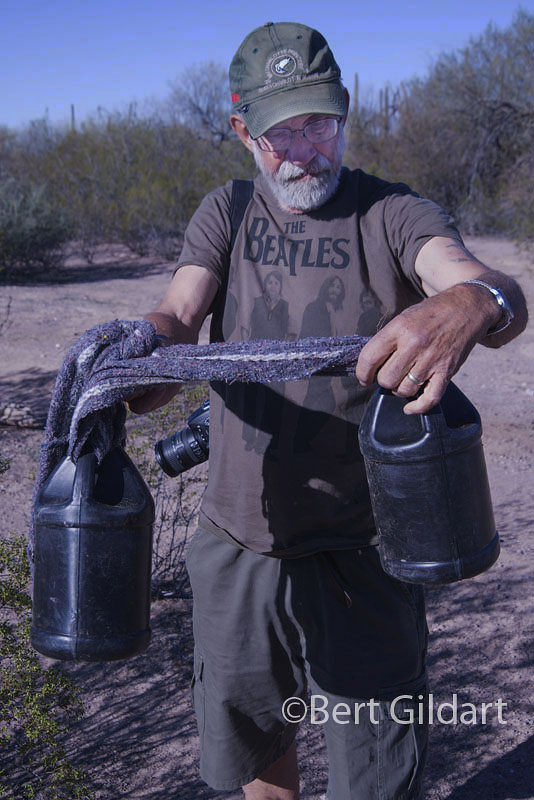
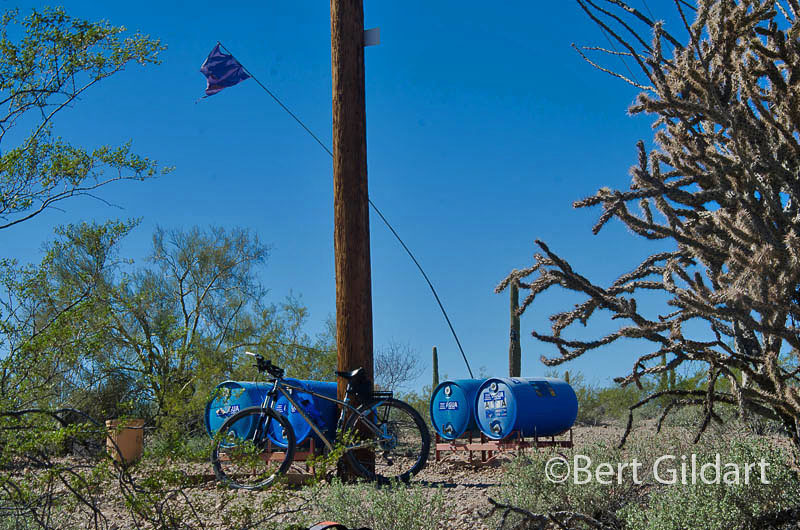
After about an hour’s ride, Don, Nancy and I came to a gate closed sign and to adjacent accommodations offered by small shelters roofed with ocotillo.  While we ate our lunch, the helicopter continued its surveillance.  We then retraced our route, stopping this time at a series of “compassionate water tanks” located about 100 yards off the road. A huge blue flag pinpointed their presence, and we tested the fullness of the tanks by attempting to inch them up, but they wouldn’t budge, so they were obviously full of water.

Water tanks were here several years ago when I visited the area, so one of the fundamentals of  human needs has been met, and for this reason it is appropriate to say that our borders – as the associated signs declare – are “Humane Borders.” And that is an American virtue.


PuertoBlanco (20 of 5)

Don and Nancy beneath roof of ocotillo shelter, representing the end of the road for us. Over half of the park lies beyond, but it is closed to Americans because of the danger posed by illegal immigrants.


But beyond that I believe the U.S. needs to protect its own resources.  The population of America is increasing exponentially, and more and more pressure is being placed on our limited resources, national parks being among those resources.  Superintendent Lee Baiza (whom I interviewed several years ago for a story about Organ Pipe) is doing a wonderful job, but he has his challenges.  Everyone should wish him the best.  I hope I can do so again, but in the meantime, I will continue to enjoy as much of this beautiful park as is possible, and hope to show images of Organ Pipe over the next few days. Legal residents are being prohibited from seeing so much of this park and that is a tragedy.


AIRSTREAM TRAVELS FIVE YEARS AGO:

*Tampa Florida


————————————————————————————————–


4th ed. Autographed by the Authors

Hiking Shenandoah National Park

Hiking Shenandoah National Park is the 4th edition of a favorite guide book, created by Bert & Janie, a professional husband-wife journalism team. Lots of updates including more waterfall trails, updated descriptions of confusing trail junctions, and new color photographs. New text describes more of the park’s compelling natural history. Sometimes the descriptions are personal as the Gildarts have hiked virtually every single park trail, sometimes repeatedly.

$18.95 + Autographed Copy


Big Sky Country is beautiful

Montana Icons: 50 Classic Symbols of the Treasure State

Montana Icons is a book for lovers of the western vista. Features photographs of fifty famous landmarks from what many call the “Last Best Place.” The book will make you feel homesick for Montana even if you already live here. Bert Gildart’s varied careers in Montana (Bus driver on an Indian reservation, a teacher, backcountry ranger, as well as a newspaper reporter, and photographer) have given him a special view of Montana, which he shares in this book. Share the view; click here.

$16.95 + Autographed Copy


What makes Glacier, Glacier?

Glacier Icons: 50 Classic Views of the Crown of the Continent

Glacier Icons: What makes Glacier Park so special? In this book you can discover the story behind fifty of this park’s most amazing features. With this entertaining collection of photos, anecdotes and little known facts, Bert Gildart will be your backcountry guide. A former Glacier backcountry ranger turned writer/photographer, his hundreds of stories and images have appeared in literally dozens of periodicals including Time/Life, Smithsonian, and Field & Stream. Take a look at Glacier Icons
$16.95 + Autographed Copy


Read Comments | Post a Comment »

Indian Hill – A Journey Into the Past

posted: November 22nd, 2012 | by:Bert

©Bert Gildart: On the ceiling of a massive rock deep in a setting known as Indian Hill, smoke spots were everywhere.  The setting was cozy, warm and seductive, prompting Tony Feathers to comment about the romance of the area. “Imagine lying here beside a cozy fire.  It’s cold but you’re snug in your sheep skin furs.  The children are asleep, and you’re with the right lady.”

Tony and his significant other, Betty, laughed and then we wandered around, looking for further evidence of this bygone era. Both work winters in Anza Borrego Desert State Park (Tony is a musician –LISTEN) and like me, they are fascinated with bygone Native American cultures.


CaveDwelling

Judging from smoke on the ceiling of this boulder, Natives burned many fires.


Venturing to Indian Hill is not for everyone.  In very general terms  our journey into the past took us up Mortero Wash, then along a 4-wheel drive to a safe spot large enough to squeeze my pickup into the surrounding cholla forest.  From there we hiked several miles toward some of the the most extensive boulder fields I have ever seen.  It was here among these granite boulders that the Kumeyaay Indians made their living over a period of hundreds of years.  The evidence was everywhere and it assumed different forms.

As we wandered we counted dozens of morteros. These large rock  pockets were created over the years through the pounding of agave and other plant materials into a flower, later used for the making of bread.

In some places we also found pictographs, suggesting a spiritual connection of the group with the Great Unknown.  Though no one can say for sure what the symbols represent or which members of the tribe created them, from other sites I know experts believe the sun was a common motif and that a “Shaman,” or spiritual leader, might have created the figures.  Likely some of the pictographs here represented the sun.

We continued our wanderings finding several boulders where smoke patterns were thick.  And then we found the massive boulder pictured here. By our calculations it measured about 120 feet by 60, meaning it would have accommodated three or four Airstream trailers similar to ours.


Morteros IndianHills Pictographs


L to R: Tony Feathers at morteros, boulder fields near Indian Hill, pictographs.


Casting around we found several small rocks on which to sit and tried to absorb the feelings of the time.  Unlike the Kumeyaay our day was free of strife and work, and here in this place and at this moment of time we felt an immense separation from all that was secular and mundane.  We imaged a gentle sun would shine forever, that the winds would be light and warm, that hunting would be productive, and that all would remain bright and good.

Reluctantly we returned to reality, leaving behind national treasures  we hoped would continue to be valued by all visitors.


AIRSTREAM TRAVELS — AT AND AROUND THANKSGIVING:

*Thanksgiving Pardon

Museum of the Cherokee and Thanksgiving salutes

Turkeys For Thanksgiving?

Lessons From Cades Cove (Great Smokies)


Snow Falling On Cedars


————————————————–


4th ed. Autographed by the Authors

Hiking Shenandoah National Park

Hiking Shenandoah National Park is the 4th edition of a favorite guide book, created by Bert & Janie, a professional husband-wife journalism team. Lots of updates including more waterfall trails, updated descriptions of confusing trail junctions, and new color photographs. New text describes more of the park’s compelling natural history. Sometimes the descriptions are personal as the Gildarts have hiked virtually every single park trail, sometimes repeatedly.

$18.95 + Autographed Copy


Big Sky Country is beautiful

Montana Icons: 50 Classic Symbols of the Treasure State

Montana Icons is a book for lovers of the western vista. Features photographs of fifty famous landmarks from what many call the “Last Best Place.” The book will make you feel homesick for Montana even if you already live here. Bert Gildart’s varied careers in Montana (Bus driver on an Indian reservation, a teacher, backcountry ranger, as well as a newspaper reporter, and photographer) have given him a special view of Montana, which he shares in this book. Share the view; click here.

$16.95 + Autographed Copy


What makes Glacier, Glacier?

Glacier Icons: 50 Classic Views of the Crown of the Continent

Glacier Icons: What makes Glacier Park so special? In this book you can discover the story behind fifty of this park’s most amazing features. With this entertaining collection of photos, anecdotes and little known facts, Bert Gildart will be your backcountry guide. A former Glacier backcountry ranger turned writer/photographer, his hundreds of stories and images have appeared in literally dozens of periodicals including Time/Life, Smithsonian, and Field & Stream. Take a look at Glacier Icons
$16.95 + Autographed Copy


Read Comments | Post a Comment »

What Happened? This Brobdingnagian Landscape May Blow Your Mind

posted: February 8th, 2012 | by:Bert


©Bert Gildart:  If there is a boulder field in Joshua Tree or one of the other national parks that has a greater “wow” factor  than does this one,  I can’t recall it.

We saw this immense scattering or rocks while hiking in Anza Borrego Desert State Park’s Indian Hill country.  This field of rock stretched for half a mile, and if you look closely at the associated photograph, you’ll see some of the rocks are rounded while others assume a more elongated configuration.

What happened?

I am not a geologist but after seeing this pile of rocks, this “Brobdingnagian landscape” as one author called it — referring to Gulliver’s travels (by Jonathan Swift) through the land of giants – I had to buy several books and try to recall college courses.


IndianHill-13

Boulder field in Anza Borrego that may blow your mind.


CLICK FOR LARGER IMAGE AND TO BETTER SENSE THE MAGNITUDE


Synthesizing information from a geology book authored by Park Ranger Paul Remeika, my understanding is that about 100 million years ago various forces pushed a molten mass to the earth’s surface and into the overlying sedimentary rock.  Depositions of these sediments preceded this molten mass by millions of years and were laid down from materials transported by inland seas.

As the granite connected with the pre-existing sedimentary rock it solidified and then crystalized, which tends to set up areas of weakness.  These areas take the form of “joints,” or horizontal and vertical fracture lines.  With time the process of erosion further weakens the joints and they fragment into huge granitic rock masses.  Wind, rain, freezing and thawing further modify their appearance whereupon elongated rocks become smaller and more rounded.

Similar processes have occurred in other areas of the park such as at Culp Valley.  Particularly impressive were the fields of boulders I saw several weeks ago off the trail and above Alcoholic Pass.

But nothing I’ve ever seen seems to match the Brobdingnagian landscape near Indian Hill, which simply blew my mind.


—————————————————————————


AIRSTREAM TRAVELS THREE YEARS AGO:


*Desert Five Spot


ADS FROM AMAZON AND GOOGLE AUGMENT OUR TRAVELS:


Read Comments | Post a Comment »

Biking Fanatic at Borrego Springs

posted: January 26th, 2012 | by:Bert

OneThousandMiles

No decimal points here.

©Bert Gildart: There are no decimal points in the picture of numbers on my bike’s odometer, and please don’t interpret the posting as one of simple vanity, for there’s information associated with the mileage numbers that might be of value to readers.

Simply said, biking can lower blood pressure. I know.  Just a few months ago mine was approaching dangerously high levels. That’s something I’ve never had to worry about before, and the doctor’s advice was to find something I enjoyed and then do it at least four to five times a week.

“Keep on with the ‘heroic’ weekend activities,” said my doctor, “but make exercise a daily component of your life.” Adding, “It’s more important as you get older.”

And so, about three months ago I bought a state of the art road bike (I’ve also enjoyed mountain biking here), and with it have been following the doctor’s advice down here in Anza Borrego State Park. But, now, because this is intended to be a posting about biking, let me give you some specifics.

NOT CHEAP

First, biking, the kind  that retains enthusiasm, is not cheap.  I bought my road bike from Bikes Direct, an on-line store recommended to me by a friend who flirts with cycling professionalism. Some say I lucked out, that one needs to be properly sized. But I disagree, and do so because I followed the on-line instructions carefully, and because I had a good friend who knew his stuff.

I paid close to $1,600 for my Motobecane, but was told that I was almost doubling my value by ordering on-line.

My LeChampion Motobecane road bike is carbon fiber and it weighs 15.5 pounds.  It’s not an entry level bike but neither is it a Lance Armstrong bike, which probably costs over $5,000.  But it is a bike intended to sustain enthusiasm, because you can “Just cruise along.”  When I first started I was averaging about 13 mph, but now average about 19.


SPANDEX—BUT OF COURSE!

Of course, once you make the initial investment, you’ll then need a good helmet (better to look like a mushroom than wind up like one), good padded gloves, various types of clothing (Spandex?  Yes, I’ve got a pair), padded shorts, color coordinated socks – and a good pair of cleated riding shoes.

Bike1

Motobecane bike ordered from Bikes Direct. Logos clearly visible by enlarging image.

Cleated shoes snap into the pedals and enable you to power on the upstroke as well as on the down stroke.

Of course you’ll need a bit of practice learning to break free from the pedals, and the advice given me was to find a nice soft field of grass, and practice there, as you’ll most like take a few falls before learning the technique.  I did!

Complementary gear will most likely cost another $300, but what’s your health worth?

Next, of course, you need to find a bike-friendly area, and my home near Bigfork comes close, though it is not perfect.  Ninety five percent of the drivers back home go out of their way to accommodate cyclist, but the other 5% drive with fire in their eyes and a determination to run bikers off the road.

CYCLING FANATICISM

Not so in Borrego Springs, where it seems as though there are as many bike riders as there are motorists.  Here, there are riding clubs of various types, to include a tandem bike club.  There are long-distance riding clubs.

And, so, Janie and I have found a haven for the winter activities we enjoy, and the bottom line for me is that my blood pressure is now like that of someone 30 years my junior, making my investment seem to have been a wise on.

One thousand miles?  Sure many down here double and even triple that, but I’ve reached my objectives, and suspect some would say I’ve become a fanatic.


I don’t mind.


—————————————————————————–


AIRSTREAM TRAVELS THREE YEARS AGO:

*My Years Favorite Photos


ADS FROM AMAZON AND GOOGLE AUGMENT OUR TRAVELS:


Read Comments | 1 Comment »

Tarantulas & Anal Sphincters at Peg Leg? Sometimes

posted: December 1st, 2011 | by:Bert

©Bert Gildart:  Though I am working on a book about Montana, the door to our Airstream is wide open allowing me to peer through the screen and maintain a vigil for migrating tarantulas.  Late November and early December is their mating season, so the prospect could be good. I have never seen one in the wild, but that could be because we’ve never been here so early.  Mind you, not everyone around me is enthusiastic about this prospect, but as a bonafied desert rat, such an event will be even more satisfying than knowing that the Steelers are playing in the Super bowl.

SOLAR POWERED

At the moment, Janie and I are housed in our Airstream in a barren spot of Anza-Borrego Desert State Park known as Peg Leg. Once again, this may not be a satisfying experience for everyone, and I hesitate to say anything good about the area for fear more people will show up.

pegleg-1

At Peg Leg solar panels are a must


For us, Peg Leg has come to symbolize peace, some freedom and a place where people seem to live and let live.  We’ll be here for several months and because of some breakdown (that’s what it has to be!) in the economic system, camping here is free, but to enjoy the area and to not piss off one’s neighbors, one must have solar panels. We have six, two that are portable, and four on top of our Airstream.  As well, we have four batteries in our trailer.

KEEPING BUSY – NO PROBLEM

Other than work, Janie and I find much to occupy ourselves. We read and watch old movies powered by our inverter.  As well we hike, ride our bicycles and explore a multitude of features left by the historic people who preceded us (Peg Leg is one).  We also enjoy evening get-togethers ‘round a fire and then socializing with people whom we have known over the years.

pegleg-2

Most surrounding us are now gone, but we're here for the long term


We were delighted to see that Ted and Carol of British Columbia were back and are looking forward to Don and Nancy of Vermont showing up. Mike the Mechanic is here, too, and several years ago he helped to demystify a life with solar panels.

THE ANAL SPHINCTER

As well, we watch for tarantulas and scorpions and publicize such creatures whenever we find one.  We hope their presence will keep the neer-do-wells away. Though we don’t see many showing up here, we do get ‘em.  One such man ran his humongous generator non-stop  ’round the clock, flew his model airplane (against all rules), and built a fire directly on the ground, which is also against the rules.  Before leaving, the man informed me that I was a “poopy kind of person.”  In turn, I informed him that he was a “First Class Anal Sphincter.”
That’s the kind of person I hope will be intimidated by the prospect of seeing a tarantula.


—————————————————————————


THIS TIME LAST YEAR:

*Bosque del Apache


ADS FROM AMAZON AND GOOGLE AUGMENT OUR TRAVELS:


Read Comments | 5 Comments »

Kootenai Falls — Impossible to Float?

posted: August 13th, 2011 | by:Bert

©Bert Gildart: Though Kevin Bacon and Meryl Streep may have navigated Kootenai Falls in the movie “River Wild,” few others have successfully run the rapids.  From a point just above the falls the river drops at a rate of 90 feet per mile.  If a floater survives the rapids, they must then contend with the falls, which drops 30 feet at its most extreme.


Kootenai-20

Some have attempted to kayak the falls and been successful, but not all.


Early explorers recognized the dangers inherent in the falls and choose to portage.  In 1808, the upper end of the falls stopped David Thompson and four other men traveling in a large canoe, at which they decided to portage.  Fifteen trips were required to pack equipment around the falls, each of which took one and a half hours.

SOME OF MONTANA’S FIRST EXPLORERS

Thirty years later, Father Pierre DeSmet, a Jesuit Missionary, arrived at the same conclusion, though his choices were limited as he was progressing up the river rather than traveling down.  DeSmet took eight hours to journey around the falls, mentioning in his journals that he made the crossing in a quadrapedal position, meaning he was crawling on all fours.


KootenaiFalls-13 Oregon Grape-10


Perhaps the most challenging aspect of visiting the falls is crossing the bridge; Kootenai River creates a warm micro-climate that speeds transition from flowers to berries, as in this Oregon Grape.


Today, thanks to creation of a Kootenai Falls County Park, established in 1991, all aspects of this beautiful falls can be enjoyed.  To look into the mouth of the falls, modern-day explorers will have to cross a swinging bridge, and that may be the most challenging aspect of the outing. But the rewards are immense.

ANCIENT ROCKS

Kootenai River flows through a narrow gorge engulfed by ledges of ancient sedimentary rock.  Rocks date from the Precambrian era and are 1.5 billion years old. Once they formed part of a great inland sea and today preserve ancient blue-green stromatolites, still visible as concentric rings.


Today, the falls are one of the main attractions in the Troy/Libby area, and a challenge to river rafters and kayakers.  Several have successfully kayaked the falls – but others have attempted – and failed.


KootenaiFalls-14

One of the major attractions in the Troy/Libby area


And now a head’s up.  Janie and I will be joining other Airstream friends for a six-day float down one of Montana’s Wild and Scenic River. We will drive to Fort Benton, spend one night in the Grand Union Hotel and then the next day launch canoes into the Missouri River.  This is the same section about which Captain Meriwether Lewis waxed so eloquent.  When we return, we will be posting images and blogs about our journey. The float provides much beauty, and glad to say, none of the near impossible challenges provided by Kootenai Falls.


——————————————————————————-


THIS TIME LAST YEAR:

*Klondike Gold Field


ADS FROM GOOGLE AND AMAZON AUGMENT OUR TRAVELS


Read Comments | 1 Comment »

Lewis & Clark Caverns, Montana’s First State Park

posted: July 28th, 2011 | by:Bert

©Bert Gildart: Almost the moment we stepped onto a stone stairway that would take us deeper into the Lewis and Clark Caverns, the lights went out.  Few had head lamps, so our descent was spooky. Janie and I both grabbed hard to the railing, and tried to maintain our balance as we descended the slippery stairs.

Laurie Koepplin, our tour guide and an employee for the Montana Department of Fish Wildlife and Parks, joked, explaining we were experiencing conditions similar to two ranchers who saw the caverns in 1892.  “Imagine,” she suggested, “that all you had was candlelight.”


L&C-Caverns-1

Deep in Lewis and Clark Caverns


Though most found the conditions intriguing, the slippery rock and tight space concerned one individual who elected to turn around. Coincidentally, we had reached “Decision Rock,” a point at which guides customarily  ask visitors if they’re apprehensive.  “Everyone OK?” queried Koepplin.  “Nothing to be ashamed of. You’ll get a full refund if you need to go back.” Despite the darkness only one person turned back.

ADVENTURE IN THE DARK

Our adventure in the dark was short lived, and soon power was restored.  Picking up from her introduction, which included information about the Townsend Big Eared Bats flying overhead, Laurie explained that though Lewis and Clark passed nearby, they never mentioned the caverns in their journals.  “Most likely,” she said, “it’s because they never saw them.”


L&C-Caverns-2 L&C-Caverns-5 L&C-Caverns-6


Though Indians knew of the caverns, the two ranchers became aware of them during a November hunting trip.  Cold air had flushed out the warm air, creating a funnel of steam that stirred the men’s curiosity.  No such funnel occurred in the summer when Lewis and Clark passed through the area.  What’s more the “discovery tunnel” is small and is located at a relatively high elevation, making the caverns unique.  “Most caverns,” said Koepplin, “are down lower and tend to run more horizontally than do these.”

MONTANA’S FIRST STATE PARK

Eventually entrepreneurs began offering tours into the caverns, but in 1908, the federal government assumed management, and then, in 1935, the caverns became Montana’s first state park.  As a state park, sophisticated tours developed — similar to the one we joined yesterday.


L&C-Caverns-4

Darci and Rob Smith of Kansas ascend into a main cavern


Our tour was several hours long and as we continued our descent, the formations seemed to become more and more spectacular.  As we progressed, Koepplin pointed out stalactites and stalagmites — those pointed columns of rock that either ascend or descend vertically.  We saw ponds of water refracting colors that appeared brilliant in the artificial lighting, and we saw formations that appeared like popcorn, flowstone and “cave bacon.”

Though the caverns are the main attraction of the park, other features exist, and we have signed up for several nights of camping. We want to hike the park’s trails, and watch as lighting dramatizes the beautiful Jefferson River, up which Lewis and Clark traveled so many years ago.


———————————————————————————————-


THIS TIME LAST THREE YEARS AGO:

*Global Warming


ADS FROM AMAZON AND GOOGLE AUGMENT OUR TRAVELS:


Read Comments | Post a Comment »

Too Beautiful To Keep? — A Fish From Montana’s Big Hole River

posted: July 5th, 2011 | by:Bert

©Bert Gildart: “It is the largest brook trout I’ve ever caught in this part of Montana,” said Chuck Robbins. “Maybe not the longest, but certainly the heaviest.  I think it may go three pounds.”


ChuckRobbins-5

Chuck Robbins, guiding in and around the Big Hole River for over a decade.


For the past few days Janie and I have been touring Big Hole River country with Chuck and Gail Robbins, good friends whom we have know for almost a decade.  The couple lives in Dillon, which is the small town in the southwestern part of the state where Chuck bases himself as a fishing guide.  Because the Big Hole is such a fabled fishing river, I have been anxious to learn all I can about the area and would be hard pressed to find a more knowledgeable couple – or a better guide than Chuck.

STILL REMOTE

Because the river has been so high for this time of year, we have been bidding our time making short driving trips and have reconfirmed our convictions that this is a beautiful part of the state.  Dotted with but a few small towns such as Wisdom, Divide, and Jackson the area remains some of the state’s most undeveloped country.  At times the area can be brutally cold and extremely hot, and that may be the country’s salvation, preventing it from such ungodly over development as is now happening in other parts of the country.


PumpkinBugger-1 BrookTrout-3 ChuckRobbins-3


L to R: Art Bivens Conehead Pumpkin Woolly Bugger; brook trout; Chuck Robbins with largest brookie he has caught in Montana.


The country is high and is surrounded by lofty mountains such as the Pioneers and Beaverheads. It is cut by the 7400 foot-high Big Hole Pass. Add to that the Big Hole River, and this becomes some of the state’s most intriguing country, particularly because of its fishing.

According to Chuck who has made precise map measurements, the Big Hole flows for 188 miles. It begins near Idaho at Skinner Lake and finally empties in the Jefferson at Twin Bridges, Montana.

NOT JUST A WOLLY BUGGER

Because of the high water, Chuck felt we should float a 15 miles upper section between Fish Trap to the East Bank of the Fishing Access Site.  I was particularly anxious because we were still finding salmon flies in the bushes. Occasionally they’d take to the air and then hit the water, causing trout to go mad.  Though the waters were unusually high and murky for this time of year, I made my first tentative casts with much anticipation, and was rewarded almost immediately when several small brookies hit the Mepps spinner I had attached to my outfit. It was not, however, until we stopped near a small feeder stream that I finally landed one.  But it was small, and nothing like the one Chuck caught later in the day.

Chuck , who was also manning the paddles, did little fishing until we stopped near Deep Creek,  a point about midway along the river.  Here, several more feeder streams entered the Big Hole and Chuck began by affixing what looked like a “Woolly Bugger” to his line. Chuck, who is thorough, said that the fly was most properly called the Art Bivens Conehead Pumpkin Woolly Bugger, “After,” Chuck said, “the man who first tied it.”

MAYBE WE’LL CATCH IT AGAIN

Chuck wasted little time. He made a few tentative casts, and then within a few minutes landed several  few medium sized fish.  Generally, he releases most all the fish he catches but because Janie and I both like fish dinners, we saved several.  Chuck then cast again, and this time I saw his rod arc sharply.  Apparently he knew he had something different on his line, as he played it slowly, bending his body left and right and keeping the line tight. He played the fish for almost five minutes, finally landing it.


BrookTrout-4

Too Beautiful to Keep


Too Beautiful to Keep!!

The fish was large, and Chuck said it was the largest he had ever caught in Montana. We both admired it and then Chuck said it was too beautiful to keep and so we released it.  We watched it as it regrouped, then suddenly, with a flick of its tail, reentered the swift waters of the Big Hole, where it made its home.

“Some day,” said Chuck with much satisfaction, “we might just catch  it gain. ”


—————————————————————————-


THIS TIME THREE YEARS AGO:

*Nikon Strobes & Flower Photography

ADS FROM AMAZON & GOOGLE AUG*MENT OUR TRAVELS:


Read Comments | 1 Comment »

Bannack, Montana’s First Capitol and One of the State’s Best Camprounds

posted: June 28th, 2011 | by:Bert

©Bert Gildart: Bannack provides some of the state’s best camping and is the spot we’re calling home for the next night or two.  The settlement was founded on July 28, 1862, when John White and other members of the “Pikes Peakers” discovered gold in Grasshopper Creek, a small flow of water we’re now watching carefully to make sure we don’t get flooded out.

Bannack2

Gold was first discovered in Montana on Grasshopper Creek, which gave rise to Bannack


Many historic preservationists believe Bannack is one of the West’s best preserved old ghost town.  It was Montana’s first Territorial Capitol.


THE LONG DROP

Little changes here and the old structures I’ve enjoyed photographing over the years still remain, appearing quite functional. Throughout, old wagons stand ready to transport gold, while buildings appear inhabitable. The old jail, Montana’s first, appears ready to accommodate thieves, drunks and murderers, while up on a prominent hill, in plain site, is a lone gallows, and it, too, appears quite functional. There, as every high school student learns in courses on Montana History, Sheriff Henry Plummer took the long drop.

Plummer arrived in Bannack in 1863, and because he was glib and persuasive, he became sheriff. What was not known by the town’s citizens is their sheriff may well have been the leader of an outlaw gang.


Gallows-1 JohnPhillip-5 OldWagon-4


Janie, who has been misbehaving, hikes to same gallows from which Henry Plummer made the “Long Drop;”  John Phillip presents lessons on gold panning; old wagon adds sense of timelessness to Bannack.


But eventually a man about to be hung pointed a finger at Henry Plummer prompting the Vigilantes to gather and meditate heavily. Helping in their thinking was lots of liquor and they soon concluded Plummer was guilty. Though their sheriff begged and pleaded—even offered to tell where $100,000 of gold was buried—the group ignored him. Story has it that Plummer’s final words were, “Just give me a good drop.”

From here, we’re heading to visit a good friend who guides on the Big Hole River.  However, the Big Hole is in flood stage so our fishing may have to wait. We’ve learned to simply take what comes.

————————————————————–


THIS TIME THREE YEARS AGO:

*Traveling the ALCAN

ADS FROM AMAZON AND GOOGLE AUGMENT OUR TRAVELS

Read Comments | 1 Comment »

Are Birds Political Creatures? You Bet!

posted: March 6th, 2011 | by:Bert

©Bert Gildart: Once again the bird feeder is capturing our attention, providing humor and sometimes creating philosophy, so easy to do on these boring winter days when winds blow and temperatures hover well below freezing.

Philosophically, we have concluded there are four different groups that gather at our feeder: the Republicans, Democrats, the Self-Assured Independents, and the Evil Ones. And  we have a rationale for each.

Doves, we’ve concluded, are the Democrats, tending to get along and allowing others of all stripes to gather along the feeding platform. At least they do so until seed on the platform begins to diminish, then realizing they may go hungry, they begin to bicker. But as long as the food lasts, they’re cooperative.


DovesFlickers-1

Flickers (perched atop feeder and descending tree) are the Republicans; doves the Democrats


Red-shafted flickers are the Republicans, and by their actions seem to express a belief in power of the individual.  Flickers never forget that one cold winter day the food could all be gone; and they have no compunctions about driving others away with their God-given sharp beaks, even those of their own kind. If they could speak, they might proclaim they had succeeded at the feeder because they worked harder than their competitors.

Pileated woodpeckers are the Self Assured Independents, and can be that way because of their size, strength and coordination. At our feeder, they’re the golden eagles. In the world of humans, they would be a Jack Dempsey, a Muhammad Ali, standing confident, even when the suet runs low. When it’s gone, pileated woodpeckers fly away, believing, it seems, that they will find other sources.

Pileated-1

Pileated woodpecks feed with confidence at our feeder; they're the Independents


And now we have our occasional Evil One, the squirrels, who come to our feeder and do whatever they have to do to capitalize on what’s there. They break the windows of the feeder, scatter seed all about, even take up residence until we shoo them away. They’re the Bernie Madoffs, the Kenneth Lays who sometimes bully their way to our feeder.

But what, we ask ourselves, is going to happen should we leave or – heaven forbid – should we run out of money to buy suet and bird feed? There will be a shut down and unless our birds can find other sources, some could perish.

Squirrel2

Red squirrels are the Bernie Madoffs at our feeder, creating havoc


So that’s how we spend boring winter days in Montana, talking about birds and their party affiliations, realizing, of course, that we need much more study to add distinction to these thoughts.

I’ll bet that Gildart blog readers are glad that winter here is starting to wind down.


————————————————————————–


THIS TIME THREE YEARS AGO:

*Missions of San Antonio

*And For Some Good Down Home Advice From an Old Farmer

ADS FROM GOOGLE AND AMAZON AUGMENT OUR TRAVELS

Read Comments | 4 Comments »

The Izaak Walton – A Lodge For All Seasons

posted: February 14th, 2011 | by:Bert

IzaakWalton-100

Mark Ambre offers over a decade of guide service for x-country ski enthusiasts, all from the Izaak Walton Inn.

©Bert Gildart: Snow swished beneath our skis and the sound mixed occasionally with the distant echo of a lonesome railroad whistle, adding nostalgic to an already romantic  setting.

Trees were weighted with dense layers of snow, and as we reached the outer limits of the well-groomed back-country trail known as the Highline, clouds lifted and we could see lofty peaks spiraling upward from nearby  Glacier National Park.

SURROUNDED BY ICONS

At this point, Janie and I had reached the summit of trails forming this delightful wilderness setting.

We stopped for a few moments to enjoy the spectacle, appreciating that we were  also engulfed by the Bob Marshall and the Great Bear wilderness areas.

A trail-side gauge indicted snow depths of over five feet, and we pointed our skis downward, quickly gliding along  Pileated run; and, then, several miles later, to a sign pointing us to the hotel, from which our outing had originated.

We removed our skis, walked a bridge that crossed over a series of railroad tracks, then picked up a snow path that took us to the steps of the Izaak Walton Inn. The rustic lodge serves as a year-around retreat for those who want access in the summer to hiking, fishing and rafting – and in the winter to cross-country skiing and snowshoeing.


IzaakWalton-105 IzaakWalton-103 IzaakWalton-104


L TO R: In addition to about 35 rooms, the hotel also offers caboose accommodations; goat is the symbol of Great Northern and official mammal of GNP; Empire Builder and freight train stopped at Izaak Walton.


Over the years, the rustic hotel has become one of our favorite destinations, and though it offers no cell phone reception and no TV, it does offer a form of charm that is unrivaled.

ROMANCE & NOSTALGIA

Placing our skis in the pegs provided, we stepped into a lounge graced by a stone hearth, which contained a robust log fire that crackled and radiated warmth. We purchased two glasses of wine then turned to the soft chairs, which invited relaxation. We sat and began looking around.

A center table cross-sectioned from a huge tamarack tree dominated the lounge and was complemented by end tables adorned with lamps and lampshades etched with images of mountain goats. Glass-covered bookcases contained old books to include a number of Reader’s Digest Condensed books.

DISTANT TRAIN TRAVELERS

Continuing our visual sweep, we noted signal lamps hung from posts reminding us that it was the train that had first brought visitors to Glacier and that this old lodge was a part of that history. And, then, as though to punctuate that thought, Amtrak’s Empire Builder whistled its way to a stop at a nearby concrete slab, which was embedded with jackets of propane-heated water, installed to prevent the accumulation of snow.


IzaakWalton-108 IzaakWalton-106 IzaakWalton-33


L TO R: Lodgepole pines flank Middle Fork River Trail; descending Highline Trail; Janie waxing skis prior to day along one of the many trails forming hotel complex.


More visitors to the lodge – and we later learned that some had boarded the train in Seattle. That evening the west-bound equivalent arrived, and this time several skiers hailed from Chicago, again, providing testimony that the rustic wooden hotel is a Mecca for those with a yen for nostalgia and the outdoors.

ICONIC FISHING AUTHOR

Izaak Walton Inn was built in 1939 in part to accommodate train crews, but also to accommodate visitors who expected to use an entrance station to Glacier that would be constructed several miles away near Park Creek. The entrance never materialized, but as time went by, outdoor people began to gravitate to the lodge. Appropriately the lodge was named for Sir Izaak Walton, the 16th century English author and sportsman who wrote The Compleat Angler. Sure enough, the area provides wildlife viewing,  rafting and lots of trout fishing.

RESIDENT SKI GUIDE

But on this particularly occasion, Janie and I were there for the skiing and to gather information for a book we’ve been commissioned to write on certain classic aspects of Glacier.  Certainly the old hotel – with its history, railroad themes, multitude of outdoor activities, as well as its cozy bedrooms and wonderful dinning – fulfills the requisite. The lodge even offers a resident ski guide and next day we’d heard that Mark Ambre would be offering a guided tour to a challenging area in Glacier not far from Firebrand Pass.


IzaakWalton-36

Dr. Andy Zimet and wife Linda Farmer of Whitefish lounge after a day of skiing. Both excellent skiers.


How could we pass up something like that? In fact, we couldn’t, appreciating that the Izaak Walton was indeed a lodge for all seasons and that it offered all these activities  against a backdrop of nostalgia that remained true to the area’s history — and Glacier National Park’s  intent.


———————————————————————


THIS TIME THEE YEARS AGO:

*Eyes of Canyon

ADS FROM GOOGLE AND AMAZON AUGMENT OUR TRAVELS


Read Comments | Post a Comment »