Favorite Travel Quotes

"Stop worrying about the potholes in the road and celebrate the journey." -- Fitzhugh Mullan

"A good traveler has no fixed plans and is not intent on arriving." -- Lao Tzu

Archive for the 'National Lands' Category

So How Do You Like It? Or, Cycling Prescott’s Peavine Trail

posted: April 12th, 2008 | by:Bert

Peavine Trail & columnar rocks

Peavine Trail & columnar rocks

©Bert Gildart: In this day of high gas prices, it is prudent to find a campground that provides various non-motorized forms of recreation. In part that is probably why our good friend Rich Charpentier decided to base himself at Point of Rocks Campground (a superb RV park that provides long-term camping).

About a year ago, Rich pulled his Airstream into this campground and has been here ever since. Yesterday, I found out yet another reason why he’s been so happy with his selection. For one thing, it is close to work for him, but perhaps as important, it provides ready access to some of Arizona’s best cycling.
Apparently he never gets tired of exploring one area in particular–by bike–and neither have I, for yesterday was the fourth time I’ve ridden the area in a week. I’ve discovered you can cycle the 12-mile-long Peavine Trail in about an hour if you push, but not so if photography is your objective. Yesterday, we explored for well over three hours, departing early for the best light. Obviously, photography was our objective.

“SO HOW DO YOU LIKE IT?

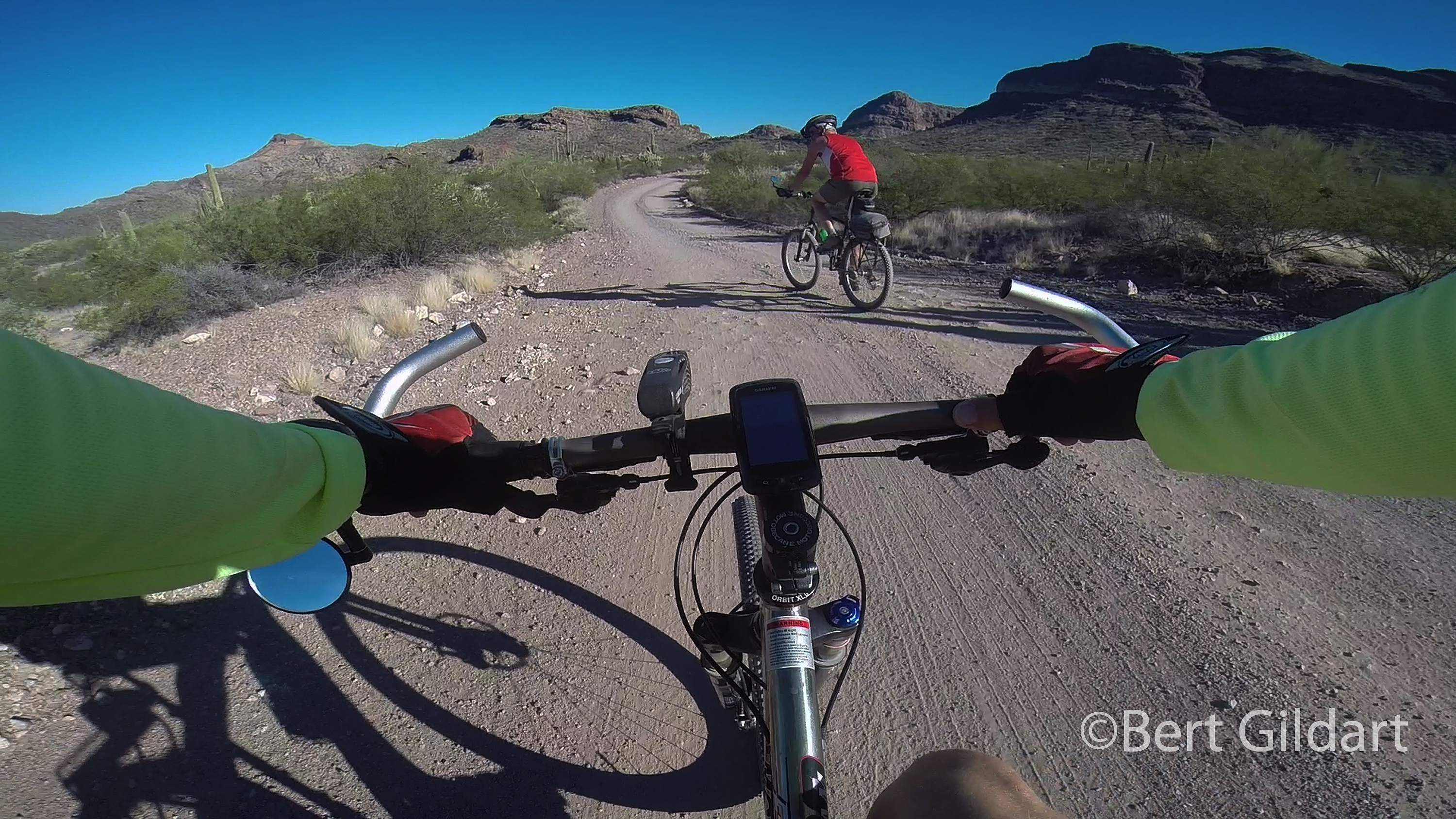
Departing Point of Rocks on bikes, within a quarter of a mile (less than five minutes) of extremely wide-shoulder riding, we were cruising into Watson Lake State Park and the trailhead for the Peavine.

The trail passes around an arc of Watson Lake, crosses a bridge near the animal shelter, and then joins Peavine Trail proper. And here is where the geology and history get so fascinating. And here’s where Rich, who remains enamored with his huge backyard begins asking, “So how do you like it, Bert? How do you like it?”

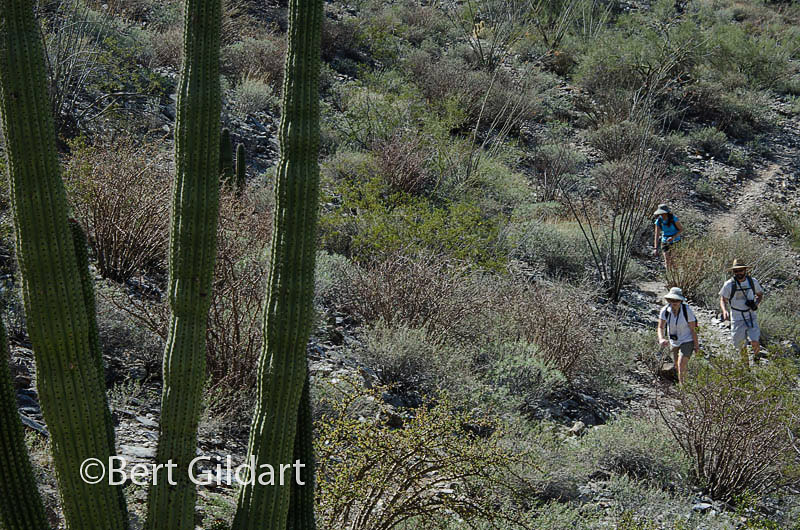
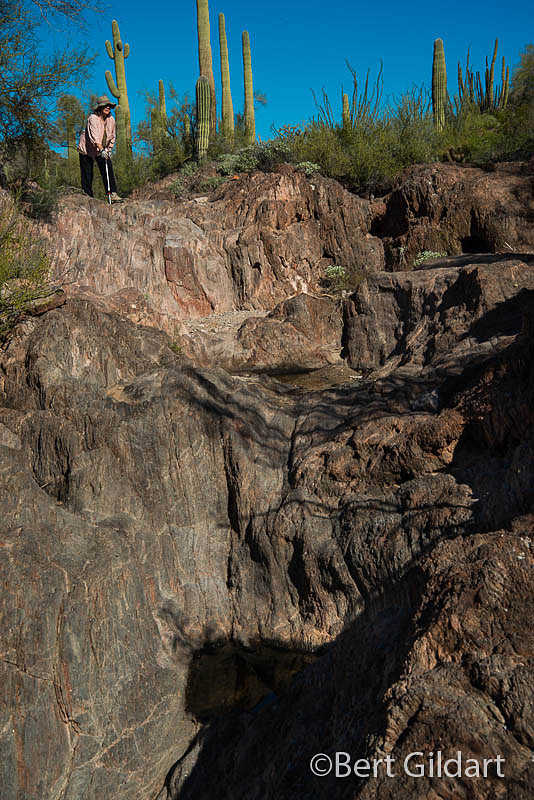
Within a few more minutes the granite mountains–with its hills and spire-like formations that appear so impenetrable–begin to open up. Then, they gobble you up. They do so because stresses within the earth occurred here well over a billion years and eventually created conditions that would form the many jumbles of rocks now littering the landscape.

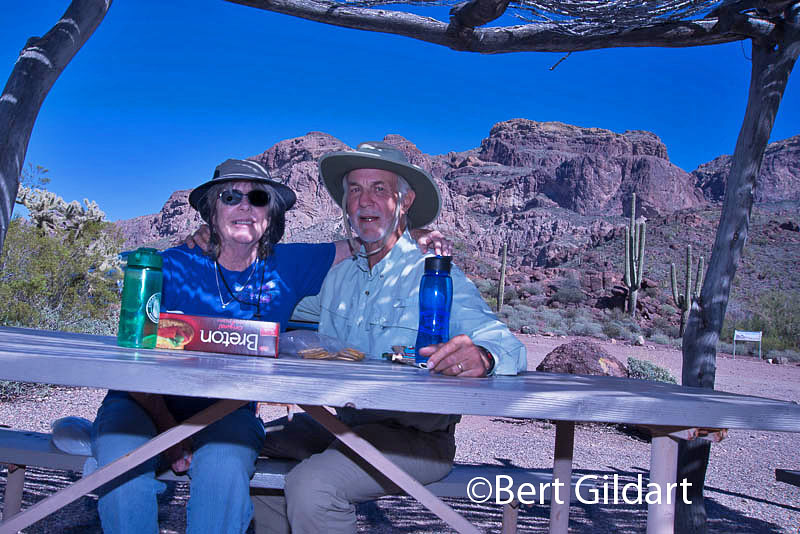
Rich Charpentier: "So how do you like it?"

Rich Charpentier: "So how do you like it?"

These jumbles are what the trail now passes through–and again, Rich couldn’t help himself:

“So how do you like it?”

As I looked around at the cluster of spires and the fields of boulders that seemed to fold one into another I could do little more than nod my approval.

GEOLOGICAL WONDERS

Geologists use the term to describe the deeply buried molten rock that eventually became today’s landscape as a “batholith.” They explain that the batholith eventually solidified, then cracked–creating all the “joints” that weathering rendered as spires. That, of course, required millions of years.

Today, the effect on those who pass them by is at times profound, as expressed by an unknown author:

“Mighty nature’s whims sometimes produce such grotesque and ponderous jumbles of rock material
that in a place like this man stands in fascinated awe and respectful admiration.”

HIDDEN PASSAGES

We continue our ride, and, Rich, whose enthusiasm continued unabated, explained that the Yavapai Indians once used the area, but that it was later used by miners who brought railroads into the area, and that most of the Peavine was once part of one of the old railroad beds. Adjacent to us as we rode was Watson Lake, and Rich pointed to the dam in the distance. Today, the “lake” provides habitat for a variety of waterfowl as well as a wonderful area on which kayakers can practice and explore hidden passages

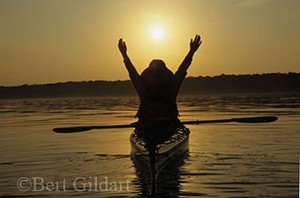
Granite Mountain backdrops Watson Lake & kayaker

Granite Mountain backdrops Watson Lake & kayaker

.

But the Peavine opened passages for us, and Rich and I continue to explore the land-based ones with our cameras. Eventually we came to one set of spires and we stopped. Light was streaming in from the side and seemed to be illuminating each of the tall finger-like projections with light that almost appeared celestial. We looked at one another and then almost laughed–for simultaneously the question popped out.

“How do you like it; how do you like it.”

There then followed moments of silence in which we both gazed in admiration.

Note: Janie and I leave Prescott today with much regret, thankful for the time both Rich and Sadira have provided in acquainting us with this wonderful part of Arizona.

Read Comments | Post a Comment »

Organ Pipe Photo Restospective

posted: March 29th, 2008 | by:Bert

Departing Organ Pipe

Departing Organ Pipe

©Bert Gildart: Though we are returning to Organ Pipe on Monday to accompany a Park Service led drive to Quitobaquito, currently we’re at Rich Luhr’s in Tucson, Arizona. Rich produces Airstream Life Magazine and in the course of writing stories for him, we’ve become good friends. Over the years now, we’ve rendezvoused about a dozen times. Another Airstream couple, Adam and Sue Maffei, are also “courtesy parking” at Rich and Elenaor’s, and in the last few years we’ve also rendezvoused with them. They’re a delightful couple and once worked for Public Radio.

MEXICO OR ORGAN PIPE?

In a day or so the Luhr’s and Maffei will be departing Tucson for a week long trip to Mexico. We were, of course, invited to join, but I have other priorities at the moment, and one of them is to learn more about Organ Pipe and some of the immigration problems. In other words, though the park is now out of sight, it is not out of mind. As a result, we offer here a few photographs from time spent this past week in that park, and hope they suggests the beauty spring in this desert has to offer.

Matilda Saraficio, a memember of the Tohono O’odam tribe, still harvests saguaro cactus. She also makes baskets from beargrass and other native vegetation. In the past Janie has purchased her baskets, and we carry a small one with us in our Airstream to hold coins and other loose items. They are exquisitely made. Photographically, the light streaming over her shoulder presented a problem, so I used a strobe. The light from the strobe complements the sunlight meaning that I was actually using two light sources. Nikon makes it easy to balance the two sources with their TTL lighting, an inherent part of their SB-800 strobe.

Matilda Saraficio creates baskets

Matilda Saraficio creates baskets

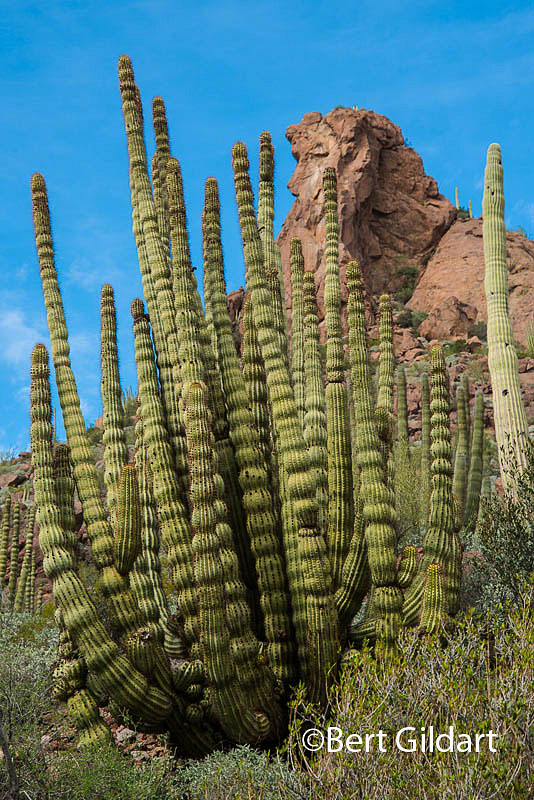
ORGAN PIPE: It is always a challenge to dramatize the organ pipe species, and so I photographed a large clump with backlighting, allowing the sun to register in the lower right hand corner. I thought the silhouette might dramatize the pipe appearance of the desert plant, which only grows in North America in Organ Pipe National Monument.

Organ Pipe

Organ Pipe

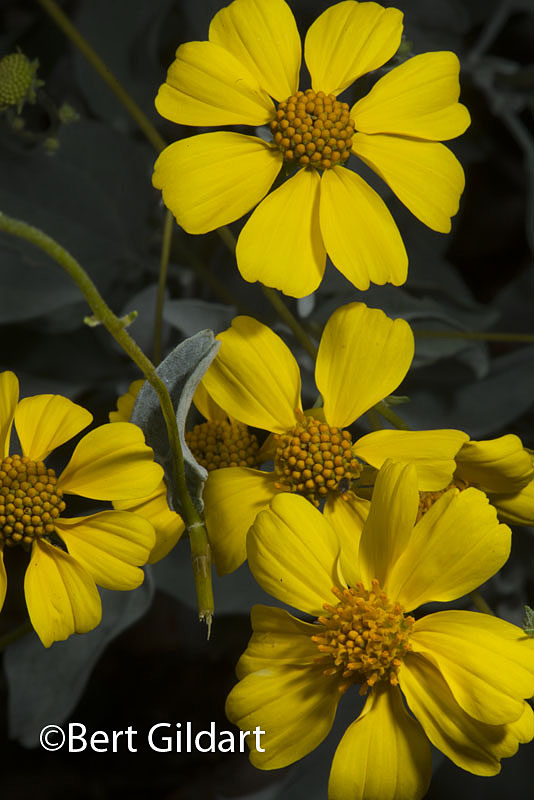
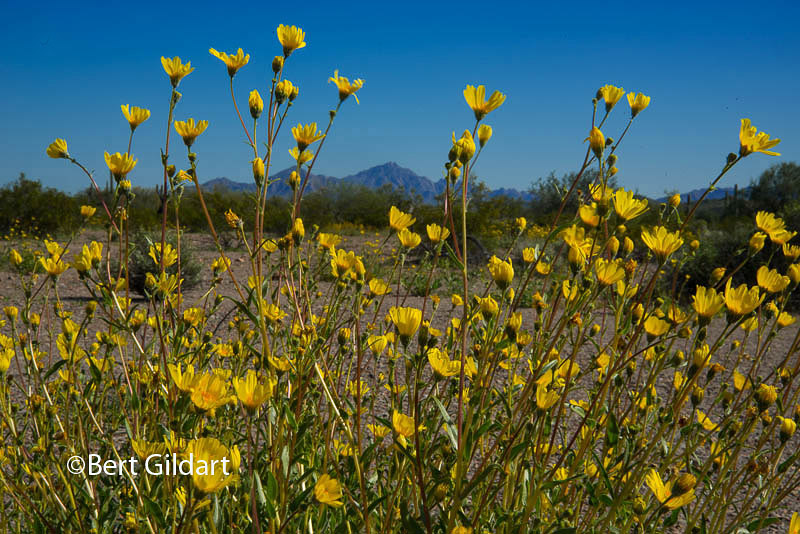
Brittle Brush now covers many hillsides, though it appears as though it is starting to fade. It has been blooming, however, for over a month and has been with us not only in Organ Pipe but in several other desert parks as well.

Brittle Brush

Brittle Brush

Cholla: I used two strobes to photograph what I believe is Teddy Bear Cholla. I held my two SB-800 strobes off to either side. By setting the strobes at f32 and the shutter on the camera at 250, the strobes so overwhelmed the existing daylight that the background went dark, helping to isolate the color of the flowers and dramatize further the spiny nature of this species of cacti.

Cholla

Cholla

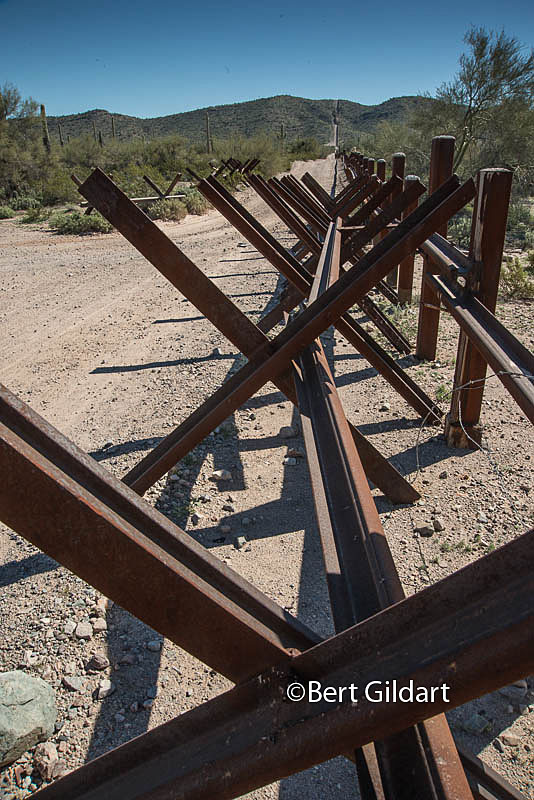
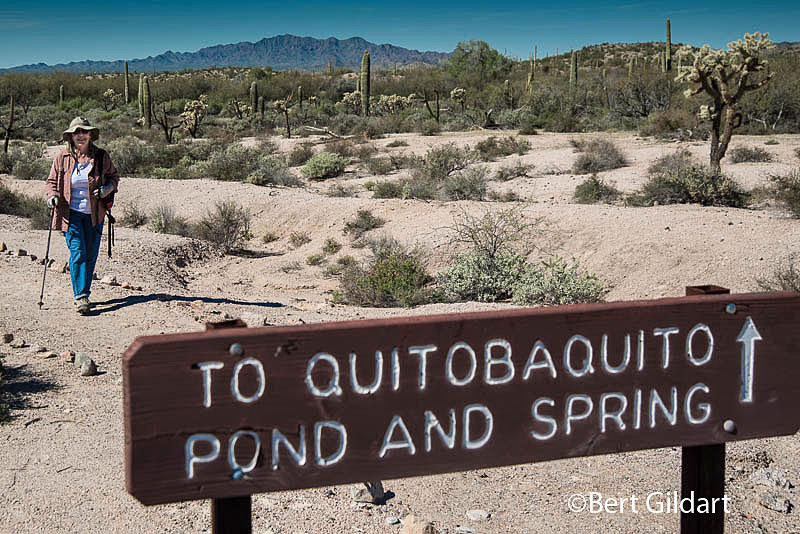
As mentioned, Janie and I will be returning to Organ Pipe and be joining a group to Quitobaquito springs, a particularly beautiful spot in the monument. Getting there is symbolic of the problems the park now suffers, specifically, the illegal border crossing. To see these beautiful springs, the park must send out an advanced patrol to make sure no illegal immigrants are in the area, particularly ones smuggling drugs and that could be potentially dangerous. After the park has been assured the area is safe, we then board a van that is further protected by rangers and then make the drive.

To prepare myself for the return to Organ Pipe I’ve been reading articles about the immense problems created by illegal immigrants. By joining this group I’m hoping to learn more about what the future bodes for this spectacular desert park.

(Where were we about a year ago ? Not far from Organ Pipe–and Tucson.)

Read Comments | Post a Comment »

Organ Pipe, Struggling to Keep the Stories Accessible

posted: March 27th, 2008 | by:Bert

Twin Peaks Campground and mountains in Mexico

Twin Peaks Campground and mountains in Mexico

©Bert Gildart: Last year about this time we camped for almost a week in Organ Pipe National Monument. Subsequent to our stay I wrote several magazine stories, and posted a number of blogs that focused on the park’s beauty, but also on its tragic problems. We’ve returned again because this is one of the nation’s premier desert parks–and because we’re curious to see what new procedures have been implemented to enable the American people to continue enjoying Organ Pipe. For the most part, we’re delighted with our findings…

SPECTACLAR CAMPGROUND SETTING

Immediately adjacent to Twin Peaks campground in Organ Pipe National Monument, there is a mountain you can climb that enables you to peer over the assortment of enthusiastic campers–as well as the Cubabi Mountains about five miles to the south. The mountains are in Mexico and it is this proximity that continues to create an immense problem for National Park Service managers. Not only do the lovely mountains flank the park but so does a 30-mile long boundary, and unfortunately, it is extremely difficult to patrol. Each year literally thousands of illegal immigrants stream across this border, some seeking work and a better way of life.

Others, however, are desperately pushing drugs, and they are creating a dangerous situation in Organ Pipe National Monument, a situation the park is struggling to remedy. In some cases, they’ve closed sections of the park or are offering special trips so that visitors can enjoy the special heritage the monument preserves.

Visitors saw Gila Monsters on Ajo Mountain Drive

Visitors saw Gila Monsters on Ajo Mountain Drive

“National Park Administered areas are the keepers of our American heritage,” says Andy Fisher, Chief of Interpretation. “If you want to learn about legal immigration and your possible ancestors, you go to Ellis Island. If you want to learn about the Civil War, you go to Gettysburg. Likewise, if you want to learn about the organ pipe this is the only place in the nation where you can do that. That’s not easy to do right now, but our new superintendent is doing everything possible to make it possible to see all this park has to offer.”

FLORAL DISPLAYS

Fisher continues, emphasizing that it is in fact, safe to visit much of this desert park. “Flowers”, she says, “are at their peak right now, and there are few places you can go to see such immense spreads of brittle brush. And the Ajo Mountain Range is always spectacular.” Fisher continues, saying that those areas that are not safe are either closed or can be visited with an organized and armed patrol.

“The superintendent is working hard,” says Fisher, “to make the entire park accessible once again to all visitors. Right now the task is not easy and is exemplified by a trip now being offered to one of the park’s most beautiful springs, Quitobaquito.

Cholla, now in bloom

Cholla, now in bloom

The springs is home to the pupfish, a tiny species that provided the students of Ajo, Arizona, with a project that won Ms. Fisher the prestigious Freeman Tilden award, something I learned not from Ms. Fisher, rather from Sharon Genaux, one of the park volunteers, who is proud of her association with the innovative naturalist. “Andy won first place regionally and second place nationally. Quite an accomplishment.”

The award was for a project Ms. Fisher spearheaded. Between 2005 and 2007 she and students from the junior high school at the nearby settlement of Ajo recreated a refugium at park headquarters that replicates the habitat of Quitobaquito Springs. Here, pupfish from the springs can easily be observed in a small pond at the park’s headquarters. “Should something happen to the pup fish at Quitobaquito,” said Genaux, “it’s now preserved here.”

Of course, seeing a replication is not the same as seeing the springs in real life and that is what the superintendent is now struggling to provide. Quitobaquito is located in the park’s southwestern quadrant, within a few hundred yards of the Mexican border. Safeguarding the area is not an easy task and requires an early morning, predawn patrol by a number of rangers. Once the area has been deemed safe from drug runners or illegal immigrants, each week those who have signed up can board a park van and travel with an armed escort to the springs, about 25 miles distance. With time the park is hoping that the installation of the new fence and better patrol will permit more traditional visitation.

Mexican poppy, now in profusion

Mexican poppy, now in profusion

Though visiting the springs is certainly a park highlight, if you miss the opportunity (and it is limited to about 12 individuals a week) the park still offers an incredible display of natural history features–all safe to explore or attempt to find. The Gila monster is often seen, and right now wildflowers are at their peak. As well, many species of cacti are now starting to bloom–all of which helps to make Organ Pipe National Monument one of the nation’s premier desert parks.

I’d also like to report that I am signed up to visit Quitobaquito next Tuesday, and if it all works out, I’ll have much more to report.

Read Comments | Post a Comment »

Sunset For the Joshua Tree?

posted: March 21st, 2008 | by:Bert

Sunset For the Joshua Tree?

Sunset For the Joshua Tree?

©Bert Gildart: Sunset for the Joshua Tree? That’s what climate scientists say may be the fate for this magnificent species, a member of the lily family that also influences the lives of at least 25 other species.

In other words, if current warming trends continue then global warming will have taken its toll not only on the glaciers of Glacier National Park, the pika of the Great Basin, the polar bear of the Arctic–but also on the Joshua Trees of this diverse California national park.

“It’s happening all ready,” said a park naturalist yesterday at the park’s visitor. “Joshua Trees require cool temperatures in order to flower and set their seeds. Because of global warming, they’re not getting it.”

The National Park Service goes further, and has published an agency-wide brochure. In the brochure, they say that human activities contribute substantially to the current warming trend.

HUMAN ACTIVITY & GLOBAL WARMING

“Most of the observed increase in globally averaged temperatures since the mid-20th century is very likely (90% certainty) due to the observed increase in anthropogenic greenhouse gas concentration… Carbon dioxide levels in the atmosphere today are higher than they’ve been in over 650,000 years.” The brochure attributes such statements to the Intergovernmental Panel on Climate Change–and its exhaustive research.

Though I’ve attempted to maintain an open ear, living as we do (when not 3/4-quarter timing it in our Airstream) close to Glacier National Park, that has been difficult, and this past summer posted a blog on a hike to Grinnell Glacier Overlook. The hike provides a hard to refute visual example that global warming is real. I realize, of course, that there are many who do not dispute global warming, saying that it is a natural cycle and not human caused.

But judging from the publication of this government brochure and the fact that certain leaders initially attempted to squelch such materials–but now accept it–it appears as though the debate may be over. Certainly the issue won’t be much of a debate among the presidential candidates, as the way the campaign has now shaped up, all (regardless of party affiliation) agree that global warming is real–and that we can control it.

“THERE IS HOPE”

As Janie and I have hiked trails in Joshua Tree National Park, it certainly does appear as though some of the trees are experiencing stress. In some cases portions of trees have died, and whether this is cause and effect, I’m not enough of a desert ecologist to be able to say.

Under stressful conditions trees don't always produce blossoms

Under stressful conditions trees don’t always produce blossoms

All I know is that park naturalist are saying that trees are dying. But they also say there is some hope: “Regardless of their [global warming factors] causes,” says the brochure, “we must do what we can to manage these impacts, and adapt to the new circumstances they bring.” The brochure concludes it thoughts, saying, “Perhaps the same wisdom that has preserved our heritage in the past can guide us in making choices for the future.”

Some, now blooming in profusion

Some, now blooming in profusion

By inference, I take it that if we group together and insist on responsible action from our leaders that it may not, in fact, be sunset for the Joshua Tree.

(Note: For those who may have attempted to communicate with us, Joshua Tree has no cell phone or Internet access.)

Read Comments | Post a Comment »

VIPs Acquaint Us with Mojave National Preserve

posted: March 13th, 2008 | by:Bert

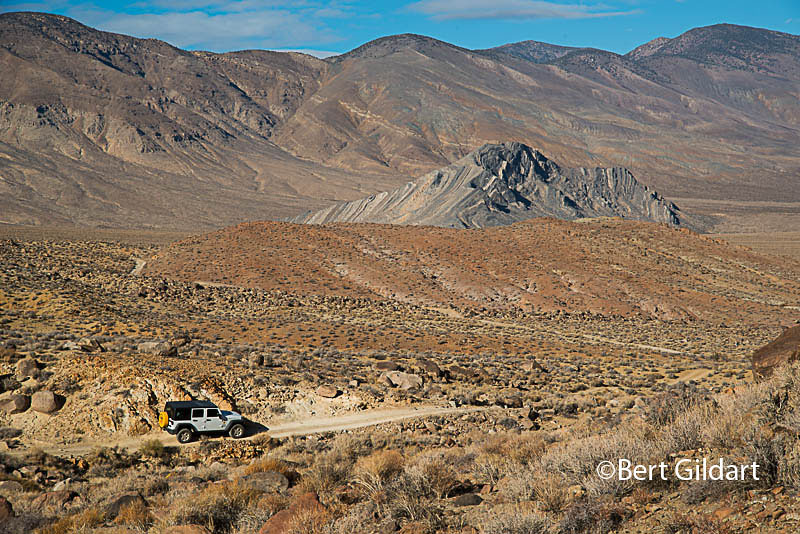
Exploring backcountry roads, near Mid Hills Campground

Exploring backcountry roads, near Mid Hills Campground

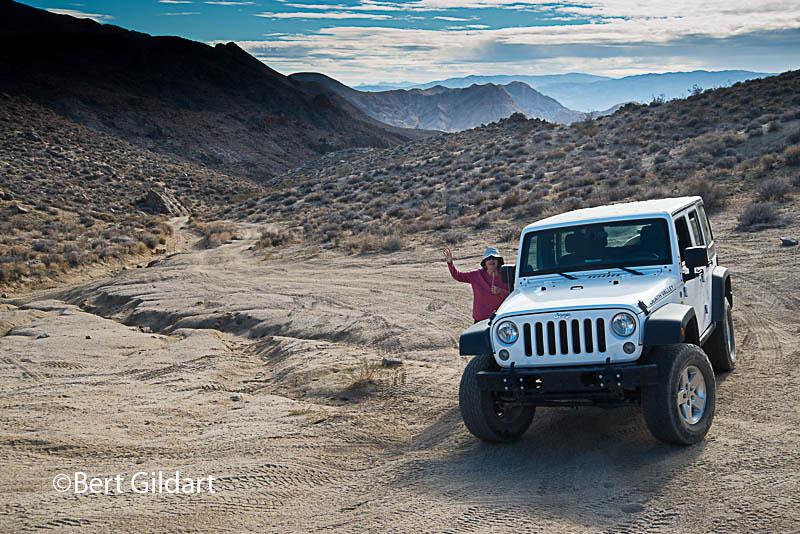
©Bert Gildart: “Hold on,” shouted Dick above the rattle of the washboard road and the chatter now occurring inside the 4-wheel drive Jeep. “We’re about to board a roller coaster.”

Dick was referring to ribbon of sand and rock that ground its way through Carruthers Canyon and into the New York Mountains, where we hoped to find an old gold mine.

Janie and I were exploring California’s Mojave National Preserve–now with a delightful couple we had met in Hole In the Wall Campground, where they are based.

PARK VIPs

The couple was on one of their two days off, and more and more in this period of immense fiscal cuts to our national lands, the National Park Service is relying on the hours contributed by VIPs, or Volunteers in the Park.

Like most VIPs, Dick and Linda are retired, Linda as a high school guidance counselor and Dick from a job as an avionic technician and manager. Because of their life-long interest in camping (Dick was once a Scout Leader) the role is perfect, and the park is certainly getting their money’s worth from this couple! They’ve been in the preserve since January and will stay until mid April. Like many volunteers, they are “fulltimers,” basing themselves–full time–out of a motorhome. While working, they patrol the campground, clean up backcountry fire pits, and then one day a week are provided with a park vehicle to learn more about the area and to help clean it up. Dick has even volunteered to lay out a new hiking trail.

Our excursion to find a gold mine was not part of their work assignment, though they are allowed a little time simply for “area familiarization.” So we decided to call it work, even though we were exploring on one of their days off.

Preserve hosts huge Joshua Trees

Preserve hosts huge Joshua Trees

“We’re working now,” joked Dick, as we passed through an extensive forest of Joshua trees. “Want to stop? Mojave’s got the most extensive forest in the world–and some of the country’s largest specimens.”

We stopped.

DETERIORATING MINES

Many stops later, we arrived at the Death Valley Mines, just off the Cedar Canyon road. Though a family once lived here, today the outbuildings are eroding. Nevertheless, Janie and Linda discovered about a dozen jars of pickled vegetables to include potatoes and cucumbers.

Old canning jars intrigue Janie and Linda

Old canning jars intrigue Janie and Linda

“Don’t think we’ll eat any of these,” joked the two ladies, looking at the corroded bottles.

As well as the general structure, an old grave marker at the base of a Joshua Tree is also eroding, but the inscription pecked into a piece of sheet metal is poignant and still legible. In part, the inscription reads:

In loving memory of husband Lee. May God be with you until we meet again.

Dick examines Death Valley Mines structures

Dick examines Death Valley Mines structures

Departing the mine we returned to the Cedar Canyon road, then traveled east. As we traveled we paralleled the old Mojave Road once used by explorers, trappers and army scouts. Among the list of notables were Jedediah Smith, John Fremont, and Kit Cason, among hundreds of others well known at the time.

The route is one I was particularly interested in learning about and both Linda and Dick wanted to explore it, too, though probably from their jeep. The road is still maintained and one of the more exciting back-country challenges is to drive all that still exists of the old route. It begins at the Colorado River proceeds west and then in about 20 miles enters the Mojave Preserve. From here it proceeds about 80 miles to Zzyzx–at the western edge of the preserve. The name is not an Indian name, rather it was created by a Dr. Springer who wanted a unique name, and his thought was that he could do so if he drew from the last letters in the English language. So far, he’s not had any competition.

Mojave Road

Mojave Road

Though Janie and I have yet to travel to Zzyzx, Dick took time to drive to a segment of the old road, and it appeared as though it might challenge a biker because of the soft sand, and, so, I will be doing some more inquiring. The group of friends with whom I climbed Rainier (links: Rainier & Rainier ) last summer are now looking for a new challenge. “Seems like you’re looking for an adventure,” said Dick, “and not a slog. You may want to test it first in a 4-wheel drive.”

FAMOUS SHOOTOUT

Other stops we made include one at Government Holes. Here on November 8, 1925 is where Matt Burts and J.W. “Bill” Robinson, shot it out. Both were killed. Because the men had been professional gunfighters the shootout has become part of the colorful history of the Mojave Preserve. It was, according to all historic accounts, one of the last classical gunfights of the Old West.

The last excursion of the day took us into the New York Mountains, home too, for many former ranchers–most of whom have allowed the government to buy out their holdings. The road was bumpy, and Dick kept asking how we liked the carnival ride. “We like it,” said Janie,” between her “umphs.”

“Glad to hear that said Dick,” laughing a bit as Linda joined Janie in creating a chorus of “UMPHS.” Dick, who is justifiably proud of his jeep’s comfort, added that it was in part because of the deep shocks, three-inch lifts and the big tires. “Creates a softer ride,” he shouted as we bounced along.

New York Mountains

New York Mountains

As we drove we also took time to enjoy more Joshua Trees, here on the verge of blooming; but our longest stop included a mile hike searching for an old gold mine. The mine was described as the Shelf Mine, and because we did find a huge shelf and the remnants of old mine diggings, we thought we were near. But the day was late, and so we departed.

Dick wasn’t disappointed and said as much. “Now, I’ve got a reason,” he said, “to return to the New York Mountains.”

“As if you really needed one,” we joked.

Read Comments | Post a Comment »

Geological Formation Unique to Mojave National Preserve

posted: March 10th, 2008 | by:Bert

©Bert Gildart: Eighteen million years ago, geological forces created a landscape at Mojave National Preserve in California that exists no where else in the world.

World class geological formations

World class geological formations

To better appreciate this condition the park has provided a trail that is unique in itself, called the Ring Trail. Because of the challenging conditions, grasps are needed to maintain balance as you scale a cliff that is honeycombed with holes that if reduced would resemble a huge wasp nest. Because of the features the trail provides in the course of a single mile, in the last two days Janie and I have now hiked it twice.

Ring Trail appropriately named

Ring Trail appropriately named

The bizarre landscape that is located adjacent to Hold in the Wall Campground resulted when rock and water were superheated to phenomenal ranges thought to have approximated 1800 degrees. That took place 18 million years ago, as first stated.

As pressures inside this gigantic pressure cooker of hard granitic rock built, they finally reached a point where they exploded, and when they did, water and rock were thrust into an much cooler surrounding. Almost instantly–within seconds, said the naturalist–the molten rock solidified, creating the pocked cliffs we see today. Wind, rain, heat and cold subsequently modified the honeycombed rock here and there adding holes.

Rings help Janie navigate defile

Rings help Janie navigate defile

And, so, today, we have Hole in the Wall campground and an adjacent canon known as Banshee Canyon; and through it threads Ring Trail. Because of its rugged and unapproachable appearance legend says it has attracted such outlaw groups as the James gang. Not all researchers, however, agree. The most likely story is that Bob Holliman, a well known gunslinger of the time, retired his ways and turned homesteader.

The trail is a delightful one and along the way we saw petroglyphs, created by the Chemehuevi Indians. Shortly thereafter we came to a narrow gap in the wall that appeared challenging, but proved otherwise because of the rings provided by the national park. Because most prefer to ascend rather than descend the narrow defile most hike clockwise, meaning that you pull up rather than hanging down.

Ancient petroglyphs

Ancient petroglyphs

The park has anchored two permanent series of rings into the sides of the narrow gap and they offer more grasp than do the rocks. The experience is just one of the many activities in which you can engage in this relatively unknown park, and because it appears as though each outing introduces new features, we may even hike it again.

Read Comments | 1 Comment »

Death Valley Can Kill

posted: February 18th, 2008 | by:Bert

©Bert Gildart: Death Valley may be the hottest place on earth. On July 10, 1913, temperatures soared to 134 degrees at Furnace Creek, and “It was so hot,” one observer said, “that swallows were falling dead out of the sky”.

Tranquil, yes, but not always

Tranquil, yes, but not always

The incredible heat that results each year is the result of essentially three factors. For one, the mountains are high and narrow, thereby trapping and holding the heat. The canyons are narrow and also trap the heat. Rather than rising and spewing into the atmosphere the heat sinks back into the valley. This compounds the situation, for as the air sinks it is compressed, an act which also generates heat and raises the temperature even further. Two other factors are the lack of moisture and the lack of vegetation.

DESPERATE TIMES

Yesterday, Janie and I discovered just what impact such heat can have on wildlife. Leaving our campground at Furnace Creek we drove 30 miles south to a trailhead at Willow Canyon, which had been recommended to us by the campground hostess. The trail leads 2.5 miles into a falls, and here is where we discovered how the lack of water can create desperation.

Death from panic?

Death from panic?

Desert bighorn sheep range throughout the park, but they need water, and when they desperately crave it panic sets in. That at least was our theory when we entered Willow Canyon and discovered that sheep bones littered the trail. Our only explanation was that sheep, sensing water from above, grew careless, slipped from the steep cliffs above and fell hundreds of feet to their deaths. Coyotes feasted, and then scattered the bones.

Though the February temperatures yesterday were in the 80s, our hike was a pleasant one, and when we reached the falls water was dropping over an expanse of about 50 feet. From here, it trickled through the canyon and then disappeared, meaning the only place water was available was in the short quarter-mile stretch.

WHAT KILLS?

Not only have sheep succumbed to the lack of water, but so have many people. Generally, people don’t die from heat exhaustion; rather they die from dehydration. On a typical June, July or August day, when the temperature has risen above 120°F, relative humidity might be little more than three percent.

Willow Falls

Willow Falls

With conditions such as these, on an average summer day a person can loose two gallons of water just sitting in the shade. Blood contains much water and this is the source of the water loss. The results are somewhat predictable: circulation becomes sluggish, muscles cramp and become fatigued, the head aches and it is a strain on the heart just to keep on pumping.

Losses of three gallons can have even more devastating affects. Your hearing goes and your eyes sink. With losses of four gallons, bloody cracks appear on your skin and generally death soon follows. Many have died here, but 1905 was the worst year when 13 men perished from thirst and water loss.

Moon rise over Willow Canyon

Moon rise over Willow Canyon

Despite the reminders of the need for water, our hike was inspiring. The canyon provided relief from the sun and on our return the moon was rising over the mountains surrounding Willow Canyon. It was just another reminder of how intriguing Death Valley can be–when explored at the right time of year.

Read Comments | Post a Comment »

Spring Awakenings in Death Valley

posted: February 16th, 2008 | by:Bert

©Bert Gildart: According to park interpreters, this is one of the best years Death Valley has experienced for early season flowers.

“This is about the earliest we’ve seen desert gold in years,” said a park volunteer, who has been here for almost a decade. “Normally, we don’t see such blooms until March, which is usually the best month for wildflowers. To a great extent, it is because of the unusually abundant rain we received last month.”

As a photographer this early spring awakening has provided some wonderful opportunities, and Janie and I have been rising at the crack of dawn to take advantage of the morning light and the calm that is usually associated with that hour of the day.

Desert Gold now carpeting valley floor

Desert Gold now carpeting valley floor

Though desert gold appears to occur in the park’s lower elevations, we’re finding that it is particularly abundant just north of Cow Creek, not far from the park’s residential housing. Here, you’ll find the species filling the side canyons that radiate off this valley that is well below sea level. We’re not far away from this run of flowering beauty camped as we are at Furnace Creek. If you’re here in the summer, you’ll understand the designation.

PHOTO TECHNIQUES

Because desert gold is yellow, it photographs well in full sunlight–not requiring the use of strobes as do species colored purple or red. With these darker colors shadows seem to block up, but not so with yellow, which can be dramatized even more with back lighting. With such lighting, you can dramatize the tiny hairs growing along the stems, which help prevent desiccation, a necessity in an area that receives but a few inches annually.

Back-lighting is effective

Back-lighting is effective

Naturalists say that other flowers will soon follow, and already we’ve found half a dozen other species. Botanists, however, say their ultimate abundance will depend on whether the park receives any more rain. Many natural history enthusiasts have their fingers crossed, recalling the abundant rains of several years ago that created one of the park’s best flower years–ever.

Though it may be some time before Death Valley sees such a spectacle again, for us, this year is turning out to be a good one.

Read Comments | Post a Comment »

Badwater, Where an Entire River Disappears

posted: February 13th, 2008 | by:Bert

©Bert Gildart: This morning our good friends Eric and Sue Hansen departed, but not until after Eric and I had one more crack at photography. Our goal was to try and capture the beauty of Badwater, lowest place in North America. The challenge was to interpret what is represented at -282 feet below sea level. In an attempt to accomplish our goal we departed Furnace Creek at 5:30 this morning and drove the 20 miles to Badwater. Sun rises about 6:30 and we wanted plenty of time for site location. En route, we saw a kit fox in the pre-dawn light.

THE AMARGOSA DISAPPEARS

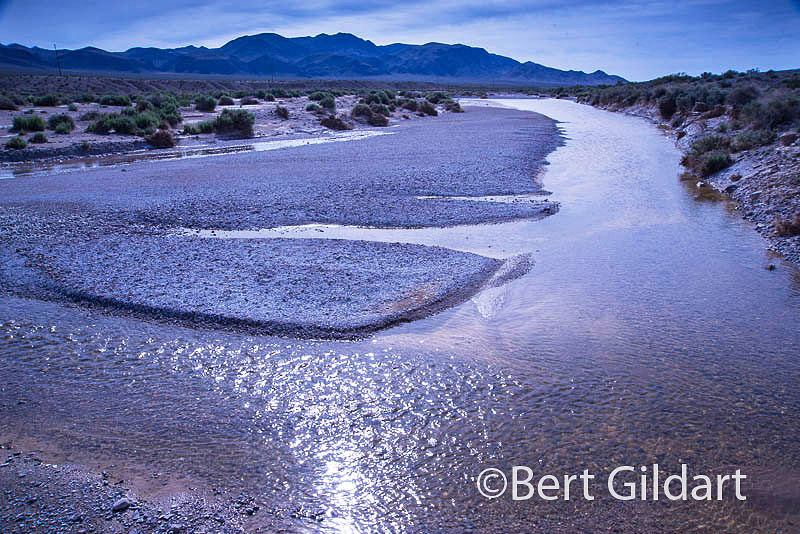
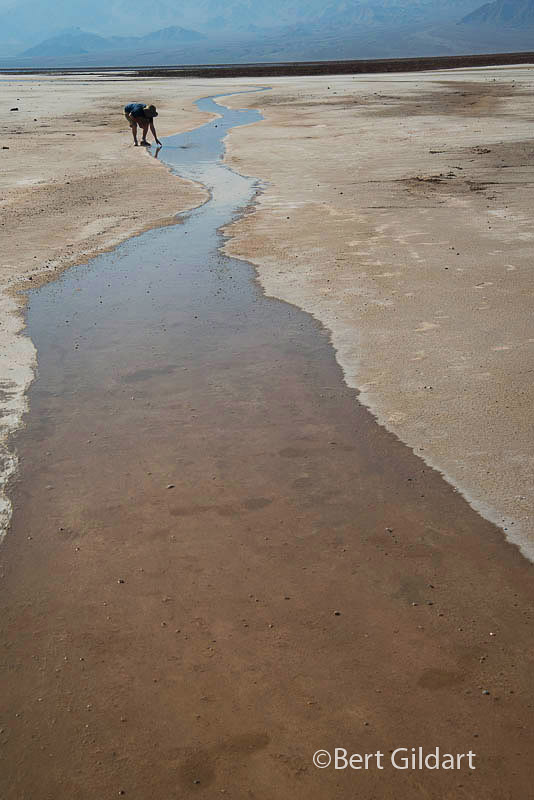
Essentially, Bad water represents the evaporation of the Amargosa River, which starts outside of Death Valley in what can at times be a raging torrent. But all that changes when the river turns north at the southern end of this valley and then begins to flow north into the park, but all the while dropping, dropping, dropping. When at last the river reaches Badwater the air is so dry that the river completely evaporates, leaving in its wake the area known as Badwater; and then, just a little further north, an area that is appreciatively called the Devil’s Golf Course.

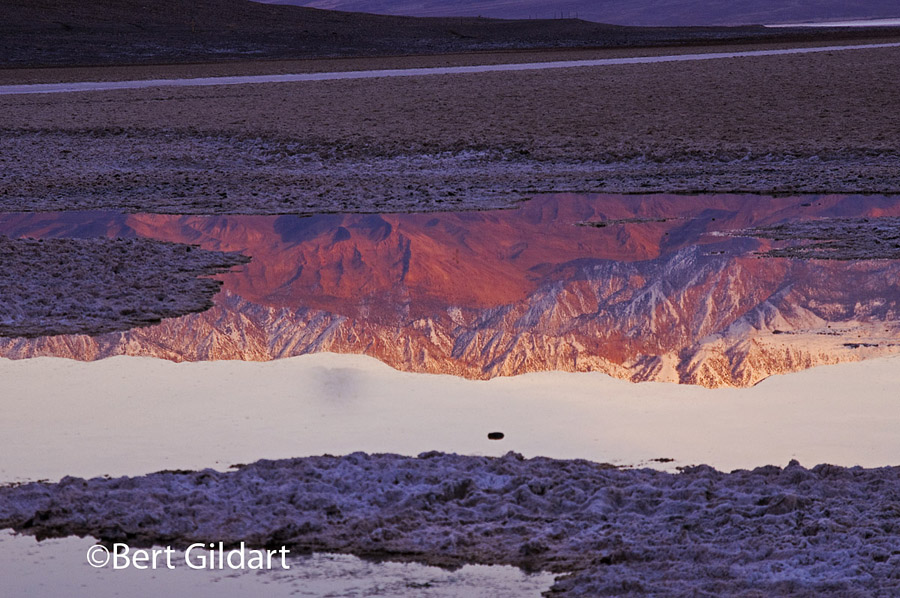
Telescope Peak reflects in Badwater

Telescope Peak reflects in Badwater

Back dropping this scene is Telescope Peak, which soars to an elevation of 11, 049 feet above sea level. Add to that 282 feet and that is the relief you experience as your eyes rise from Badwater to snow-capped Telescope Peak. Both areas are white, but both areas represent decidedly different types of environments. In one you could expire from frost, the other from desiccation. And some, of course, have.

WILSON ANTENNA

Eric and I returned to our campers about 8 and they departed about 9. With a little more time on my hands I decided to experiment with Internet reception. Recently the Visitor Center, located about one mile away, installed a wireless communication package and offers it free of charge, but officials tell you that you must be on site.

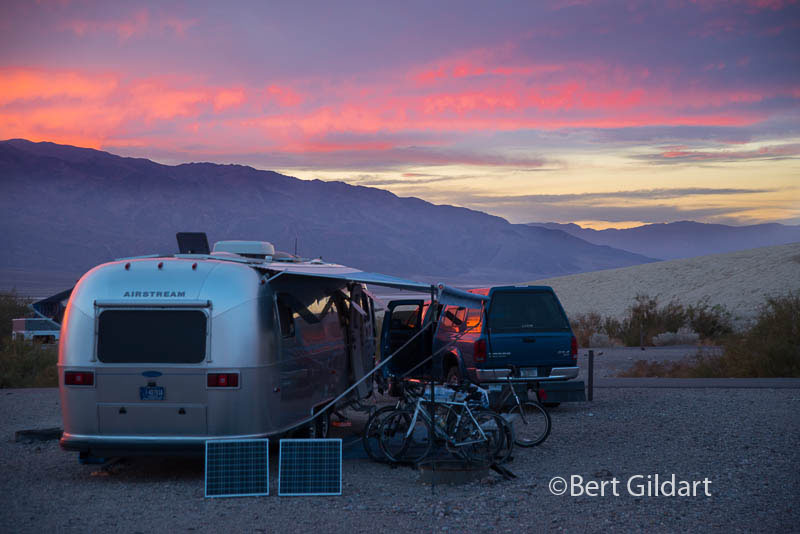
Our Wilson booster and antenna, however, is supposed to augment signal strength by 10 times, and this morning we decided to try it out. Attaching all the appropriate chords we quickly discovered that we can, in fact, get reception inside our Airstream. (The antenna is mounted outside on one of the side windows.) For me, that is a great relief as I can now work from the comfort of our Airstream and create postings and complete stories, soon to be sent via complement Death Valley’s wireless setup. Except at night, the bulk of our power demands are meet by the two solar panels Airstream mounted on top as part of the Safari’s LS package.

Devil's Golf Course

Devil’s Golf Course

We’ll be here for about a week, and each day will devote some portion to writing, but much as well to photography. Desert gold is starting to bloom and in some areas is beginning to fill entire canyons. We wish the Hansen could have stayed to enjoy all this park will soon be offering.

Read Comments | Post a Comment »

Death Valley and the Challenge For Photographers

posted: February 11th, 2008 | by:Bert

Eric at  Zabriske Point

Eric at Zabriske Point

©Bert Gildart: Death Valley is a photographer’s paradise, and that is one of the reasons we have rendezvoused in this largest of all national parks in the Lower 48 with good friends Eric and Sue Hansen. We all belong to the Outdoor Writer’s Association of America, and it seemed only logical that we could accomplish much by pooling resources. In other words, one day they’d drive another day we’d drive. In the evening we’d enjoy evening cookouts.

The only draw back of being here is that we have no cell phone reception, and at Stove Pipe Wells where we’re camped, we have no Internet. Thirty miles away, however, at Furnace Creek the park provides access to the Internet at its Visitor Center and that is the vicinity to which we’ll soon be moving. When you read this, we will have moved to the campground at Texas Springs-within walking distance of the Visitor Center.

ATTRACTS PHOTOGRAPHERS

It is the austerity of the park that makes this such a joy to photograph and that initially began attracting photographers. Ansel Adams was lured here as well as the Munch family, and they set some pretty high standards. Adams created an entire book of black and white photography on this park, and to a large degree, it is his work that lured me into photography. I still enjoy making black and white images.

Hikers en route to Golden Canyon

Hikers en route to Golden Canyon

One man Eric and I know said he thought Death Valley was the most interesting mass of nothingness he’d ever seen. We considered his thought, but agreed that the point of photography is to find organization when others see confusion. And that’s what we’ve been working at these past few days.

The mining industry also found value in this land of “nothingness” and created a legacy the park inherited and that is now played out in various ways. Once Ronald Regan narrated “Death Valley Days,” a TV series that recalled the hardships miners endured before this part of the Mojave Desert became a park. Though miners such as “Shorty” Harrison and Pete Auguberry hoped to get rich on precious metals, instead many struck it rich with Borax.

DEATH VALLEY DUNES

Eric and I began our photographic explorations with the sand dunes, a place that for pure sensual pleasure is hard to beat. On some February mornings you can strike out across the dunes bare-footed, but need to remember that by mid morning the hot sands can sometimes blister your feet. That’s certainly true as spring soars into summer with temperatures here that compete for the world’s hottest.

Sand Dunes

Sand Dunes

In Death Valley there are four separate series of sand dune, all created (mostly) by the forces of wind-and their prevailing patterns. The dunes near Stove Pipe Well are known as the Death Valley Dunes. They’re not the most massive, but they are the most accessible. Twice now, Eric and I have departed our trailers well before the rising sun to be properly positioned as the first rays of light struck individual particles of sand. These particles represent both time-and timelessness-and good photography can help impart that story.

ZABRISKE POINT

Zabriske Point is another of those areas with rampant lines of erosion, but these represent erosion at their most eloquent. For whatever reason many are drawn to Zabriske Point and we watched a number of couples as they began hiking down a wash we knew would terminate several miles later near Golden Canyon. They were drawn by the austerity of the land-and its enchanting beauty.

Searching for meaningful patterns

Searching for meaningful patterns

We plan to be here for about another week, revisiting this place in which Janie and I have spent so much time that it seems (as I’ve noted before) like an old home. We’re fortunate to be joined by friends with whom we can pool knowledge and can help us transform good times into most memorable times.

Read Comments | 1 Comment »

The Compulsion of the Borrego Badlands

posted: January 22nd, 2008 | by:Bert

Navigating Font's Point Wash

Navigating Font’s Point Wash

©Bert Gildart: For a photographer, I can not imagine a better spot to begin touring Anza Borrego State Park in California than Font’s Point. Noted for its views of the Borrego Badlands, the patterns therein provide a fascinating array.

If captured appropriately, the badlands leaves viewers wondering about the power of nature, the power of erosion, the difficulty of navigating such broken land. As well, these broken lands leave viewers wondering about the creatures that may once have lived here, which were, in fact, many.

The view from Font’s Point also reveals much about this largest of state parks in California. Facing south, your gaze embraces Mexico, just 25 miles away. It encompasses Borrego Springs to the west and the Salton Sink with its Salton Sea to the east. Turning around, your gaze falls on the Santa Rosa Mountains to the north.

FONT’S POINT WASH

Font’s Point also suggests a historic association, and the assumption is correct, for Pedro Font was the chaplain and navigator on Spain’s second expedition from Tubac, Mexico to Mission San Gabriel Arcangel in California, in 1775-76. The expedition was led by Spanish explorer Juan Bautista de Anza, for whom this park was named, in part (the other part, Borrego, for the endangered peninsular desert bighorn–yesterday’s post). On this expedition, which brought colonists from Mexico to establish the pueblo of San Francisco, Font’s role was multi-purposed, for he also served as the expedition’s diarist.

Yesterday, we reached the overlook following a four-mile drive from our campground in Borrego Springs to the Pegleg Smith’s memorial, then another few miles along the Palm Canyon Road to Font’s Point Wash. The jeep road is sand covered, and though you don’t have to have four-wheel drive, it makes traction through the four-mile-long wash a bit more secure.

Travel along the wash is another four miles, and ascends to Font’s Point Overlook, and if you think the setting created by the Borrego Badlands appears timeless, you are not mistaken.

REACTIONS TO THE BORREGO BADLANDS

First, the badlands are protected under both federal and state laws, and in Lowell and Diana Lindsay’s book, The Anza Borrego Desert Region, the authors suggest that the badlands contain an immense number of fossils to include the ground sloth, short-faced bear, dire wolf, sabertooth cat, mastodon, mammoth, giant zebra, half-ass, camel, yesterday’s camel, llama, giant camel, pronghorn, elk, deer, shrub oxen, and the Bautista horse.

Borrego Badlands

Borrego Badlands

But those are abstractions, obscure and sometimes unfathomable findings from a different millennium. What seems to draw so many now is the staggering beauty, which seems to illicit different reactions. As visitors gaze over this sweep that extents south to Mexico, some call out to friends and family members to hurry; they can’t wait to share the immense beauty. Others simply stand and stare, at a loss for words.

My reaction, the reaction of a photographer, was to mount my camera on a tripod and then search for some balanced and coherent pattern in this maze that will suggest something other than confusion. That’s not to say my gaze provided understanding, rather it was more like the displacement reaction of a startled goose that starts pecking at stones because it is at a momentary loss for anything else to do.

Perhaps I’ve succeeded with my photography, but, if not, the Borrego Badlands have been a million years in their creation, and will most likely be there tomorrow. What’s more, I’m sure these badlands draw people back time after time, for they are endlessly changing–and that’s what makes them so compelling.

Read Comments | Post a Comment »

Zion’s Ancient Rock Art

posted: January 17th, 2008 | by:Bert

The "Ancient Ones" once gathered here

The "Ancient Ones" once gathered here

©Bert Gildart: Years ago, when I first ventured into Zion National Park, one of the most interesting discoveries was to learn that the park once served as the hunting grounds for the Anasazi people who inhabited the area from A.D. 200 to 1250. The Kaibab Paiute also lived here, occupying the area for the last 800 years, and all these people created rock art, also known as petroglyphs. Petroglyphs are images that have been chipped into a rock surface as opposed to pictographs, which are images created with the pigments of plants or pulverized rock.

CANYON WITH ANCIENT ART

Janie and I learned about one such panel about 15 years ago, having stumbled onto a canyon in the course of one of our hikes. The park, of course, knows about these panels, and now show photographs of them, but there are no interpretive signs saying “Pull over, Indian Rock Art Ahead.” Instead, they wait for a visitor to ask about their presence, then they point the way, reminding people that there is a protocol for visitations.

Each time Janie and I visit the site, we do so hoping to see that they have not been defaced, as so many have in other parts of the Southwest. In Dinosaur National Monument, for instance, a certain type of person has used petroglyphs for target practice.

Sheep, common motif

Sheep, common motif

But we were so happy to see on this trip that this particular panel has endured, suggesting that perhaps the majority of visitors are beginning to appreciate such mysteries. Of course, signs posted near the panels advising that it is illegal to deface such archaeological treasures and that fines up to $20,000 may be imposed, could also help.

MYSTERIES REMAIN

Though no one knows what motivated Native Americans to create these panels, some scientists believe they were inspired by hunters, hoping to lure sheep back to sites through which they might once have ranged. Because sheep are the dominate theme that theory seems plausible. In fact, as we examined the panels we discovered that literally thousands had been pecked into the rock. Some of the sheep had huge horns, others, the females, had large bellies, suggesting a desire to see sheep procreate. Though some of the sheep are fading from sun, wind, rain and general weathering, several images remain vibrant.

Mysterious forms

Mysterious forms

This canyon also contains images that are difficult to interpret, and these include circles, and images that depict the human form. Scientists have made attempts to age these glyphs and brochures say that they are on the verge of creating new techniques that may help.

We spent about an hour yesterday, photographing the art of the Ancient Ones, using both natural light and strobe lights. No one else was around, just us–and the ancient art left by a people who once came here to create a magic that still endures. By their art we could still sense their presence.

Read Comments | Post a Comment »

Day’s Best Photo from Zion National Park

posted: January 16th, 2008 | by:Bert

©Bert Gildart: Zion National Park is a photographer’s paradise, and we’ll be here for a few more days. We’re amassing a large number of new images for our stock photo files (much of our business), and over the next few days we’ll be posting one or two from each day’s outing.

Moon rising in Temple of Sinawava

Moon rising in Temple of Sinawava

The image posted today was taken in the Temple of Sinawava, at the end of the Zion Canyon Scenic Drive, which is about six miles from the park entrance. The advantage of visiting at this time of year is that you are not required to take the shuttle, which increases your ability to move around. The image was made late in the day, and at the time a crescent moon was rising over this huge mass of slick rock, which was capped with snow. The dark trees in the foreground add depth, and the deepening shadows some sense of drama.

Because the moon is small on most computer screens, the image looks better as a slightly larger image. Still, I think it shows the potential of photography in Zion National Park, so I’ve posted it as my day’s best.

Read Comments | Post a Comment »

Montana’s Pryor Mountains

posted: January 10th, 2008 | by:Bert

©Bert Gildart: Several days ago Tom Palesch posted a comment on one of my blogs (Photoshop Revisited ), asking if I’d visited the Pryor Mountains in southeastern Montana. Like me, Palesch also writes for Airstream Life Magazine.

If you review his comments you’ll see he was fascinated with this vast recreational complex and asked me to post a few photographs of the area–if I had any.

30049.jpg
30059.jpg

Like Palesch, I’m intrigued with the Pryor Mountains and if you are the type who likes to make plans in the winter for summer adventures, the following photos may suggest possibilities. Palesch’s comments might do the same.

Essentially, Palesch and I were fascinated with the Pryors for similar reasons, and here are a few.

The Pryor’s are home to some of the state’s most incredible geology, having been carved out by the Bighorn River years ago. The result is Bighorn Canyon, shown in one of my photos.

The Spanish visited the area and left behind horses, and so the wild horses seen in another of the posted photos are thought to be genetically related. DNA testing helped shape that opinion.

Bighorn Canyon, carved through the millennium by the Bighorn River

Bighorn Canyon, carved through the millennium by the Bighorn River

As Palesch said, bears, elk and deer inhabit the area, as do bighorn sheep. What’s more the area provides excellent fishing and wonderful camping, making the area an ideal destination for the RVer.

Read Comments | 1 Comment »

Fall’s Ripeness Along the Natchez Trace National Parkway

posted: November 17th, 2007 | by:Bert

Small stream along Trace in Tennessee

Small stream along Trace in Tennessee

©Bert Gildart: Along the Natchez Trace National Parkway* few seasons are more spectacular than fall. All up and down the highway the subdued colors of spring and summer change, rushing finally to a magnificent crescendo of reds, yellows, and oranges. At times, these profusions rival the diversity of colors found throughout the seaboard states of the northeast. But regardless of degree, the colors along the Trace offer a variety that satisfies the most jaded of spirits, for the colors can be profuse and varied; at times they can be intense.

Just what purpose this brilliance of color serves, no one really knows, and in the biological world that is peculiar, for color usually accounts for something: to provide protective coloration; to serve as a warning to other members of the animal world to steer clear; to attract insects to insure pollination. But not so with fall foliage, which seems to serve no purpose other than to satisfy the needs of the soul.

Not only is the purpose of the season’s wonderfully diverse variegations not clearly understood, but worldwide, fall color is unique, confined as it is to but a few specific areas of our globe. Why were we so blessed? No ready answer comes to mind.

Fall color is the result of a gradual diminishment in the amount of light, inaugurated June 21sth, the day of the summer solstice, or that period when the sun has reached its northern zenith and is poised to commence its return south. At that time, light is intense, but as the alignment of the sun and earth gradually changes, the chemical reaction of light striking various pigments in the plant slows. The result is that chlorophyll, the dominant pigment so vitally important to the plant — indeed to the very air we and most other forms of vertebrate life breathe in its byproduct form of photosynthetically produced oxygen — is reduced.

Tobacco Farm Along Natchez Trace

Tobacco Farm Along Natchez Trace

Throughout the summer, chlorophyll has masked three other pigments, xananthophyll, carotene and anthocyanin. As the important role of chlorophyll concludes, these other pigments begin to emerge, and does so in a manner that suggests they are making up for lost time, demanding the attention of all by boldly exhibiting a palette of brilliance. Xanthophylls produce yellow; carotines, orange; anthocyanins, red, and by the month of the autumnal equinox, their time is neigh! Literally, it is time for their place in the sun; time for their displays, which are made with a genius acquired through millions of years of dedicated practice. Singularly, they produce pure colors. Together, they produce blends, so that often, leaves assume the color of burgundy, ochre, blood… mahogany.

Staghorn Sumac

Staghorn Sumac

Because botanists know the types of pigments that predominate in specific plants, they can, in some cases, predict the hues the leaves of certain species of plants will assume. For example, blackgum, dogwood, sourwood sumac and some of the maples and sassafrasses contain much anthocyanin, so color them reddish on the easel of your mind’s eye. Birches, aspens and tulip poplar contain xanthophylls, so color them yellowish. Other trees such as the red maple, sugar maple and some of the other sassafrasses, contain a combination of all of the pigments, so envision for them a meld.

Sometimes trees along the Trace don’t assume any real brilliance, metamorphosing almost overnight from green to brown, as with some of the oaks. Oaks have one more compound, tannin, and that substance produces the color brown, particularly when fall is dominated by rain and leaden skies, denying the other pigments their chance to assert themselves. And, so, we have another factor influencing color: the weather.

Weather undeniably influences the manifestation of pigments. Clear, cold days seem to intensify brilliance while prolonged rain subdues it, though even then there is a consolation. Often associated with dampness is a profusion of fungi, brilliant in their own right. Look for the coral-colored Indian pipes. Look for them almost anywhere, for they run the slopes flanking the Trace and dot their woods.

Look as well for the ripeness of fall as seen in the branches bent with berries and nuts. Muscadines and persimmons exhibit such ripeness, though not in the ridiculous way of some. Dogwood leaves droop from the clusters of small red berries, while the branches of sumac sag from sheer gaudiness.

One more component of weather influences fall’s proliferations and that is frost. Frost seems to accelerate the disturbance of chlorophyll, thereby hurrying the appearance of color. What’s more, frost, when it rims the edge of a leaf or sparkles over a field of wind-incised leaves, combines to produce a beauty that is a photographer’s delight. It is yet another player on the stage of the seasons’ major opus, so exquisitely acted out along the Natchez Trace.

And so the Trace can, and usually does, provide travelers with one of the nation’s most spectacular fall drives. And like other places in America, this caste serves no purpose other than to proclaim that fall is not the prelude to a great sleep, rather it is a time of great ripeness of which we are the benefactors.

Fall's richness, northern Alabama

Fall’s richness, northern Alabama

But why were we so blessed?

Still, no answer comes, only the echo that viewing such ripeness is beneficial to the soul.

*The above is in part from my book The Natchez Trace: Two Centuries of Travel–and though I am far removed from the Trace at this moment, an inspiring photo blog created by Kimmy (We seem to share the same concerns) shows me the beauty of fall in Tennessee hasn’t changed–and suggests that you’re not too late to enjoy it.

Read Comments | 1 Comment »

Montana’s Grant Kohrs Ranch Brings the Old West Alive

posted: September 27th, 2007 | by:Bert

Ranch hand and Belgian horse

Ranch hand and Belgian horse

©Bert Gildart: “Don’t go anywhere,” said the ranch hand, “I can get those big Belgian horses here to the barn. They’re so easy to work with and they just love the attention.”

Janie and I are back on the road again, traveling throughout Southwestern Montana for the next few weeks, camping in our Airstream as we continue our work gathering material for various magazines. Stop one required a four-hour drive south of our home in Bigfork, Montana to Deer Lodge, site of the Grant Kohrs Ranch, renowned for its living history programs on the life of the cowboy.

An Historic Ranch: The ranch is under the auspices of the National Park Service and it preserves a significant slice of the Old West. Johnny Grant first owned the old ranch but shortly after the Civil War, he sold it to Conrad Kohrs, and today the living ranch not only raises cattle, but interprets life on a ranch reminiscent of the period when cowboys were driving cattle from Texas into Montana. For Old West enthusiasts and movie watches, it interprets the period that picks up from when Gus and Call drove cattle into Montana in the classic movie Lonesome Dove.

Horse use is one of the aspects interpreted at the old ranch and it hard to imagine a more beautiful setting. Several horses trotted to the barn where we stood with the ranch hand. They stuck their heads through the window–all back dropped by Mount Deer Lodge. But soon we moved on for there was so much to see.

Walking around we gravitated toward an old Chuck Wagon. Allen Vaira was interpreting the setup and as he began his narration, I realized I had photographed the man in another setting, in Death Valley, where he worked as a ranger in the late 1990s. For us, that was one of the joys of RV travel, constantly running into people we’ve previously meet but in different and sometimes, exotic, settings.

VIP Bob George intereprets Grant Kohrs Ranch

VIP Bob George intereprets Grant Kohrs Ranch

Chuck Wagon Changes Cowboy’s Life
Though time and distance had altered the substance of what Allen interpreted, his information was sound. He talked about the history of the Chuck Wagon, which he said had been developed by Charles Goodnight. “This wagon improved the cowboys life,” said Allen. “Food was carried in the back of the wagon and was available shortly after stopping. It improved the moral of the cowboy because it maintained his energy level.”

Allen poured us a cup of coffee and then served us some beans he had specially prepared, adding bacon bits and several types of spices.

Ranger Julie Croglio and historic wagon

Ranger Julie Croglio and historic wagon

Grant Kohrs Ranch is extensive and also houses about 30 old wagons, one of which attracted our attention because it was once used as a Civil War ambulance. The old wagon was brought up the Missouri River to Fort Benton, Montana, on the Steamboat Emily. Later the wagon was used to transport soldiers wounded in 1877 at the battle with the Nez Perce at what is now Montana’s Bighole Battlefield.

The wagon was owned by Johnny Grant who initially established what is today the Grant Kohrs Ranch as a trading post. In 1867 he sold the ranch to Conrad Kohrs who became one of Montana’s first cattle barons. As a wealthy cattleman Kohrs added to the home begun by Johnny Grant, and the home remains a lavish repository of elegant living.

VIP Bob George intereprets Grant Kohrs Ranch

VIP Bob George intereprets Grant Kohrs Ranch

Fulltime RVers
Bob George, a retired army officer, fulltime RVer and volunteer (VIP), has immersed himself in the history of the old ranch, and detailed the origin of the various pieces of furniture. He explained how an old chair was developed for the dual use of sitting and help as a step stool. The chair has attracted much interest and you can purchase plans from the Grant Kohrs Visitor Center.

We spent the entire day at the old ranch, also visiting the blacksmith shop and the pasture which corrals long-horn cattle. Indeed the ranch is a window on Montana’s past, and as our trip progresses you will see how this ranch also links to several of Montana’s other historic settings.

But first, a stop at West Yellowstone and the interior of Yellowstone National Park, now hosting some of fall’s most spectacular dramas.

Read Comments | Post a Comment »

Fall Foliage in Glacier National Park

posted: September 18th, 2007 | by:Bert

Mountain Ash, symbolic of early fall in GNP

Mountain Ash, symbolic of early fall in GNP

©Bert Gildart: Several days ago I visited with a very perceptive media representative who works in Glacier National park. In the course of our conversation, I said that with Logan Pass now closed for much needed repair work, essentially that meant the park was closed.

“No,” she said, it’s not closed. Virtually all the campgrounds are open, and you can still hike most of the trails.” And then she went on to say that it was fall-and after that there was no reason to say anymore.

She’s right, of course, it is fall, and that got me to thinking about all the times Janie and I have ventured into the park in late September clear on into mid and even late October. In fact, right now is the time to tour the park. Along the slopes paralleling the trail to Iceberg Lake, mountain ash berries are now a deep crimson.

Over near Two Dog Flats, elk are bugling, and all around colors are changing, and certain colors are intensifying. Granted, the Northwest doesn’t have the hardwoods so common in Eastern forests, but I defy anyone to show me a more beautiful setting than the one that results when cottonwood and quaking aspen are transformed from green to yellow and when they’re all back-dropped by mountains covered with a dusting of snow.

Though these photographs were taken over a period of several years, they suggest what you may expect to see in the next two to four weeks, for all were taken starting mid September.

Because I so thoroughly enjoy photography in Glacier in the fall, invariably I pack along a 4×5 with my 35mm equipment, just as I did several weeks ago on our trip to Two Medicine . Though 35mm works extraordinarily well for fast moving subject or for situations that require an instant response such as an elk bugling on a misty morning, for times when the winds die down and the peaks of Glacier are touched with snow, I love the 4×5. However, that doesn’t mean I’ll put aside my 35mm camera.

Red Eagle, Mahtotopa and Little Chief mountains

Red Eagle, Mahtotopa and Little Chief mountains

Last fall we were in New Jersey, and I needed photographs for publication. Winds however were kicking up, and that’s where my 35mm came in handy. The photographs satisfied my publisher and also enabled me to publish a blog (Leaves Fall and Birds Fly And I Wonder Why ) about the biological conditions that cause leaves to change.

Nevertheless, I like the 4×5 even though it’s cumbersome, and under the proper circumstances, I image myself joining Ansel Adam’s f-64 club and attempt to duplicate his technique, which called for tiny apertures and long exposures. (That also works for 35mm but isn’t so critical.) So doing, everything from the closest of objects to those most distant are in focus.

Chief Mountain

Chief Mountain

Because everything must be still, the technique requires patience, but if you look at these photographs and evaluate the depth of field, hopefully you’ll understand why I appreciate the 4×5-particularly for landscape images in Glacier National Park.

So, now, even though Logan Pass is closed, there’s still much to look forward to, just as managers are now suggesting. In other words, now is the time for Fall Foliage in Glacier National Park.

Read Comments | Post a Comment »

Faces From Mount Rainier

posted: August 16th, 2007 | by:Bert

©Bert Gildart: Representatives of the various guide services that help individuals ascend Mount Rainier say that to successfully complete the climb, you must be in the best shape of your life. The National Park Service adds yet another thought, saying that those climbers attempting an ascent stand the best chance of success if accompanied by a guide.

The past week, as those of you know who follow the blog Janie and I have maintained this past year recall, I ascended and descended Mountain Rainier. All totaled, the adventure required three days, and though I’m not sure I was in the best shape of my life, I was close to it. Nevertheless, the ascent was exceedingly difficult. I can also say that getting to the top was the result of a team effort and the help of several very good guides.

What follows in this posting is a series of photos of individuals in our group with a few comments about each. I suspect our group was somewhat typical, though perhaps on average, a bit older than most. I also suspect that we had our share of disappointments and achievements.

Paul Baugher

Paul Baugher

Heading the list is Paul Baugher, one of the owners of International Mountain Guides. With legs shaped like those of an elephant, the man is built for Rainier, and judging from the manner in which he was greeted by other guides along the trail, one of the best known. If I were in a bind on Mount Rainier, I’d feel comforted knowing Paul was leading the rescue party.

Aaron Mainer

Aaron Mainer

Aaron Mainer, another International Mountain guide, has worked for several years for this relatively new Rainier guide service. Though my experience with mountain guides is limited, Aaron, seems destined to become one of the most sought after guides. Personable, yet firm when times demanded, we hope Aaron’s former life here in the Flathead as a guide