Night Of The Grizzlies
©Bert Gildart: Nineteen sixty seven was a dramatic time in Glacier National Park. Some of the park’s worst forest fires were raging, but what I remember most were the park’s first fatal grizzly bear maulings. I remember them because I was intimately involved, and this year, I’m remembering them as Backpacker Magazine is recalling them in their current issue. As well PBS is interviewing me—and others—asking us to recall our various involvements. They’re doing so now as this year marks the 40th year since those tragic times. Like most people, I don’t mind a bit of publicity, but am hoping the various publications will also focus on the good that came from these horrible tragedies. To some extent, that is what Jack Olsen did in his classic book, Night of the Grizzlies.
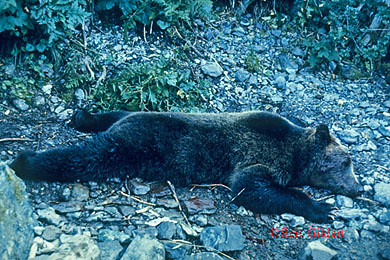
1967 Killer Bear, created by backcountry neglect
I was involved essentially because all permanent rangers were out fighting fires. In 1967 I was a road patrol ranger and though I wanted to be out fighting fire—and had asked for such consideration—the powers to be felt road patrol work was critical to visitor safety, and so my request was denied. As a result, I was one of the few rangers available when tragedy befell the two 19-year old girls.
On August 13, 1967, shortly after midnight I was piloting a huge truck over Logan Pass. Suddenly I heard a voice from Granite Park Chalet trying to reach headquarters, but failing because of poor transmission. Hearing the voice, from my location high up near Logan Pass, I served as a relay to headquarters, explaining medical attention was needed at Granite Park Chalet—that a young lady had been critically mauled…
That night I returned to my apartment in West Glacier about 3 a.m.
Several hours later, about 6:30 a.m., Norm Hagen, another seasonal ranger, woke me and said that I was needed immediately, that a young lady had been mauled at Trout Lake, and that I was to hike the four miles into Trout Lake and the Camas Creek drainage and see what I could find. Not surprisingly, I was confused, for I could not believe that yet another mauling had occurred. Sadly, Norm told me the young lady at Granite Park had died hours earlier.
Driving around lake McDonald to the trailhead I then rushed into Trout Lake and met Leonard Landa, who had left an hour or so prior to my departure. He was the seasonal ranger at Lake McDonald, and was waiting for some support before beginning a search. With my arrival and that of a helicopter flown in by John Westover who brought in the park’s engineer, Max Edgar, we formed an adequate search party. We all fanned out and began a search–hoping for the best.
Moments later, Leonard called out softly and announced that he had found the girl. We wrapped her in a body bag and Westover flew her out. The engineer left his rifle with me, and Leonard and I searched the valley for other campers and then provided an armed escort to the one remaining couple that we had located miles up the drainage.
Several days later, Leonard and I were dispatched to find the bear. We hiked back into the valley, then hiked up the Camas Creek drainage and spent the night in the park’s Arrow Lake Patrol Cabin. Early next morning (to make a long story short), I went outside to use the bathroom, and there, about 30 yards away, was a grizzly bear. I called for Leonard to bring out the rifles, and when the bear started moving toward us, we both fired. Both shots were fatal, one fired from a .300 H&H magnum, the other from a .30-06. A later evaluation of the bear confirmed we had shot the right bear (we’d been told to shoot any bear we saw, believing that any bear that didn’t run was a suspect bear). Later evaluation also revealed the bear had glass embedded in its molars and that this was, in fact, a small emaciated 17-year-old sow, weighing less than 300 pounds.
Much the same thing was happening at Granite Park Chalet, though more bears were shot there as more bears had become “conditioned” to the presence of people.
About a week after the incidents, Ruben Hart, the park’s chief ranger and I flew by helicopter back to Trout Lake, and found so much garbage that the huge Huey Helicopter didn’t have adequate space for just a single trip. In fact, many trips were subsequently required to clean up this backcountry campsite.
In fact, virtually all backcountry campsites had become dump grounds. Because of the conditions, these were tragedies just waiting to happen. In fact, the dual maulings created a national outcry demanding an evaluation of backcountry conditions, and the implementation of a Bear Management Plan, previously lacking.
At Granite Park Chalet, managers there had been intentionally luring bears to the chalet to entertain guests. At the time, National Park managers said they were unaware of the situation, but that was not the case, as David Shea, another seasonal ranger, and I had hiked to the chalet a week prior to the mauling, watched the feeding and reported on our findings to park headquarters. Others had done similarly.
With time the problems were corrected, and a bear management plan was implemented. Still, about ten years later, another mauling occurred, this time along Divide Creek near St. Mary. Once again, garbage was the culprit, and I focused on that for a major story I wrote for Smithsonian Magazine. The story also examined bear biology.
Today, the park has a well thought out management plan. In the broadest sense, the plan seeks to separate people and bears, and has mandates to help achieve that goal. For starters, regulations prohibit dogs from accompanying their owners into the backcountry. As well, they suggest people not hike alone, or if they do, make plenty of noise. The plan recommends women not hike during their menses. In 1967 all these factors now considered taboo were present. But at the time, no one had researched the delicate coexistence of man and bear.
The plan further specifies that bears that habitually frequent areas of human habitation are tranquilized and then relocated. If they return, they are euthanized. The plan requires that you suspend food in a tree some distance from your tent. Of course, I’ve only touched the surface, as you’ll discover if you visit any park service facility.
Is the Bear Management Plan working?
I think it is and when you consider that over 2-million people now pass through Glacier National Park annually, it’s to the park’s credit that most fatalities that do occur in the park are generally not from bear maulings. Stupid things do, however, still occur, and I’ve inadvertently been in situations where people have done unimaginable things, but by and large, the park is much safer today than it was 40 years ago—that awful Night of the Grizzlies.
4th ed. Autographed by the Authors
Hiking Shenandoah National Park
 Hiking Shenandoah National Park is the 4th edition of a favorite guide book, created by Bert & Janie, a professional husband-wife journalism team. Lots of updates including more waterfall trails, updated descriptions of confusing trail junctions, and new color photographs. New text describes more of the park’s compelling natural history. Often the descriptions are personal as the Gildarts have hiked virtually every single park trail, sometimes repeatedly.
Big Sky Country is beautiful
Montana Icons: 50 Classic Symbols of the Treasure State
 Montana Icons is a book for lovers of the western vista. Features photographs of fifty famous landmarks from what many call the “Last Best Place.” The book will make you feel homesick for Montana even if you already live here. Bert Gildart’s varied careers in Montana (Bus driver on an Indian reservation, a teacher, backcountry ranger, as well as a newspaper reporter, and photographer) have given him a special view of Montana, which he shares in this book. Share the view; click here.
$16.95 + Autographed Copy
What makes Glacier, Glacier?
Glacier Icons: 50 Classic Views of the Crown of the Continent
 Glacier Icons: What makes Glacier Park so special? In this book you can discover the story behind fifty of this park’s most amazing features. With this entertaining collection of photos, anecdotes and little known facts, Bert Gildart will be your backcountry guide. A former Glacier backcountry ranger turned writer/photographer, his hundreds of stories and images have appeared in literally dozens of periodicals including Time/Life, Smithsonian, and Field & Stream. Take a look at Glacier Icons
$16.95 + Autographed Copy

July 2nd, 2007 at 2:06 pm
jst read this account of grizzly maulings in Glacier. In an amazing coincidence. My family and I had camped in Lake MacDonald on August l2th.1967 We left Glacier early Aug. l3 and did not hear of the maulings till we returned to Illinois 3 days later. It spooked us a bit.
jennie (Tim’s aunt)
July 2nd, 2007 at 2:08 pm
2/ How can I send this article to Tim’s cousin, Rob? Don’t know what website I’m on since Tim put this ‘quick link’ for me.
thanks. Jennie
June 4th, 2008 at 5:52 pm
I think it is sick that they would kill the poor bears, its thier turf that people keep tresspassing on, its just not fair, they existed here thousands of years befor us, if you get killed in bear country, its nobodys fault but your own, we are not gods!
June 4th, 2008 at 7:31 pm
Ryan, Things are much different now from the way they were back in 1967, when Leonard Landa and I were charged by Glacier to kill the offending bear. The bear we shot had been fed garbage and had lost its fear of people. Probably in part because of the garbage its teeth were worn and it had glass embedded between its molars. As a result of the above, the bear had lost its fear of people and had to be dispatched. This was a sad situation and the conditions of the times will probably never repeat themselves. Today there is a solid Bear Management plan and it is working well. That said, I understand exactly where you’re coming from and agree in principle. Thanks!
June 17th, 2008 at 12:18 am
Bert, I appreciate this account of that 1967 experience. Climbing that hill as part of the search party and finding Michele’s body, is as vivid in my memory as if it had happened just yesterday. I also remember that, earlier that morning, I had gone back to bed after flying Roy Ducat to the Kalispell hospital. I was soon awakened again with the announcement, “They found the girl!” (Julie Helgeson). When I landed at Granite Park Chalet, I learned that she had died just two minutes before I arrived!
Wow, what a night!
August 16th, 2008 at 6:03 pm
If I had known 1967 was to be the Summer of Love in San Francisco, I would never have applied for summer work in Glacier Park. I had just completed high school, and went to work as a waiter at Swift Current Motor Inn, about a mile away from a huge hotel (Many Glacier) that most tourists inhabited. Swift Current was at the end of the road, at the start of the main series of trails leading over the High Divide. So Many Glacier got the tourists from all over the globe, it was a huge hotel, while Swiftcurrent got most of the serious outdoors people—It was maily a group about 30 cabins with a sleazy, smallish dining room. The full name was Swiftcurrent Motor Inn.
During the days, I waited tables at Swiftcurrent Motor Inn. At night I was the keyboard player for a seriously middle of the road pop band at the big hotel about two miles south. I walked the distance between the two locations three to four times a week. It was kind of draining, but I was young, and I was having the time of my life. (My twelve string guitar was stolen from my cabin, but that was the only major bummer, until one night in the middle of August).
The end of the summer is fire season in most parks, and the summer of ’67 is still on record as one of the top five worst fire seasons in Glacier Park. By the end of July, the smoke was thick all over, and night was like the day, lit eerily by the red moonlight. It was totally bright out night after night, it was just like the day, except it was all red, and there was perpetual foggy haze of smoke. We breathed it for three weeks.
On this particular night, one of my musical nights, I was about halfway down the road from Swifty to Many Glacier. The weird light, the smoke and red haze. It was hard to see in distance. I was totally alone. No cars (a very isolated spot). I heard something in the woods to my right. And then the huge grizzly lumbered out onto the road no more than fifty feet from me.
We had been warned that the bears (browns and grizzlies) were being driven down from their usual spots because of the fires, and that they were likely to be looking for food anywhere they could find it in unusual places (trash dumps and the like).
At any rate, I immediately turned around and began walking very slowly and very quietly back toward Swifty. I could actually hear the grizzly’s claws on the pavement. I could tell it was about halfway across the road when it stopped. It apparently caught my scent, turned in my direction and began to slowly plod in my direction. Grizzlies can move very fast. As soon as I heard it change direction and pace I took off running as fast as I could, and the bear started sort of loping behind me. I doubt it saw me, but it smelled me.
It was at the point of panic the car actually did approach from behind the bear.(coming from Many Glacier). The driver saw what was going on, and hit the horn. The bear freaked out and headed back into the trees.
It was the only car I had ever seen in any of my walks to or from the hotel on countless evenings. If it hadn’t been on that night, just at that time, who knows what might have happened. It turns out that it was my boss returning from a business trip in Babb. He stopped of course. When I got in the door, I collapsed. He drove me back to the hotel where I was originally heading because they had rudimentary medical facilities. I was white as a sheet. They gave me oxygen.
I spent the night there recovering. And when I got back to Swiftcurrent the next day, I stayed in my cabin, and no one pried. Later on in the day I told everyone exactly what had happened.
But this not the end of the story.
The same night I was followed (chased?) by a grizzly, two girls (also employees at various locations in Glacier Park) were mauled to death, on the same night, twenty miles apart, by two different bears, while camping with groups.
There was actually a book about this night (not about my experience) called “Night of the Grizzlies.”
On…the…same…night. It totally freaked me right out when I heard this. A few of the rangers covering the Ganite Park Chalet incident were daily habitues of Swiftcurrent Motor Inn. They made sport of the time I was decompressing at Many Glacier. I left the park and came home a couple of weeks early.
So what had been a beautiful, gorgeous summer experience turned very weird fast. Not exactly the Summer of Love. More like the summer of weird.
There is more to this tale, but my fingers are sore.
August 17th, 2008 at 4:15 pm
Richard, if you read the book Night of the Grizzly then you know a little about my involvement as a ranger at Trout Lake. The summer after that infamous night, I spent two weeks with Jack Olsen, the author of the book. Now, I’d very much like to hear the “rest of your tale.” I hope you’ll give you fingers a rest and then resume.
Thanks very, very much for your note.
Bert
August 17th, 2008 at 9:50 pm
Bert,
1967 was a weird summer in Glacier Park. You have the story of my encounter. At the time, no one seemed to be isolating possible offenders. To this day, I wonder about the identity of the large, light colored brown/greenish grizzly (in the waning sun) who crossed my path, then followed me, and finally chased me. I got the sense toward the end that a charge was near. I could not have escaped that.
It was a very big, light colored grizzly. A blonde, almost. I would be interested to know if this bear was on anyone’s radar for the “most wanted” list. I did hear afterward of a bear matching this descripion who had been going through trash at both Many Glacier and Swiftcurrent around the time of my encounter. It was unusual for any bear to come down that far, especially a grizzly, but then, there it was. And the forest fires were forcing new strategies for survival.
My guess is that there was only one bear in this particular populated valley matching the general description. It was just my luck, apparently, to accidentally happen upon it, and to call him or her out (unintentionally) in a direct confrontation. I never got the sense there were any cubs around.
There might have been some other reason for the bear’s curiosity and then, pursuit. Bears are not into random violence.
September 22nd, 2008 at 6:11 pm
Bert,
I hiked to Trout Lake for the first time earlier this month. It was an erie place for me to be because of the 1967 attack. I tried to locate the exact location of the campground and attack. I also thought that I would find some kind of memorial identifying the site. Does any exist?
September 22nd, 2008 at 6:55 pm
I’ve returned to Trout Lake many times and know for sure that no memorial exists. I agree,it is an erie place.
Bert
August 15th, 2009 at 11:46 am
I worked at Lake McDonald Lodge. A friend and I were going to go and hike where Michele Koons was mauled to death, I guess you could say out of morbid curiosity for both of us.
I mainly wanted to go because I felt this weird connection to her. I worked at Lake McDonald Lodge 2008 (41 years after she was attacked), I applied to work at the Gift Shop but instead worked in the EDR (weird to think she ate in the EDR where I worked), I wanted to build a memorial to her of some sort letting people know that there is danger in the park but to be wise about it because it could lead to death.
While working in the EDR, I would get a weird sense if I was working late that somebody was watching me or near me. I would look over my shoulder and out the windows and there would be nobody nearby.
I remember reading Night of the Grizzlies and feeling spooked that both Michele and I worked at Lake McDonald Lodge. I couldn’t get to sleep after reading that book for like a week.
The priest that gave last rites to Julie Helgeson worked at Gonzaga University where my brother went.
So all in all, really weird, spooky similarities.
August 29th, 2009 at 7:34 pm
A month before the Trout Lake attack, I was there camping one weekend with several college buddies. We were in Montana attending Iowa State’s summer forestry camp near Greenough on Highway 200. We camped in two groups of 3 or 4 each, at the upper and lower ends of the lake. During the night, a bear came into the camp of the upper group, scaring them enough that they broke camp and hiked out in the middle of the night. I’ve always wondered it it was the same bear. Trout Lake, beautiful and eerie at the same time.
August 30th, 2009 at 5:31 pm
Hey Bert, I thought I knew you pretty well, but didn’t know about this unfortunate situation. I do know that you are one of good guys who has contributed greatly to our awareness of the space wildlife needs and to our appreciation of wildlife in general.
August 30th, 2009 at 11:00 pm
Are there any more copies of the book in print? I think the tragic, unfortunate lessons of that night need to be taught over and over, to each new generation. MAJORITY of the problem of that night was HUMAN … ok …. I’ll be gentle and say error. Yes, there was a very antagonistic grizzly near cabins that rangers did NOT take care of … they didn’t, at least per the book, take any action. But still, the blame lies in the people.
PLEASE let me know where or how I can pick up a couple copies of this book. Thanks.
September 2nd, 2009 at 7:18 am
I just finished reading “night of the Grizzlies” after (keyword is AFTER, not before) I backpacked Glacier NP. I found a copy in the Logan Pass lodge. It was an awesome read.
To people who keep saying that “we are on their turf”, I consider it just as much my turf as the bears. I’m an avid backpacker who has treked thousands of miles around the world, but mostly throughout the western US, including Glacier where I spent 8 days in the backcountry just last week. I love nature and the outdoors, but I’m tired of being told by the “eco nuts” that I am a “guest” on planet earth. I used to subscribe to Backpacker magazine, but I was so disgusted with the constant politically correct rants about how “dirty” we humans are that I couldn’t stand it anymore. I refuse to apologize for existing. Funny thing is those who keep wanting us humans to feel repulsed by our own existences never put themselves in the same equation. They are elitist hypocrites and I can’t stand them. I don’t like to see grizzlies or anything else killed, and I like the danger involved in backountry hiking which is one of the reasons why I do it–I don’t want that danger removed. However, I belong out there just as much as any bear or wolverine. I refuse to feel guilty for living!
September 2nd, 2009 at 9:56 am
My husband and I are currently Airstream full-timers and spent a week in Glacier National Park last week. On the shuttle bus to one of the trails, I met a local woman who told me of this event and recommended the book. Yesterday, I sat at the Bozeman Public Library and read the book. Wow! is all I can say. I completely annoyed my husband last night because I couldn’t stop talking about the book, the work and evolving role of the National Park Service, and our coexistence with bears. I could go on and on, but I won’t. Thank you, Bert, for the work that you did that night and the work you continue to do.
January 5th, 2010 at 8:11 pm
Any idea when Montana PBS is going to air the reinactment of the Night of the Grizzles?
January 26th, 2010 at 11:54 am
Dear Bert, very ineresting site. Congratulations on your involvement w. “Night” and your site and outdoor activities. Will read further later.
Am rereading Olsen’s book and plan to incorporate information re: the tragic event in passing. It will be my 5th “bear book” hoping to share information about being safe with bears…instead of the litany of bear mannerisms experts want backwoodsers to know, itis more important to know 1) whether the bear’s in your space and 2) to be prepared to stop the animal. I’m convinced the young women would NOT have been attacked with more adequate NPS intervention and those attacked had been armed with a bear stopper. Pepper spray was in its infancy, tasers probably were not available, flaregun probably would have scared off tears or a firearm (not allowed). Some information is available at http://www.kaniut.com. Would like to correspond with you.
To Mark, poster # 15 I agree totally with you. We have a growing number of bears in Anchorage which need some serious reduction but our department of fish and game is of the greenie persuasion (animals are more important than people),as Ryan #3 above. We have a state legislator introducing a bill to reduce the numbers of bears to try to avoid a repetition of 3 grizzly maulings in our city in 2008. I amazed by the general public’s philosophy regarding man as the tresspasser. Wow.
December 18th, 2010 at 3:21 pm
In the summer of 1967 I was a young Marine stationed at MCRD San Diego Cal when I heard about the the events at Glacier Park. After I was discharged from the Marine Corps in late 69 I applied for a job with the USFS and secured a job in Thompson Falls Montana in 1970. One of the first things I did when I had a chance was to hike into both Trout Lake and Granite Park Chalet. Untill I had made the hike into Tout Lake with a friend I had never seen a Grizzly in the wild. We made our camp at the old camp site. My friend was busy fishing from the log jam and I was walking the trail to Arrow Lake looking for a fresh water stream for camp water when I heard my friend yelling my name and Grizzly! I ran back to camp, a Grizzly had walked onto the log jam from the other side of the lake. What had alerted my friend of the bear’s presents was when it slipped off the log and into the lake. It then swam to the other side and and walked the lake shore toward Arrow Lake. We had broken Park rules as I had a .44 mag handgun in my pack and my friend a .357. We had no intentions of suffering the same fate as those poor Girls had in 67. We had no futher bear sitings and hiked back out the next day.
In 1975 I moved to Alaska and became a big game guide. In 2000 while working as a Safety officer on a construction job on Kokiak Island I was attacked and mauled by a large Male Brown Bear. I survived the mauling and continue to guide here in Alaska.
Brent Hudson
June 14th, 2011 at 5:18 pm
Does anyone know if there is a memorial for Julie at the chalet? I’ve long been interested in bears and have always felt somehow connected with these two girls. I would love to visit these areas of Glacier one day to pay my respects to Julie and Michele and maybe to better understand that connection with them.
July 16th, 2011 at 3:28 pm
WOW We watched the documentary on WUSF TV Channel 16, we have watched it 4 times and shared it with our family.
January 7th, 2012 at 10:56 pm
I’ve just learned of the passing of Roy Ducat (Julie Helgeson’s partner at Granite Park) in July. Very sad news. RIP, Roy and Julie.
January 15th, 2012 at 8:35 pm
I have applied for several different NPS jobs in Glacier this year and it got me thinking about the events of 1967. I have spent 34 summers in the park, and have hiked most of the park over the years. I agree that over the years that the the NPS has drastically improved procedures, and practices to reduce unfortunate encounters with bears in the park. I have seen many many bears, and have had 3 close encounters of the grizzly kind. I always carry bear spray, though I have never had to use it. To me the best defense from attacks is to educate ourselves. (make ourselves bear smart) I would like to know how to obtain a copy of the PBS documentary on the night of the grizzlies. I have never seen it. Thank you.
January 19th, 2012 at 12:55 pm
Jim,
Here’s a link to the entire documentary…
Glacier Park’s Night of the Grizzlies
I just finished reading “Night of the Grizzlies” last night. I’ve always enjoyed the Nevada Barr series of books, but fiction pales in comparison to this heartbreaking story. I was expecting a book about grizzlies, but I took away more about mankind from this book than the great bear.
Ben
February 14th, 2012 at 11:30 pm
Bert, and #24 Ben Rankin.
Thank you both for the information that I was looking for. Bert, thanks for responding via e-mail so quickly. It is an excellent telling of the events. It seems to give a visual picture to those who have read Jack Olsen’s book, but have never been to either location in person.
Thanks again
Jim
January 14th, 2013 at 10:29 am
Bert,
David and I were friends at Bigfork elementary. My dad and I had a bear incident on the loop trail in 1985. We had hiked from ahern pass and it was very late. We were just before the bridge and loop parking lot. A young grizzly was above the trail. He was agitated and tore into a tree next to him. He then followed us from trail. We tried yelling at him but he would not leave us. Every time we turned our backs he tried sneaking pehind us. After what seamed like forever, he left us.
June 7th, 2014 at 7:49 pm
Hi, I grew up about 35 miles from Albert Lea, Mn and remember hearing about the mauling death of Julie Helgeson. At that time our family were avid campers so we took the news very seriously and took every precaution when we were camping.
I was under the impression that the two young women were menstrating at the time of the attacks. First – is this true? Jand Second – is this something that women need to keep in mind when they are camping in areas that are inhabited by bears?
April 22nd, 2015 at 5:13 pm
I stumbled across this website while looking for information about the grizzly maulings at Granite Park Chalet in 1967. This incident has been on my mind over the years. I read Night of the Grizzlies in the late 1970’s while camped at Redstreak Campground near Fairmont Hot Springs. The book freaked me out so badly I was petrified all night with only a nylon tent wall between me and the mad rogue bears which I was sure were out there !!
My interest (and fear) were born from hiking up the HiLine Trail to Granite Park Chalet with my father and younger brother on August 14, 1967. I was 15 years old and my brother was 13. We had been staying in a cabin at Lake MacDonald on a holiday. My mother drove us to the trailhead that morning right after breakfast and was set to pick us up later in the day where the trail comes out on the highway. She was unable to hike with us as she had my two year old sister to care for. We had a very beautiful, leisurely hike up to the Chalet, taking time along the way to sit and rest, take pictures of ourselves amongst the beautiful alpine meadows, and were in no hurry to get anywhere. We had NO clue about the events that had taken place just hours earlier or we never would have taken that hike. When we reached the Chalet the first thing we noticed was a preponderance of rangers.
We went into the Chalet and ordered some lunch (”grizzly burgers” as I recall – we all got a laugh out of that at the time). When the waitress brought the food my father asked her if something was going on as there seemed to be a large number of rangers on site, and a visible lack of tourists at the Chalet. She told us what had transpired during the night and said that most of the Chalet guests had been escorted down the trail at first morning light. I was horrified to realize that we had to get down off this mountain on foot with possibly a deranged grizzly or two lurking nearby. We ate hurriedly and just as we finished my father noticed a ranger preparing to go down the trail by horseback. He yanked at both my brother and myself and said “Come on, we’re going to stick close behind this guy”. Tired from the morning hike up to the Chalet and now full of food, we found ourselves running down the outbound trail trying to keep up with the ranger on his horse. We passed within feet of the makeshift campground where Julie Helgeson met her fate hours earlier.
It was impossible to keep up with the horseback ranger and we fell further and further behind him as my brother suffered from stomach cramps from running on a full stomach. My father insisted we keep moving and keep making noise. I was in a cold sweat as we left the alpine meadows and entered thick dark forest. My father was in the lead, and my brother and I fought constantly about NOT being last in line ! I was convinced that grizzly was nipping at my heels and would occasionally snap my head in horror looking back over my shoulder. Of course, we saw nothing untoward on that hike, but the sight of the highway made me cry with relief. I was not fully safe, though, until all the car doors were shut and locked with us inside.
It took me many YEARS to get over that hike and to this day I remain ridiculously afraid of grizzlies. I forced myself to hike back up to Granite Park about 30 years after the incident in an effort to find some balance in my own mind. We saw nothing that day, no evidence in the chalet of the mighty struggle that had taken place to save that young girl’s life. Incidentally, the physician who tried valiantly to save her was one of my father’s colleagues from Lethbridge. The tables which had been used as emergency surgical table were all back in place; the campground showed no signs of blood or disturbed ground, but as I read Night of the Grizzlies years later I realized what chaos there must truly have been that night. And what fear – Roy Ducat must have been on the verge of insanity as he ran the 500 or so yards from the campground to the Chalet, not knowing if the bear was on his tail or not.
Truly, Night of the Grizzlies is the scariest thing I’ve ever read – Stephen King couldn’t come up with a better description of a bear attack. I’m very glad to hear that the result of that terrible night was much better management by the Parks. Hopefully there will never be a repeat of these incidents.
July 10th, 2015 at 8:29 am
[...] wild cayuse. I learned to shoot well, and once I dispatched a charging bear with a .30-06. The bear had killed a young [...]
December 27th, 2015 at 10:56 am
My junior high school social studies teacher, Mr. Hensley, read Jack Olsen’s three part series in Sports Illustrated in 1969 to us detailing the events of that horrible night in August. The combined three installments was the basis for Olsen’s book, “Night of the Grizzlies.”
It made quite an impression on a classroom of 13-year-old’s from the backwoods of the Ozark Plateau and we sat spellbound listening to the tale, eagerly awaiting the second and third installments in the series. I think I still have my original dog eared copy of Olsen’s book which I’ve probably read a couple dozen times over the years. Not an August 12TH passes but what I don’t briefly think about the anniversary.
It’s hard to imagine that Paul Dunn, among the party of five people at Trout Lake who were attacked by the emaciated old sow that took the life of Michelle Koons, was only three years older than I at the time I first heard the story. One of the most poignant parts of the Montana PBS hour and half program on the incident is an interview with Dunn more than four decades later. He was supposed to be with Roy Ducat and Julie Helgeson at the campground at Granite Park Chalet that night but instead opted to accompany the two other young couples to Trout Lake.
In the PBS documentary, Paul stated, “When I finally pieced it together that Granite Park Chalet’s incident involved two other friends of mine that I had intended to go camping with, there was a shudder through my being that still remains today about some where, some how I was meant to be in an experience that night with a grizzly bear and I was just lucky to be a survivor.”
The inevitability of Paul Dunn’s experience was as inevitable as an incident occurring between man and beast under the circumstances of the times. Busting the trillion to one odds with two incidents occurring only hours apart on that hot August night is what draws us again and again to the story.
The horror that unfolded was the catalyst for much needed change that today makes Glacier, “The Crown Jewel of the Continent,” a place with room for both man and bear.
December 6th, 2016 at 12:05 pm
Have just finished re-reading Night of the Grizzlies. I first came across this book some years ago in what was apparently one of its earlier print runs, it was a hardcover edition that I borrowed from my local library. I purchased a used copy of the paperback just recently from Amazon as I remember what a great book it was. I gather that some of the people posting here are more personally involved in the events, especially Mr. Gildart. The attacks occurred 4 days before I was born, in fact. I just thought I’d add some random thoughts. I gather the 1970’s B-movie “Grizzly” was probably inspired by these true attacks, just as I’ve heard Jaws was loosely based on the 1916 Jersey Shore shark attacks. I have not seen the PBS documentary but would certainly be interested in that as well.
To me, the attacks seem a great shame, fostered by mismanagement and an ill-advised underestimation of wild predators by people who should have known better. These 2 women might still have been alive today and in their late 60’s. Still younger than both my parents, in fact. Then again, it’s always easy to point fingers after the fact and my impression of events as described in the book is that no one purposely did anything to place anyone in harm’s way. Some of the Park Service employees may have been guilty of cutting corners; for example, the fact that no one got around to doing anything to eliminate the Camp Kelly bear earlier in the summer. Something the book never made clear as far as I can remember is whether or not that same bear was a suspect in the killings.
In any case, though I’ve never visited a national park, this story makes me wonder if any of the inevitable changes in the policies of Glacier Park following the attacks are still being implemented today. (I didn’t have a chance to read the entire blog) For example, are bears still being fed with garbage, even clandestinely? What about the “no guns allowed in the park” policy? Are people still allowed to camp out in these backcountry areas that are frequented by grizzlies? Bear attacks still happen; there was a fatal black bear attack in my own state of New Jersey just last year, on the very doorstep of suburbia in fact.
One thing I know about human nature is that, sadly, we tend to make the same mistakes over and over and over.
December 21st, 2016 at 12:24 pm
Sorry Lawrence to be so slow in responding to your post, but truth of the matter is that I have been in the hospital for the past 23 days, and I guess there is no reason to keep that a secret. I appreciate your thoughts and want to add a few of my own. First, the first two fatal maulings in GNP were the direct result of garbage. At Granite Park Chalet managers were actually feeding bears to better entertain their visitors. At Trout Lake the campground was an absolute mess, loaded as it was with garbage, and that sad fact was true f virtually all park campgrounds. Subsequent that tragic August night everything has been cleaned up and feeding is absolutely prohibited. Big fines for infractions.
Guns are allowed in the park, but their use is discouraged. In fact, it has been proven that Bear Spray is far more effective. Regarding camping in bear country, as a back country ranger my role was to be alert to the presence of bears in an around campgrounds. If bears are frequent visitors I’d close the campground and if necessary trap the bear and relocate it. I’d also fine people if their campground was not tidy and if bears had access to food.
You’re right, the bear at Kelly’s camp should have been eliminated, for most think it was also the bear that killed the girl at Trout Lake, just a few miles away. It’s the one I shot and I discovered it had glass imbedded in its molars. Not to pat my own back, but a friend of mine and I hiked to Granite Park Chalet saw managers feeding bears and reported the fact the next day to headquarters. Nothing was done
Ten years later some of the same problems cropped up and I wrote a major story for Smithsonian and that helped shape the current Bear Management Program.
You posed some very interesting thoughts and appreciate your interest and the opportunity to respond. Thanks for you patience. One of our children live in Great Meadow, NJ and we’ve seen black bears in some of the surrounding woodlands. I always think the state is much wilder than many imagine. My best, Bert
December 22nd, 2016 at 8:14 am
Thanks Bert, I must apologize also as when I saw my initial comments disappear I assumed they had been deleted for whatever reason. I was unfamiliar with the moderation process.
Sorry to hear you have been in the hospital, I hope you are OK and that all turns out well.
Until a few years ago, I myself did not know that we had such a large population of black bears in New Jersey, I’ve read that there were over 2000 bear complaints just in 2014, and the proposed solution is to keep the bears away from “unnatural” sources of food such as bird feeders, outdoor coolers, and of course garbage. Easier said than done, maybe. I know that they reinstated the bear hunt here, but not what the quota is per year.
I agree, the state IS much wilder than people imagine. For example, my girlfriend works at a medical facility in Newark, NJ—hardly anyone’s idea of a wild paradise, but she is regularly able to observe wild red-tail hawks preying on pigeons and squirrels in the courtyard at her job, right in the middle of downtown.
I haven’t studied the subject in depth, but I’d bet there are many other species of wildlife around that one would not associate with urban or even suburban environments. I find it very interesting.
Best wishes and Happy holidays, Lawrence
May 7th, 2017 at 1:26 pm
You can still get that book on Kindle at amazon. com.
https://www.amazon.com/dp/B00NU5WL72/ref=r_soa_w_d
Don’t read it after dark. It’s scary!
May 7th, 2017 at 1:33 pm
To Jim Olson:
Night of the Grizzlies Documentary DVD:
https://www.amazon.com/Glacier-Parks-Night-Grizzlies-various/dp/B003VAO8B8/ref=sr_1_1?s=movies-tv&ie=UTF8&qid=1494189095&sr=1-1&keywords=Night+of+the+Grizzlies+documentary
February 14th, 2018 at 8:20 pm
Hi Bert:
What a great resource you’ve provided! Just recently reacquainted myself with the events surrounding the tragic Night of the Grizzlies via Fisher-Smith’s “Engineering Eden,” which is a terrific read that’s focused on a bear mauling/killing in Yellowstone in the 1970s (it includes a brief chapter detailing Night of the Grizzlies). Absolutely terrifying and heartbreaking to hear the details of August 12-13, 1967 (both for humans and bears) and, in some ways, it reminds me of bear encounters I experienced while living in Lake Tahoe, CA. years ago. For example, one summer evening (back in 2003 or so), my wife (at the time) and dog and I (we were eventually joined by two other hikers) were followed down a trail by a curious black bear sow and her cub for somewhere between 20-40 minutes. It was very, very unnerving to say the least.